
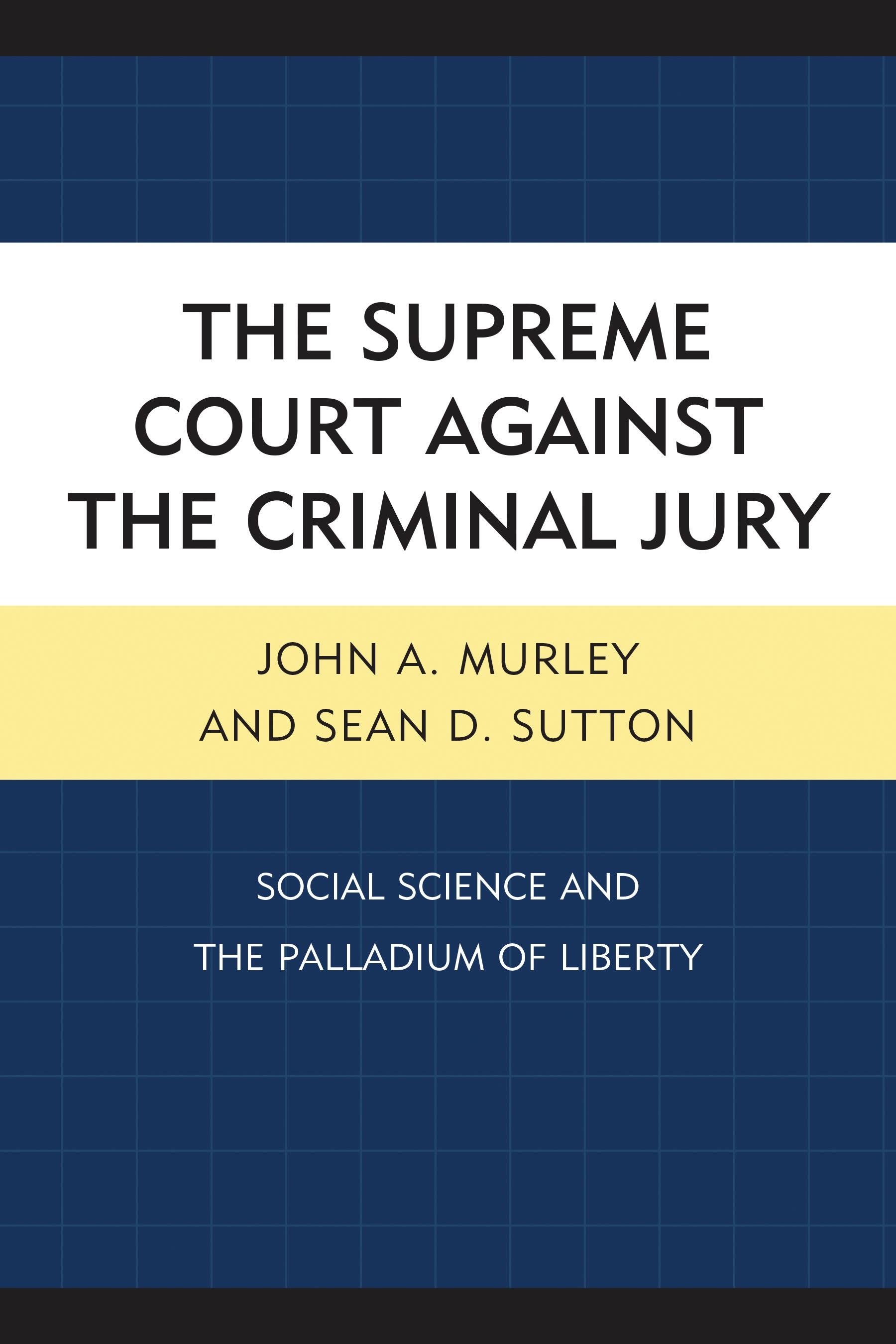
The Supreme Court against the Criminal Jury: Social Science and the Palladium of Liberty is an analysis of the United States Supreme Court decisions in what has come to be called the “jury-size” and “jury-decision rule” cases. In Williams v. Florida (1970) and Ballew v. Georgia (1978), a majority of the Supreme Court looked to history, empirical studies, and functional analysis to support its claim that there was “no discernible difference” between the verdicts of juries of six and juries of twelve. In the process the Court also decided that the number twelve was an historical accident and that the twelve-member jury was not an essential ingredient of trial by jury.
Two years later, the Court, following essentially the same line of reasoning used in Williams, decided in the companion cases Apodaca v. Oregon (1972) and Johnson v. Louisiana (1972) that defendants were as well served with juries that reached verdicts by a majority vote of 11-1,10-2 and 9-3 as they were with unanimous jury verdicts. In these cases the Supreme Court rejected the centuries old common law view that the unanimous jury verdict was an essential element of trial by jury. With these four decisions, the criminal jury as it had been known for more than six hundred years under the common law and the Constitution was in principle abandoned. We critique these decisions from the perspective of unreliable jury studies and the impact of these decision on jury nullification.
Two years later, the Court, following essentially the same line of reasoning used in Williams, decided in the companion cases Apodaca v. Oregon (1972) and Johnson v. Louisiana (1972) that defendants were as well served with juries that reached verdicts by a majority vote of 11-1,10-2 and 9-3 as they were with unanimous jury verdicts. In these cases the Supreme Court rejected the centuries old common law view that the unanimous jury verdict was an essential element of trial by jury. With these four decisions, the criminal jury as it had been known for more than six hundred years under the common law and the Constitution was in principle abandoned. We critique these decisions from the perspective of unreliable jury studies and the impact of these decision on jury nullification.
Paga fácilmente con tarjeta, Klarna, Apple Pay o Google Pay. ¿No estás contento? Siempre tienes 14 días de garantía de devolución. Lee más en nuestros términos. Si tienes preguntas, escríbenos a hello@memmo.org.
Memmo hace que estudiar sea más fácil, estés donde estés. Aquí tienes tus libros de texto y herramientas de estudio inteligentes en un solo lugar: resúmenes, quizzes, podcasts y flashcards. Y también a Ted, tu compañero de estudio que responde a todo lo que te preguntes. Más de 50 000 estudiantes ya estudian aquí. Está hecho para que aprendas más rápido y te estreses menos.