
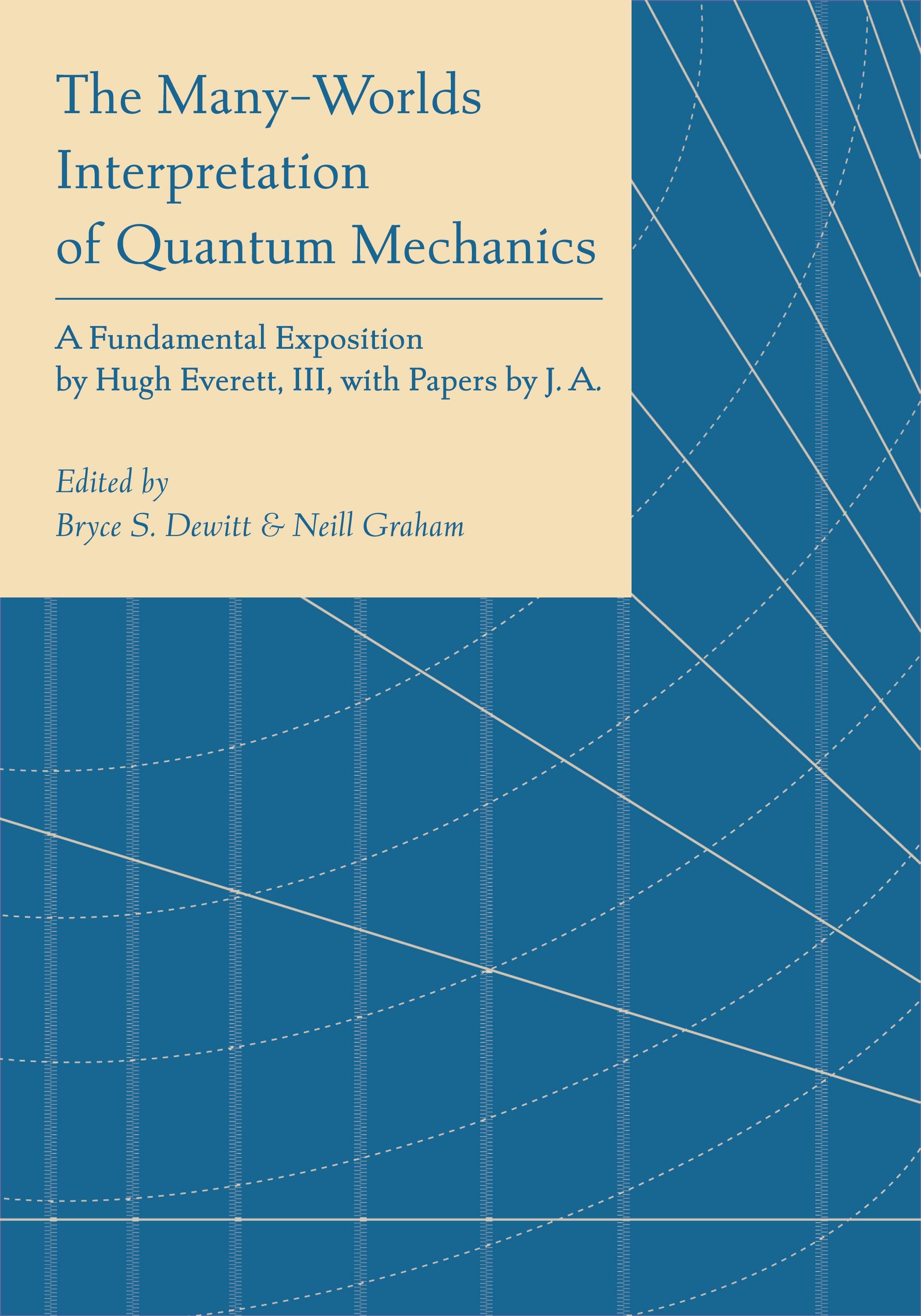
A landmark book on the influential many-worlds interpretation of quantum mechanics
In 1957, Hugh Everett proposed a novel interpretation of quantum mechanics—a view that eventually became known as the many-worlds interpretation. This book presents Everett’s two landmark papers on the idea—“‘Relative State’ Formulation of Quantum Mechanics” and “The Theory of the Universal Wave Function”—as well as further discussion of the idea in papers from a number of other physicists: J. A. Wheeler, Bryce DeWitt, L. N. Cooper and D. Van Vechten, and Neill Graham.
In his interpretation, Everett denies the existence of a separate classical realm and asserts the propriety of considering a state vector for the whole universe. Because this state vector never collapses, reality as a whole is rigorously deterministic. This reality, which is described jointly by the dynamical variables and the state vector, isn’t the reality customarily perceived; rather, it’s a reality composed of many worlds. By virtue of the temporal development of the dynamical variables, the state vector decomposes naturally into orthogonal vectors, reflecting a continual splitting of the universe into a multitude of mutually unobservable but equally real worlds, in each of which every good measurement has yielded a definite result, and in most of which the familiar statistical quantum laws hold.
Bryce S. DeWitt (1923–2004) was a prize-winning theoretical physicist and professor emeritus of physics at the University of Texas at Austin. Neill Graham (1941–2015) was a physicist and writer.
Paga fácilmente con tarjeta, Klarna, Apple Pay o Google Pay. ¿No estás contento? Siempre tienes 14 días de garantía de devolución. Lee más en nuestros términos. Si tienes preguntas, escríbenos a hello@memmo.org.
Memmo hace que estudiar sea más fácil, estés donde estés. Aquí tienes tus libros de texto y herramientas de estudio inteligentes en un solo lugar: resúmenes, quizzes, podcasts y flashcards. Y también a Ted, tu compañero de estudio que responde a todo lo que te preguntes. Más de 50 000 estudiantes ya estudian aquí. Está hecho para que aprendas más rápido y te estreses menos.