
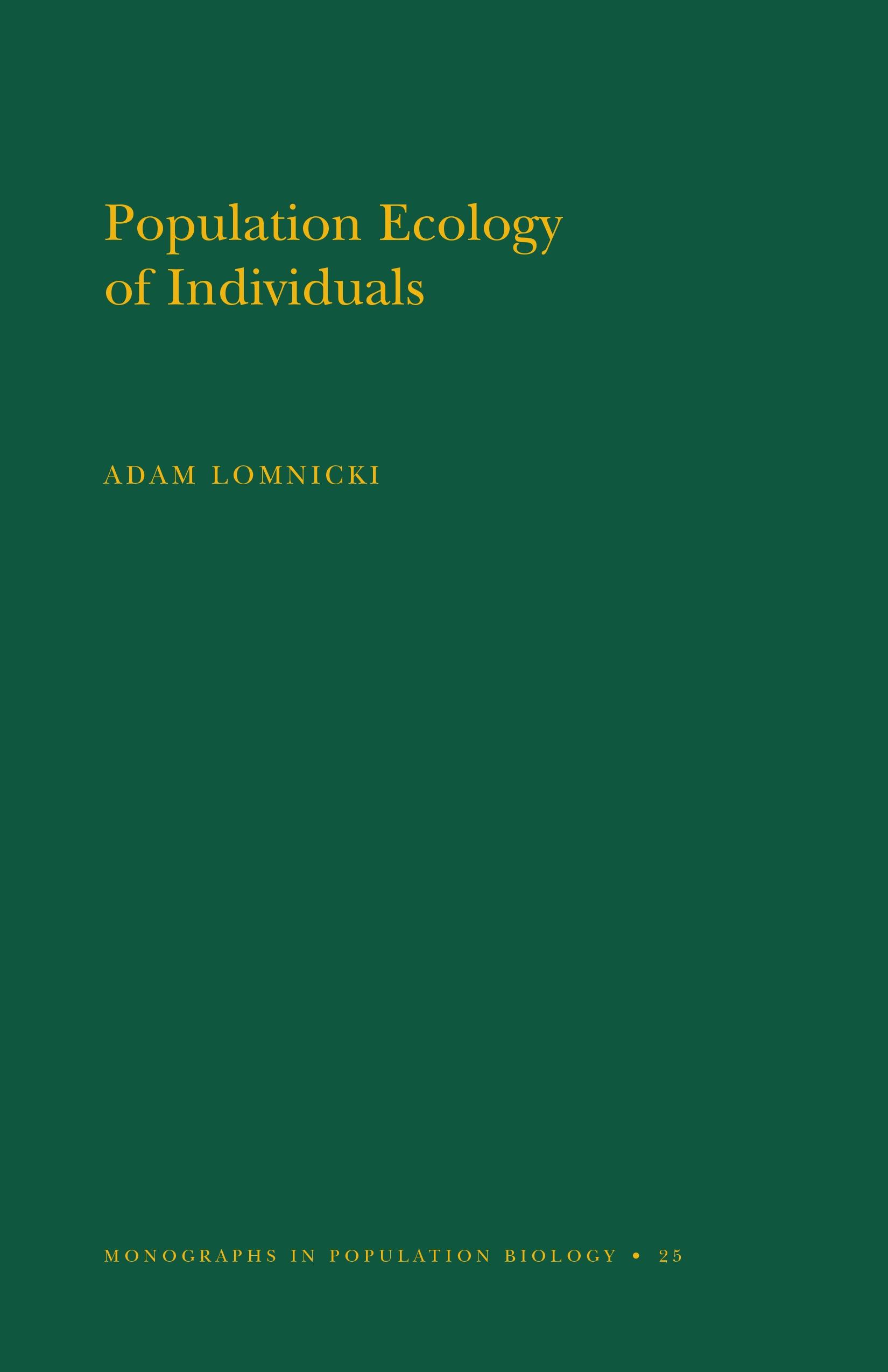
A common tendency in the field of population ecology has been to overlook individual differences by treating populations as homogeneous units; conversely, in behavioral ecology the tendency has been to concentrate on how individual behavior is shaped by evolutionary forces, but not on how this behavior affects population dynamics. Adam Lomnicki and others aim to remedy this one-sidedness by showing that the overall dynamical behavior of populations must ultimately be understood in terms of the behavior of individuals. Professor Lomnicki's wide-ranging presentation of this approach includes simple mathematical models aimed at describing both the origin and consequences of individual variation among plants and animals.
The author contends that further progress in population ecology will require taking into account individual differences other than sex, age, and taxonomic affiliation--unequal access to resources, for instance. Population ecologists who adopt this viewpoint may discover new answers to classical questions of population ecology. Partly because it uses a variety of examples from many taxonomic groups, this work will appeal not only to population ecologists but to ecologists in general.
Paga fácilmente con tarjeta, Klarna, Apple Pay o Google Pay. ¿No estás contento? Siempre tienes 14 días de garantía de devolución. Lee más en nuestros términos. Si tienes preguntas, escríbenos a hello@memmo.org.
Memmo hace que estudiar sea más fácil, estés donde estés. Aquí tienes tus libros de texto y herramientas de estudio inteligentes en un solo lugar: resúmenes, quizzes, podcasts y flashcards. Y también a Ted, tu compañero de estudio que responde a todo lo que te preguntes. Más de 50 000 estudiantes ya estudian aquí. Está hecho para que aprendas más rápido y te estreses menos.