
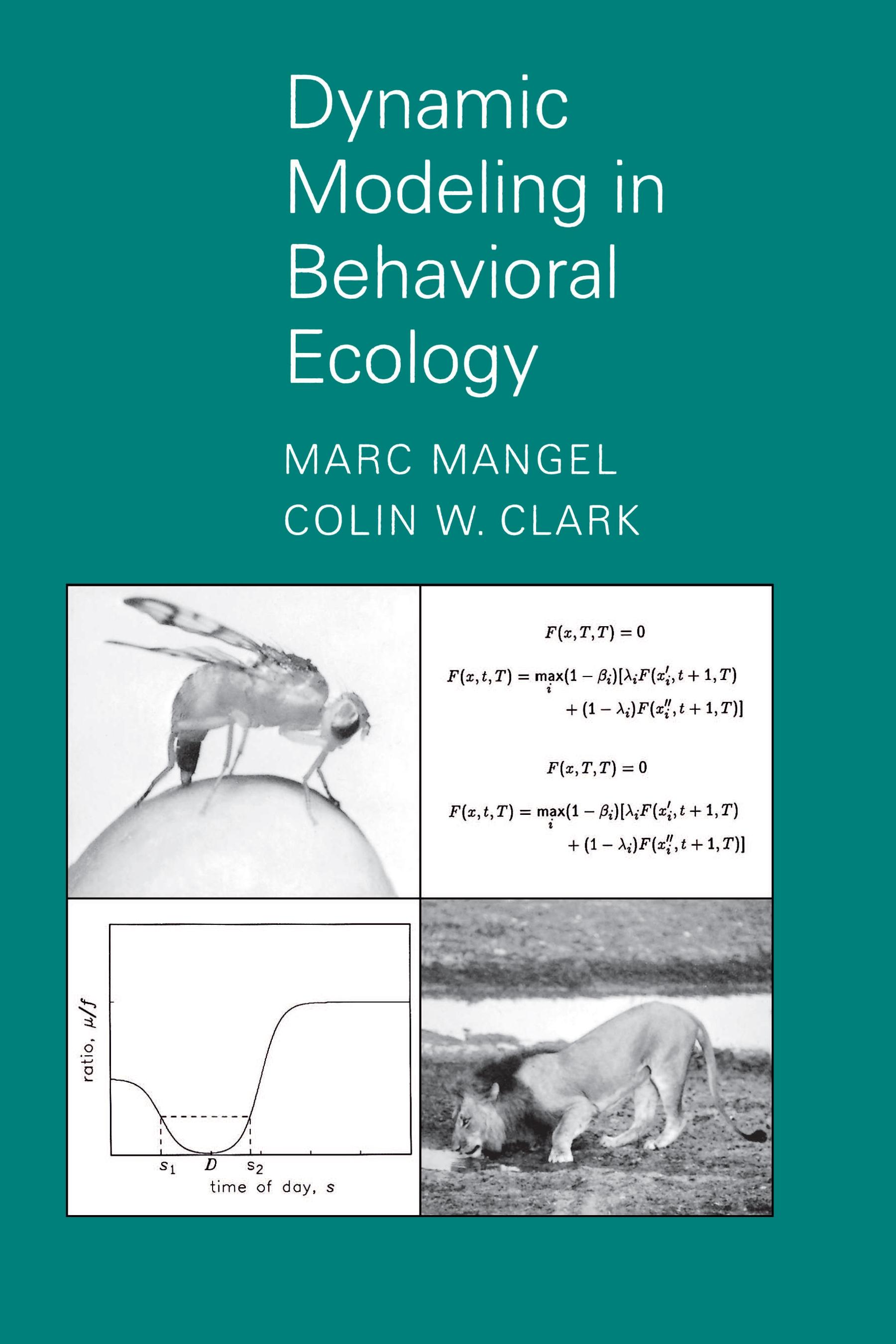
This book describes a powerful and flexible technique for the modeling of behavior, based on evolutionary principles. The technique employs stochastic dynamic programming and permits the analysis of behavioral adaptations wherein organisms respond to changes in their environment and in their own current physiological state. Models can be constructed to reflect sequential decisions concerned simultaneously with foraging, reproduction, predator avoidance, and other activities.
The authors show how to construct and use dynamic behavioral models. Part I covers the mathematical background and computer programming, and then uses a paradigm of foraging under risk of predation to exemplify the general modeling technique. Part II consists of five "applied" chapters illustrating the scope of the dynamic modeling approach. They treat hunting behavior in lions, reproduction in insects, migrations of aquatic organisms, clutch size and parental care in birds, and movement of spiders and raptors. Advanced topics, including the study of dynamic evolutionarily stable strategies, are discussed in Part III.
Paga fácilmente con tarjeta, Klarna, Apple Pay o Google Pay. ¿No estás contento? Siempre tienes 14 días de garantía de devolución. Lee más en nuestros términos. Si tienes preguntas, escríbenos a hello@memmo.org.
Memmo hace que estudiar sea más fácil, estés donde estés. Aquí tienes tus libros de texto y herramientas de estudio inteligentes en un solo lugar: resúmenes, quizzes, podcasts y flashcards. Y también a Ted, tu compañero de estudio que responde a todo lo que te preguntes. Más de 50 000 estudiantes ya estudian aquí. Está hecho para que aprendas más rápido y te estreses menos.