
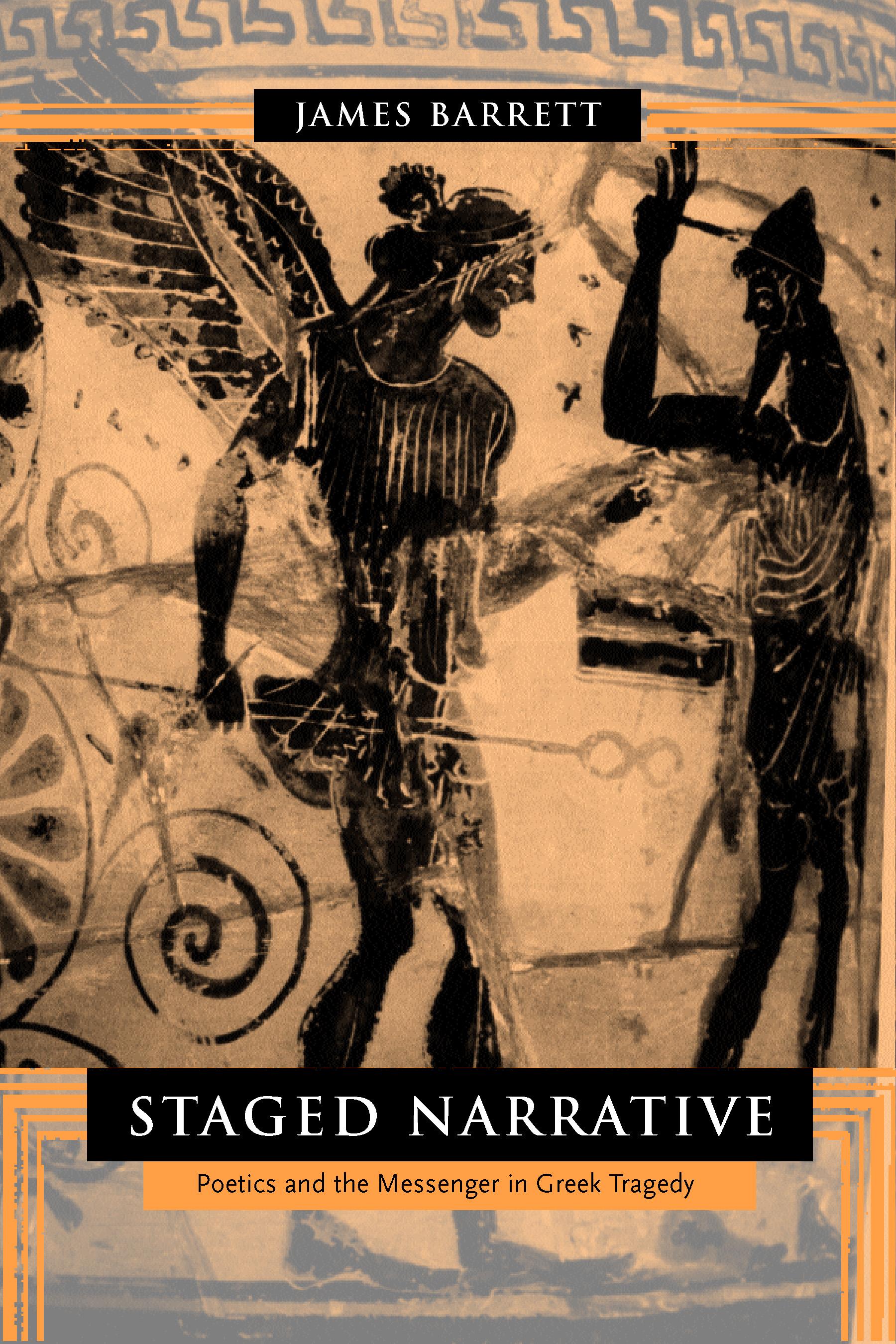
The messenger who reports important action that has occurred offstage is a familiar inhabitant of Greek tragedy. A messenger informs us about the death of Jocasta and the blinding of Oedipus, the madness of Heracles, the slaughter of Aigisthos, and the death of Hippolytus, among other important events. Despite its prevalence, this conventional figure remains only little understood. Combining several critical approaches—narrative theory, genre study, and rhetorical analysis—this lucid study develops a synthetic view of the messenger of Greek tragedy, showing how this role illuminates some of the genre's most persistent concerns, especially those relating to language, knowledge, and the workings of tragic theater itself.
James Barrett gives close readings of several plays including Aeschylus's Persians, Sophocles' Electra and Oedipus Tyrannus, and Euripides' Bacchae and Rhesos. He traces the literary ancestry of the tragic messenger, showing that the messenger's narrative constitutes an unexplored site of engagement with Homeric epic, and that the role illuminates fifth-century b.c. experimentation with modes of speech. Breaking new ground in the study of Athenian tragedy, Barrett deepens our understanding of many central texts and of a form of theater that highlights the fragility and limits of human knowledge, a theme explored by its use of the messenger.
James Barrett gives close readings of several plays including Aeschylus's Persians, Sophocles' Electra and Oedipus Tyrannus, and Euripides' Bacchae and Rhesos. He traces the literary ancestry of the tragic messenger, showing that the messenger's narrative constitutes an unexplored site of engagement with Homeric epic, and that the role illuminates fifth-century b.c. experimentation with modes of speech. Breaking new ground in the study of Athenian tragedy, Barrett deepens our understanding of many central texts and of a form of theater that highlights the fragility and limits of human knowledge, a theme explored by its use of the messenger.
Paga fácilmente con tarjeta, Klarna, Apple Pay o Google Pay. ¿No estás contento? Siempre tienes 14 días de garantía de devolución. Lee más en nuestros términos. Si tienes preguntas, escríbenos a hello@memmo.org.
Memmo hace que estudiar sea más fácil, estés donde estés. Aquí tienes tus libros de texto y herramientas de estudio inteligentes en un solo lugar: resúmenes, quizzes, podcasts y flashcards. Y también a Ted, tu compañero de estudio que responde a todo lo que te preguntes. Más de 50 000 estudiantes ya estudian aquí. Está hecho para que aprendas más rápido y te estreses menos.
También te podría gustar
Comprar el libro0