
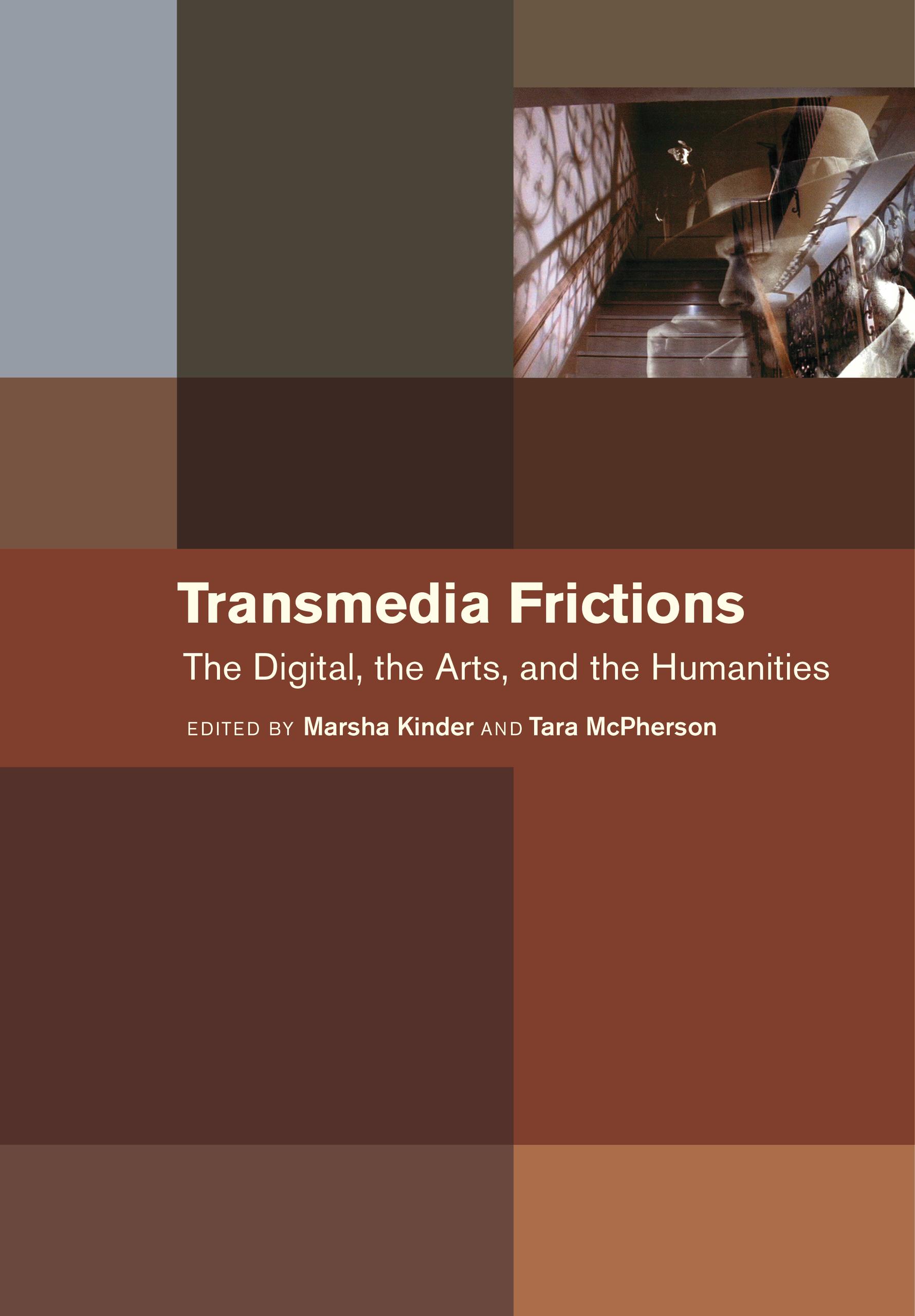
Editors Marsha Kinder and Tara McPherson present an authoritative collection of essays on the continuing debates over medium specificity and the politics of the digital arts. Comparing the term "transmedia" with "transnational," they show that the movement beyond specific media or nations does not invalidate those entities but makes us look more closely at the cultural specificity of each combination. In two parts, the book stages debates across essays, creating dialogues that give different narrative accounts of what is historically and ideologically at stake in medium specificity and digital politics. Each part includes a substantive introduction by one of the editors.
Part 1 examines precursors, contemporary theorists, and artists who are protagonists in this discursive drama, focusing on how the transmedia frictions and continuities between old and new forms can be read most productively: N. Katherine Hayles and Lev Manovich redefine medium specificity, Edward Branigan and Yuri Tsivian explore nondigital precursors, Steve Anderson and Stephen Mamber assess contemporary archival histories, and Grahame Weinbren and Caroline Bassett defend the open-ended mobility of newly emergent media.
In part 2, trios of essays address various ideologies of the digital: John Hess and Patricia R. Zimmerman, Herman Gray, and David Wade Crane redraw contours of race, space, and the margins; Eric Gordon, Cristina Venegas, and John T. Caldwell unearth database cities, portable homelands, and virtual fieldwork; and Mark B.N. Hansen, Holly Willis, and Rafael Lozano-Hemmer and Guillermo Gómez-Peña examine interactive bodies transformed by shock, gender, and color.
An invaluable reference work in the field of visual media studies, Transmedia Frictions provides sound historical perspective on the social and political aspects of the interactive digital arts, demonstrating that they are never neutral or innocent.
Part 1 examines precursors, contemporary theorists, and artists who are protagonists in this discursive drama, focusing on how the transmedia frictions and continuities between old and new forms can be read most productively: N. Katherine Hayles and Lev Manovich redefine medium specificity, Edward Branigan and Yuri Tsivian explore nondigital precursors, Steve Anderson and Stephen Mamber assess contemporary archival histories, and Grahame Weinbren and Caroline Bassett defend the open-ended mobility of newly emergent media.
In part 2, trios of essays address various ideologies of the digital: John Hess and Patricia R. Zimmerman, Herman Gray, and David Wade Crane redraw contours of race, space, and the margins; Eric Gordon, Cristina Venegas, and John T. Caldwell unearth database cities, portable homelands, and virtual fieldwork; and Mark B.N. Hansen, Holly Willis, and Rafael Lozano-Hemmer and Guillermo Gómez-Peña examine interactive bodies transformed by shock, gender, and color.
An invaluable reference work in the field of visual media studies, Transmedia Frictions provides sound historical perspective on the social and political aspects of the interactive digital arts, demonstrating that they are never neutral or innocent.
Paga fácilmente con tarjeta, Klarna, Apple Pay o Google Pay. ¿No estás contento? Siempre tienes 14 días de garantía de devolución. Lee más en nuestros términos. Si tienes preguntas, escríbenos a hello@memmo.org.
Memmo hace que estudiar sea más fácil, estés donde estés. Aquí tienes tus libros de texto y herramientas de estudio inteligentes en un solo lugar: resúmenes, quizzes, podcasts y flashcards. Y también a Ted, tu compañero de estudio que responde a todo lo que te preguntes. Más de 50 000 estudiantes ya estudian aquí. Está hecho para que aprendas más rápido y te estreses menos.
También te podría gustar
Comprar el libro0