
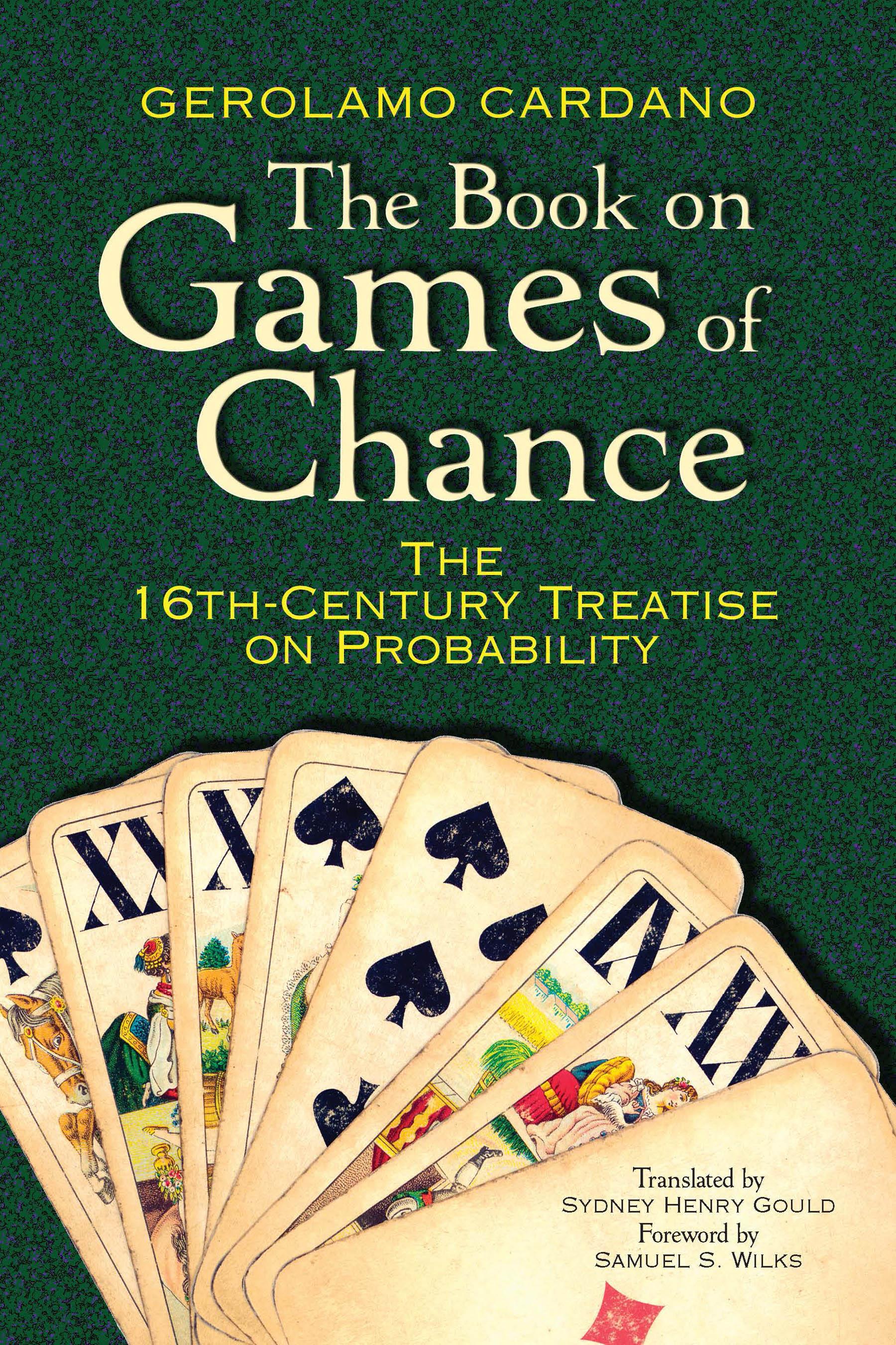
Mathematics was only one area of interest for Gerolamo Cardano ― the sixteenth-century astrologer, philosopher, and physician was also a prolific author and inveterate gambler. Gambling led Cardano to the study of probability, and he was the first writer to recognize that random events are governed by mathematical laws.
Published posthumously in 1663, Cardano's Liber de ludo aleae (Book on Games of Chance) is often considered the major starting point of the study of mathematical probability. The Italian scholar formulated some of the field's basic ideas more than a century before the better-known correspondence of Pascal and Fermat. Although his book had no direct influence on other early thinkers about probability, it remains an important antecedent to later expressions of the science's tenets.
Published posthumously in 1663, Cardano's Liber de ludo aleae (Book on Games of Chance) is often considered the major starting point of the study of mathematical probability. The Italian scholar formulated some of the field's basic ideas more than a century before the better-known correspondence of Pascal and Fermat. Although his book had no direct influence on other early thinkers about probability, it remains an important antecedent to later expressions of the science's tenets.
Paga fácilmente con tarjeta, Klarna, Apple Pay o Google Pay. ¿No estás contento? Siempre tienes 14 días de garantía de devolución. Lee más en nuestros términos. Si tienes preguntas, escríbenos a hello@memmo.org.
Memmo hace que estudiar sea más fácil, estés donde estés. Aquí tienes tus libros de texto y herramientas de estudio inteligentes en un solo lugar: resúmenes, quizzes, podcasts y flashcards. Y también a Ted, tu compañero de estudio que responde a todo lo que te preguntes. Más de 50 000 estudiantes ya estudian aquí. Está hecho para que aprendas más rápido y te estreses menos.
También te podría gustar
Comprar el libro0