
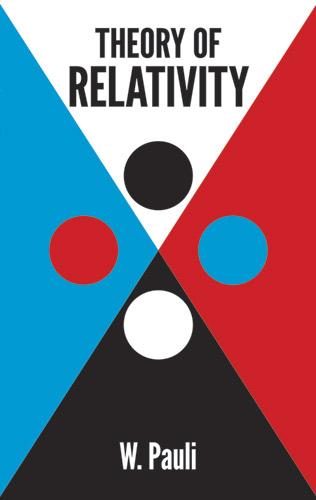
Wolfgang Pauli (1900–1958) was one of the 20th-century's most influential physicists. He was awarded the 1945 Nobel Prize for physics for the discovery of the exclusion principle (also called the Pauli principle). A brilliant theoretician, he was the first to posit the existence of the neutrino and one of the few early 20th-century physicists to fully understand the enormity of Einstein's theory of relativity.
Pauli's early writings, Theory of Relativity, published when the author was a young man of 21, was originally conceived as a complete review of the whole literature on relativity. Now, given the plethora of literature since that time and the growing complexity of physics and quantum mechanics, such a review is simply no longer possible.
In order to maintain a proper historical perspective of Professor Pauli's significant work, the original text is reprinted in full, in addition to the author's insightful retrospective update of the later developments connected with relativity theory and the controversial questions that it provokes.
Pauli pays special attention to the thorny problem of unified field theories, its connection with the range validity of the classical field concept, and its application to the atomic features of nature. While an early skeptic of solutions along classical lines, Pauli's alternative model was subsequently supported by the newer epistemological analysis of quantum or wave mechanics. Given the many pieces of the puzzle yet to be fitted into a cohesive picture of relativity, the differences of opinion on the relation of relativity theory to quantum theory are merging into one of science's great open problems.
Pauli provides additional informative views on: problems beyond the original frame of special and general relativity; the conflict between "classical physics" and the quantum mechanical approach; the importance of Einsteinian theory in the development of physics; and finally, the epistemological analysis of the finiteness of the quantum of action and the move away from naïve visualizations.
Pauli's early writings, Theory of Relativity, published when the author was a young man of 21, was originally conceived as a complete review of the whole literature on relativity. Now, given the plethora of literature since that time and the growing complexity of physics and quantum mechanics, such a review is simply no longer possible.
In order to maintain a proper historical perspective of Professor Pauli's significant work, the original text is reprinted in full, in addition to the author's insightful retrospective update of the later developments connected with relativity theory and the controversial questions that it provokes.
Pauli pays special attention to the thorny problem of unified field theories, its connection with the range validity of the classical field concept, and its application to the atomic features of nature. While an early skeptic of solutions along classical lines, Pauli's alternative model was subsequently supported by the newer epistemological analysis of quantum or wave mechanics. Given the many pieces of the puzzle yet to be fitted into a cohesive picture of relativity, the differences of opinion on the relation of relativity theory to quantum theory are merging into one of science's great open problems.
Pauli provides additional informative views on: problems beyond the original frame of special and general relativity; the conflict between "classical physics" and the quantum mechanical approach; the importance of Einsteinian theory in the development of physics; and finally, the epistemological analysis of the finiteness of the quantum of action and the move away from naïve visualizations.
Paga fácilmente con tarjeta, Klarna, Apple Pay o Google Pay. ¿No estás contento? Siempre tienes 14 días de garantía de devolución. Lee más en nuestros términos. Si tienes preguntas, escríbenos a hello@memmo.org.
Memmo hace que estudiar sea más fácil, estés donde estés. Aquí tienes tus libros de texto y herramientas de estudio inteligentes en un solo lugar: resúmenes, quizzes, podcasts y flashcards. Y también a Ted, tu compañero de estudio que responde a todo lo que te preguntes. Más de 50 000 estudiantes ya estudian aquí. Está hecho para que aprendas más rápido y te estreses menos.
También te podría gustar
Comprar el libro0