
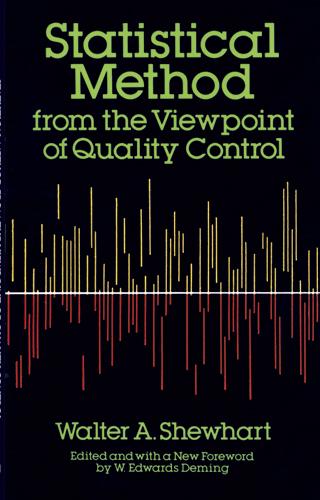
The application of statistical methods in mass production make possible the most efficient use of raw materials and manufacturing processes, economical production, and the highest standards of quality for manufactured goods. In this classic volume, based on a series of ground-breaking lectures given to the Graduate School of the Department of Agriculture in 1938, Dr. Shewhart illuminated the fundamental principles and techniques basic to the efficient use of statistical method in attaining statistical control, establishing tolerance limits, presenting data, and specifying accuracy and precision.
In the first chapter, devoted to statistical control, the author broadly defines the three steps in quality control: specification, production, and inspection; then outlines the historical background of quality control. This is followed by a rigorous discussion of the physical and mathematical states of statistical control, statistical control as an operation, the significance of statistical control and the future of statistics in mass production.
Chapter II offers a thought-provoking treatment of the problem of establishing limits of variability, including the meaning of tolerance limits, establishing tolerance limits in the simplest cases and in practical cases, and standard methods of measuring. Chapter III explores the presentation of measurements of physical properties and constants. Among the topics considered are measurements presented as original data, characteristics of original data, summarizing original data (both by symmetric functions and by Tchebycheff's theorem), measurement presented as meaningful predictions, and measurement presented as knowledge.
Finally, Dr. Shewhart deals with the problem of specifying accuracy and precision — the meaning of accuracy and precision, operational meaning, verifiable procedures, minimum quantity of evidence needed for forming a judgment and more.
Now available for the first time in this inexpensive paperbound format, this highly respected study will be welcomed by mathematics students, engineers, researchers in industry and agriculture — anyone in need of a lucid, well-written explanation of how to regulate variable and maintain control over statistics in order to achieve quality control over manufactured products, crops, and data.
In the first chapter, devoted to statistical control, the author broadly defines the three steps in quality control: specification, production, and inspection; then outlines the historical background of quality control. This is followed by a rigorous discussion of the physical and mathematical states of statistical control, statistical control as an operation, the significance of statistical control and the future of statistics in mass production.
Chapter II offers a thought-provoking treatment of the problem of establishing limits of variability, including the meaning of tolerance limits, establishing tolerance limits in the simplest cases and in practical cases, and standard methods of measuring. Chapter III explores the presentation of measurements of physical properties and constants. Among the topics considered are measurements presented as original data, characteristics of original data, summarizing original data (both by symmetric functions and by Tchebycheff's theorem), measurement presented as meaningful predictions, and measurement presented as knowledge.
Finally, Dr. Shewhart deals with the problem of specifying accuracy and precision — the meaning of accuracy and precision, operational meaning, verifiable procedures, minimum quantity of evidence needed for forming a judgment and more.
Now available for the first time in this inexpensive paperbound format, this highly respected study will be welcomed by mathematics students, engineers, researchers in industry and agriculture — anyone in need of a lucid, well-written explanation of how to regulate variable and maintain control over statistics in order to achieve quality control over manufactured products, crops, and data.
Paga fácilmente con tarjeta, Klarna, Apple Pay o Google Pay. ¿No estás contento? Siempre tienes 14 días de garantía de devolución. Lee más en nuestros términos. Si tienes preguntas, escríbenos a hello@memmo.org.
Memmo hace que estudiar sea más fácil, estés donde estés. Aquí tienes tus libros de texto y herramientas de estudio inteligentes en un solo lugar: resúmenes, quizzes, podcasts y flashcards. Y también a Ted, tu compañero de estudio que responde a todo lo que te preguntes. Más de 50 000 estudiantes ya estudian aquí. Está hecho para que aprendas más rápido y te estreses menos.
También te podría gustar
Comprar el libro0