
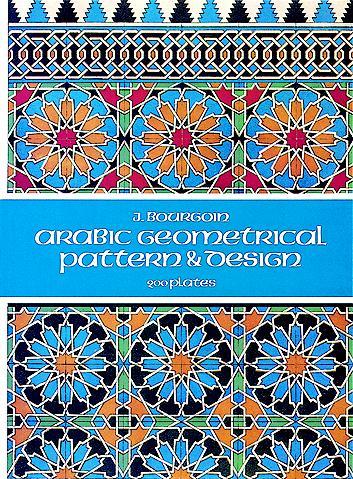
By forbidding the representation of the human figure, the Mohammedan religion helped push Islamic art along a path much different from that of traditional European art. European abounds with perspective renderings of figures and landscapes, while Islamic translates artistic impulse into elaborate geometric patterns and linear designs. Through centuries of practicing this purely abstract art, Muslim artists have perfected it to an incomparable elegance.
This book contains 190 examples exhibiting the wide range of Islamic geometrical art: hexagon designs, octagon designs, dodecagon designs, combinations of stars and rosettes (of many variations), combinations of squares and octagons, heptagon designs, and pentagon designs. These fundamental shapes give rise to hundreds of different designs, and merely altering an angle or curving a straight line can create an entirely new pattern. When transferred to metal, wood, stucco, mosaic, and paint, these patterns make up the elaborate ornamentation for which Arabic architecture is noted, and twenty-eight examples of actual applications from Cairo and Damascus are included: sanctuary doors, openwork windows, inlaid marble pavements, and ceilings.
The reader may wish to try his own hand at drawing patterns, to which purpose dotted construction lines are given for sections of the plates. Artists and designers will appreciate this book as a valuable source for Islamic art and design, which they may use directly or vary at will, and with the added use of color they will find that striking and beautiful results can often be achieved.
This book contains 190 examples exhibiting the wide range of Islamic geometrical art: hexagon designs, octagon designs, dodecagon designs, combinations of stars and rosettes (of many variations), combinations of squares and octagons, heptagon designs, and pentagon designs. These fundamental shapes give rise to hundreds of different designs, and merely altering an angle or curving a straight line can create an entirely new pattern. When transferred to metal, wood, stucco, mosaic, and paint, these patterns make up the elaborate ornamentation for which Arabic architecture is noted, and twenty-eight examples of actual applications from Cairo and Damascus are included: sanctuary doors, openwork windows, inlaid marble pavements, and ceilings.
The reader may wish to try his own hand at drawing patterns, to which purpose dotted construction lines are given for sections of the plates. Artists and designers will appreciate this book as a valuable source for Islamic art and design, which they may use directly or vary at will, and with the added use of color they will find that striking and beautiful results can often be achieved.
Paga fácilmente con tarjeta, Klarna, Apple Pay o Google Pay. ¿No estás contento? Siempre tienes 14 días de garantía de devolución. Lee más en nuestros términos. Si tienes preguntas, escríbenos a hello@memmo.org.
Memmo hace que estudiar sea más fácil, estés donde estés. Aquí tienes tus libros de texto y herramientas de estudio inteligentes en un solo lugar: resúmenes, quizzes, podcasts y flashcards. Y también a Ted, tu compañero de estudio que responde a todo lo que te preguntes. Más de 50 000 estudiantes ya estudian aquí. Está hecho para que aprendas más rápido y te estreses menos.
También te podría gustar
Comprar el libro0