
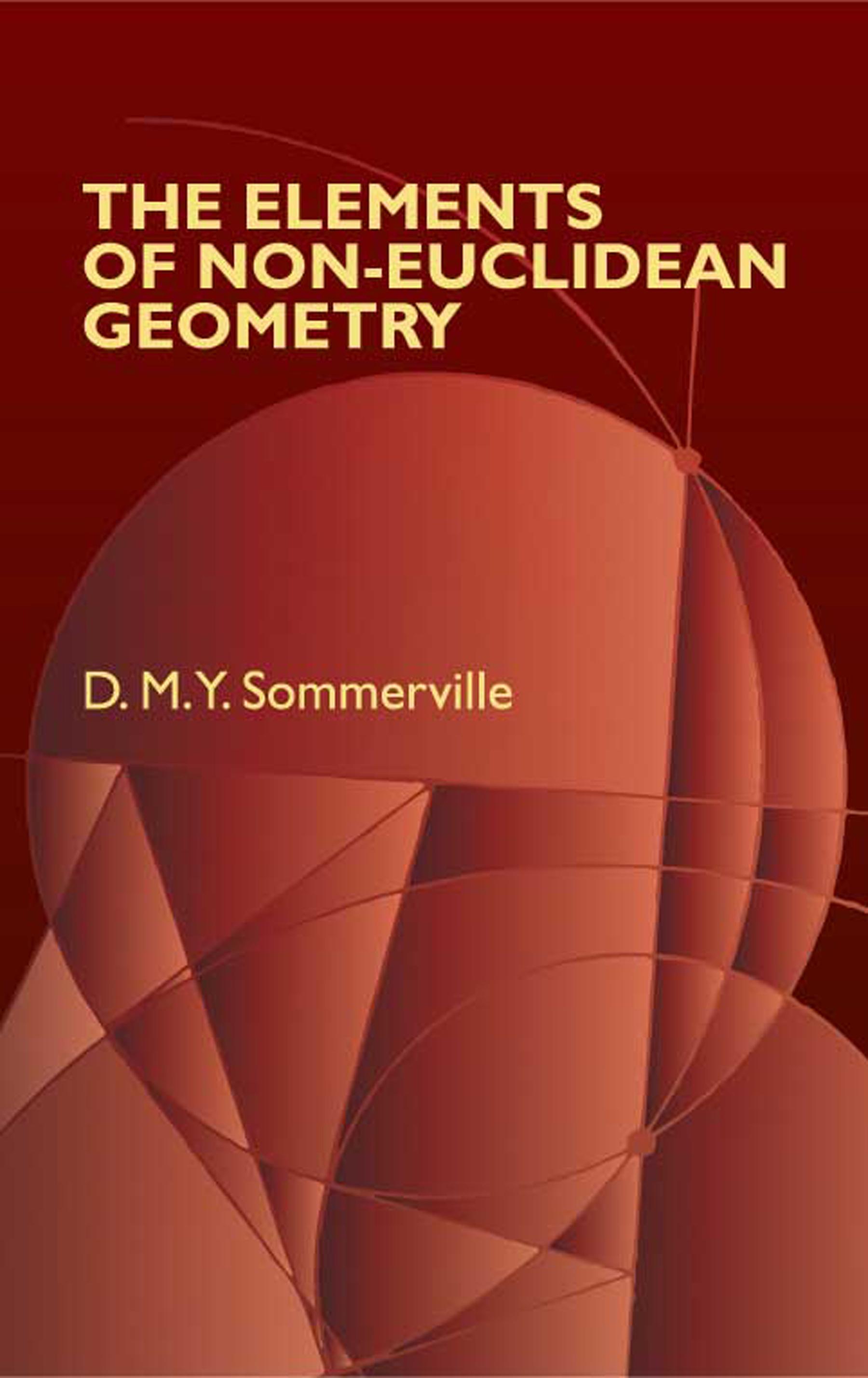
This volume became the standard text in the field almost immediately upon its original publication. Renowned for its lucid yet meticulous exposition, it can be appreciated by anyone familiar with high school algebra and geometry. Its arrangement follows the traditional pattern of plane and solid geometry, in which theorems are deduced from axioms and postulates. In this manner, students can follow the development of non-Euclidean geometry in strictly logical order, from a fundamental analysis of the concept of parallelism to such advanced topics as inversion and transformations.
Topics include elementary hyperbolic geometry; elliptic geometry; analytic non-Euclidean geometry; representations of non-Euclidean geometry in Euclidean space; and space curvature and the philosophical implications of non-Euclidean geometry. Additional subjects encompass the theory of the radical axes, homothetic centers, and systems of circles; inversion, equations of transformation, and groups of motions; and the classification of conics.
Although geared toward undergraduate students, this text treats such important and difficult topics as the relation between parataxy and parallelism, the absolute measure, the pseudosphere, Gauss’ proof of the defect-area theorem, geodesic representation, and other advanced subjects. In addition, its 136 problems offer practice in using the forms and methods developed in the text.
Topics include elementary hyperbolic geometry; elliptic geometry; analytic non-Euclidean geometry; representations of non-Euclidean geometry in Euclidean space; and space curvature and the philosophical implications of non-Euclidean geometry. Additional subjects encompass the theory of the radical axes, homothetic centers, and systems of circles; inversion, equations of transformation, and groups of motions; and the classification of conics.
Although geared toward undergraduate students, this text treats such important and difficult topics as the relation between parataxy and parallelism, the absolute measure, the pseudosphere, Gauss’ proof of the defect-area theorem, geodesic representation, and other advanced subjects. In addition, its 136 problems offer practice in using the forms and methods developed in the text.
Paga fácilmente con tarjeta, Klarna, Apple Pay o Google Pay. ¿No estás contento? Siempre tienes 14 días de garantía de devolución. Lee más en nuestros términos. Si tienes preguntas, escríbenos a hello@memmo.org.
Memmo hace que estudiar sea más fácil, estés donde estés. Aquí tienes tus libros de texto y herramientas de estudio inteligentes en un solo lugar: resúmenes, quizzes, podcasts y flashcards. Y también a Ted, tu compañero de estudio que responde a todo lo que te preguntes. Más de 50 000 estudiantes ya estudian aquí. Está hecho para que aprendas más rápido y te estreses menos.
También te podría gustar
Comprar el libro0