
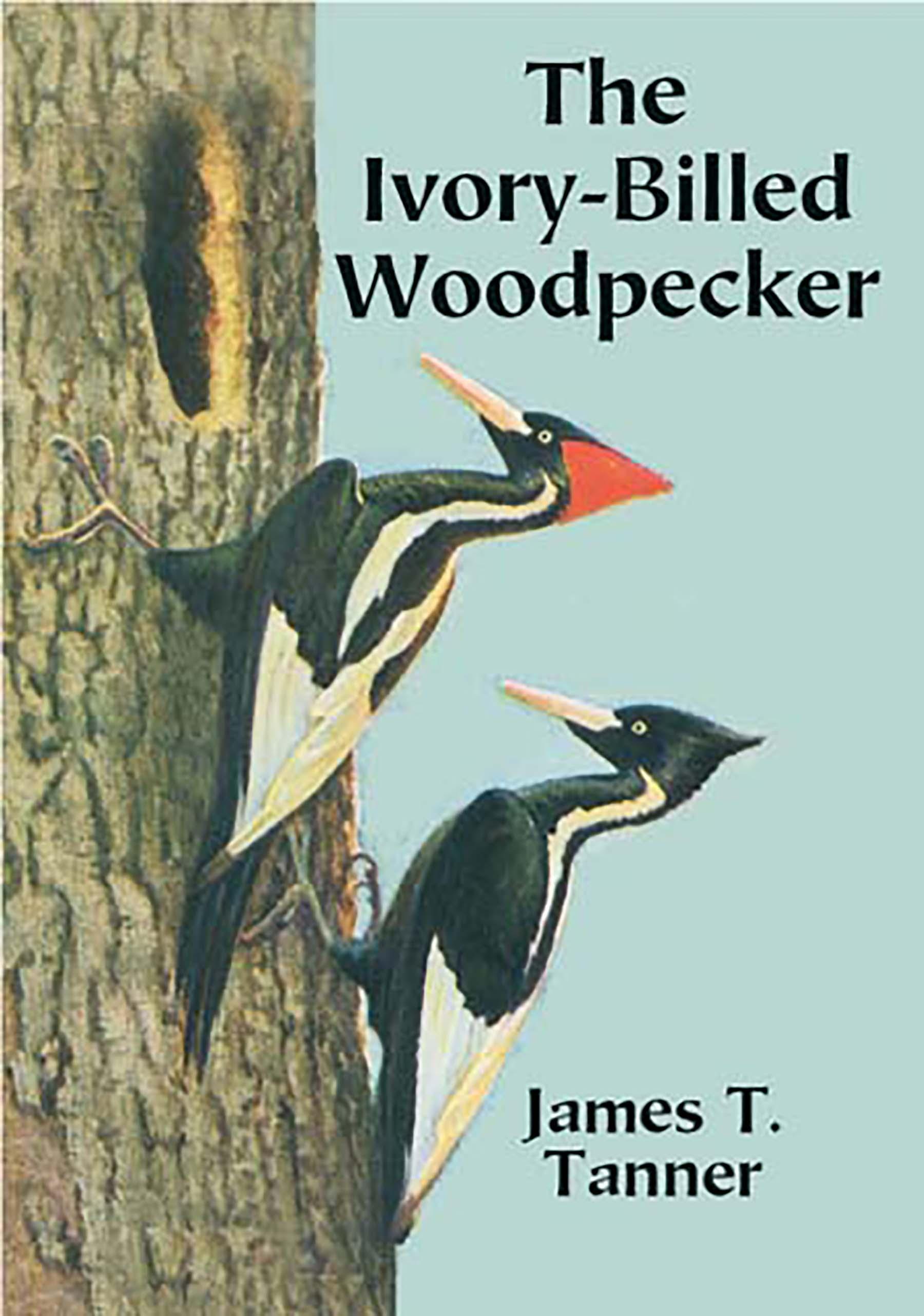
Long thought extinct, the elusive Ivory-billed Woodpecker was finally officially declared so in 2021. But in 1999, the birding community was galvanized at the news of a sighting by a hunter in a Louisiana forest. A series of expeditions continued to search for the rare bird, and all seekers relied on this elegant treatise. Written by James Tanner as his doctoral thesis, it was published by the National Audubon Society in 1942, when a few of the species could still be found in the cypress and bottomland forests of the southern United States.
The book opens with a general description of the Ivory-bill, explaining how to distinguish it from its more commonly encountered cousin, the Pileated Woodpecker. It then plots the species’ original distribution pattern; tells the history of its disappearance and the story of its distribution as of 1940; discusses the population density and range of individual birds; food and feeding habits; daily routine in the non-nesting season; voice; reactions to human presence; roosting; reproductive and nesting habits; care of the young; and causes of nesting failure. In conclusion, the author outlines both a general and a specific program for conserving the species. An appendix covers nomenclature, related species, plumages, anatomy, and measurements, and lists the scientific names of birds, mammals, and reptiles mentioned in the text. A model of patient, exacting field research, this book offers fact-filled and engrossing reading for birders and other nature lovers.
The book opens with a general description of the Ivory-bill, explaining how to distinguish it from its more commonly encountered cousin, the Pileated Woodpecker. It then plots the species’ original distribution pattern; tells the history of its disappearance and the story of its distribution as of 1940; discusses the population density and range of individual birds; food and feeding habits; daily routine in the non-nesting season; voice; reactions to human presence; roosting; reproductive and nesting habits; care of the young; and causes of nesting failure. In conclusion, the author outlines both a general and a specific program for conserving the species. An appendix covers nomenclature, related species, plumages, anatomy, and measurements, and lists the scientific names of birds, mammals, and reptiles mentioned in the text. A model of patient, exacting field research, this book offers fact-filled and engrossing reading for birders and other nature lovers.
Paga fácilmente con tarjeta, Klarna, Apple Pay o Google Pay. ¿No estás contento? Siempre tienes 14 días de garantía de devolución. Lee más en nuestros términos. Si tienes preguntas, escríbenos a hello@memmo.org.
Memmo hace que estudiar sea más fácil, estés donde estés. Aquí tienes tus libros de texto y herramientas de estudio inteligentes en un solo lugar: resúmenes, quizzes, podcasts y flashcards. Y también a Ted, tu compañero de estudio que responde a todo lo que te preguntes. Más de 50 000 estudiantes ya estudian aquí. Está hecho para que aprendas más rápido y te estreses menos.
También te podría gustar
Comprar el libro0