
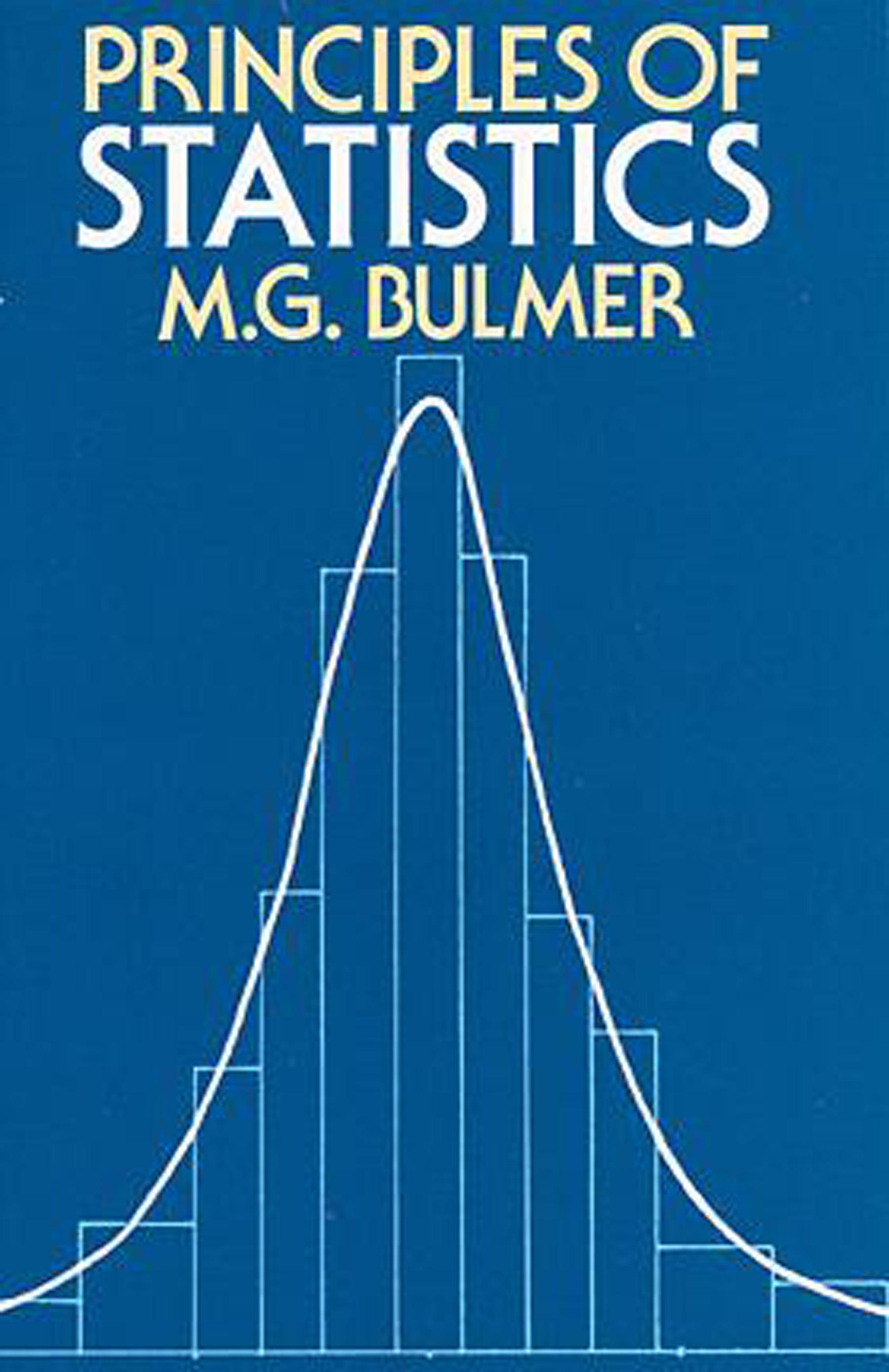
There are many textbooks which describe current methods of statistical analysis, while neglecting related theory. There are equally many advanced textbooks which delve into the far reaches of statistical theory, while bypassing practical applications. But between these two approaches is an unfilled gap, in which theory and practice merge at an intermediate level. Professor M. G. Bulmer's Principles of Statistics, originally published in 1965, was created to fill that need. The new, corrected Dover edition of Principles of Statistics makes this invaluable mid-level text available once again for the classroom or for self-study.
Principles of Statistics was created primarily for the student of natural sciences, the social scientist, the undergraduate mathematics student, or anyone familiar with the basics of mathematical language. It assumes no previous knowledge of statistics or probability; nor is extensive mathematical knowledge necessary beyond a familiarity with the fundamentals of differential and integral calculus. (The calculus is used primarily for ease of notation; skill in the techniques of integration is not necessary in order to understand the text.)
Professor Bulmer devotes the first chapters to a concise, admirably clear description of basic terminology and fundamental statistical theory: abstract concepts of probability and their applications in dice games, Mendelian heredity, etc.; definitions and examples of discrete and continuous random variables; multivariate distributions and the descriptive tools used to delineate them; expected values; etc.
The book then moves quickly to more advanced levels, as Professor Bulmer describes important distributions (binomial, Poisson, exponential, normal, etc.), tests of significance, statistical inference, point estimation, regression, and correlation. Dozens of exercises and problems appear at the end of various chapters, with answers provided at the back of the book. Also included are a number of statistical tables and selected references.
Professor Bulmer devotes the first chapters to a concise, admirably clear description of basic terminology and fundamental statistical theory: abstract concepts of probability and their applications in dice games, Mendelian heredity, etc.; definitions and examples of discrete and continuous random variables; multivariate distributions and the descriptive tools used to delineate them; expected values; etc.
The book then moves quickly to more advanced levels, as Professor Bulmer describes important distributions (binomial, Poisson, exponential, normal, etc.), tests of significance, statistical inference, point estimation, regression, and correlation. Dozens of exercises and problems appear at the end of various chapters, with answers provided at the back of the book. Also included are a number of statistical tables and selected references.
Paga fácilmente con tarjeta, Klarna, Apple Pay o Google Pay. ¿No estás contento? Siempre tienes 14 días de garantía de devolución. Lee más en nuestros términos. Si tienes preguntas, escríbenos a hello@memmo.org.
Memmo hace que estudiar sea más fácil, estés donde estés. Aquí tienes tus libros de texto y herramientas de estudio inteligentes en un solo lugar: resúmenes, quizzes, podcasts y flashcards. Y también a Ted, tu compañero de estudio que responde a todo lo que te preguntes. Más de 50 000 estudiantes ya estudian aquí. Está hecho para que aprendas más rápido y te estreses menos.
También te podría gustar
Comprar el libro0