
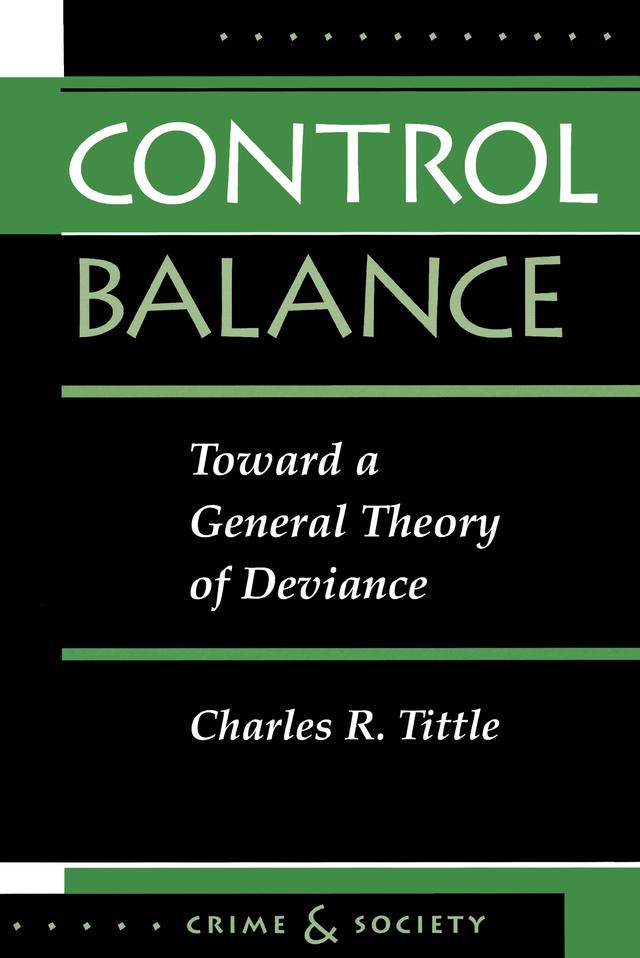
A major contribution to the field of crime/deviance, this volume by noted criminologist Charles R. Tittle puts forth an integrated theory of deviance—control balance. Its central premise is that the total amount of control people are subjected to, relative to the control they can exercise, will affect the probability and type of their deviant behavior. In developing control balance, Tittle critically reviews other general theories such as anomie, Marxian conflict, social control, differential association/social learning, labelling, and routine activities and offers reasons why those theories are insufficient. Using real-world examples to illustrate his argument, he contends that deviance results from the convergence of four variables, each of which represents an interactive nexus of several inputs, including most prominently a control imbalance. The variables are predisposition, motivation, opportunity, and constraint. Control balance theory also explains six basic types of deviance, ranging from predation, defiance, and submissiveness on one end of a control ratio continuum to exploitation, plunder, and decadence on the other. Tittle conceives of control balance as a continuation, or temporary culmination, of the collective efforts of crime/deviance scholars who have gone before, presenting it as a vehicle for trying to achieve a fully adequate general theory of deviance.
Paga fácilmente con tarjeta, Klarna, Apple Pay o Google Pay. ¿No estás contento? Siempre tienes 14 días de garantía de devolución. Lee más en nuestros términos. Si tienes preguntas, escríbenos a hello@memmo.org.
Memmo hace que estudiar sea más fácil, estés donde estés. Aquí tienes tus libros de texto y herramientas de estudio inteligentes en un solo lugar: resúmenes, quizzes, podcasts y flashcards. Y también a Ted, tu compañero de estudio que responde a todo lo que te preguntes. Más de 50 000 estudiantes ya estudian aquí. Está hecho para que aprendas más rápido y te estreses menos.
También te podría gustar
Comprar el libro0