
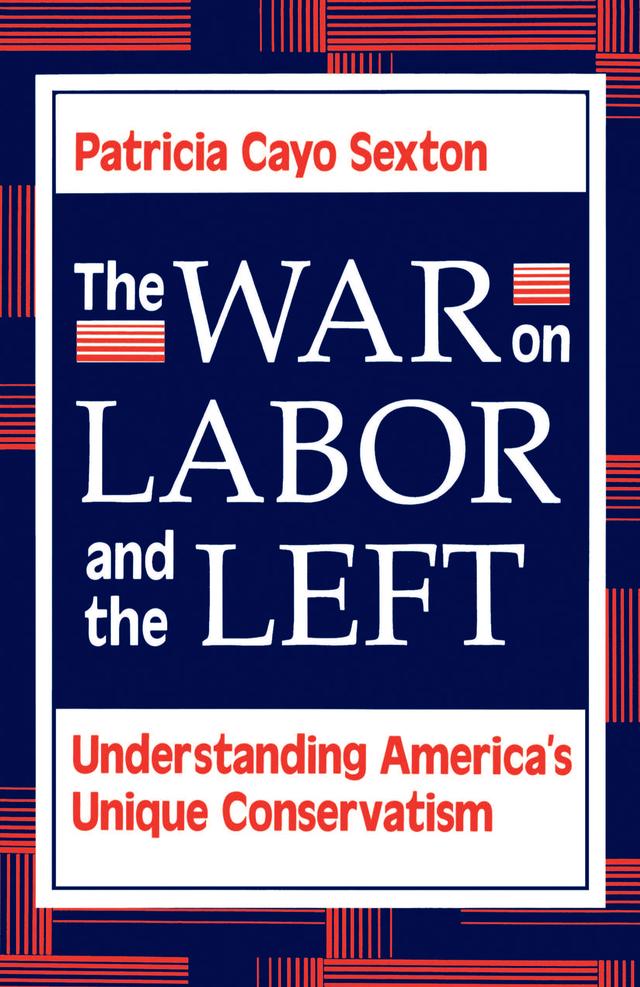
In all countries, labour has war stories" to tell, but none are so violent as those of American labour. Since the 1870s at least 700 workers have been killed and thousands seriously injured in labour disputes. Nowhere but in this country have employers so actively fought back against strikes through the use of scabs," surveillance, and mercenary armies.Although much of the violence occurred decades ago, author Patricia Sexton contends that this rich history sheds light on questions that still plague observers of the American political system: Why has the United States been more conservative in its domestic policies than other Western democracies? Why is it almost alone among them in lacking a mass labour or democratic socialist party,or the kind of social policies favoured by such parties? And why has American labour unionism been in serious decline in recent decades?The most familiar answers to these questions involve consensus explanations of what has come to be known as American exceptionalism. America is conservative, observers say, because its citizens have loved" capitalism and supported its political policies wholeheartedly or because the nation's open frontier and early voting rights reduced dissent and class consciousness. Other explanations focus on various internal constraints said to be unique to the American working class or its organizations, such as conflict among diverse immigrants, the sectarianism and blunders of leftist groups, and the conservatism or incompetence of labour union leadership. All of these are said to have prevented labour from carrying out successful conflicts with employers and economic leaders.According to Sexton, these arguments ignore the remarkable record in American history of labour-left struggles: the violent suppression of industrial unionism prior to the 1930s, legal and forceful repression of trade unionism, and destruction by various means of left-leaning unions and political organizations. Her book explores instead a neglected explanation of American conservatism,that of a literal war on labour, waged by unusually powerful economic entities using repressive strategies, often backed by police and sometimes by federal forces.The details of this violent history, familiar to labour historians, are recounted here in a new perspective emphasizing the impact on workers of conflict sustained over many years. But the book is much more than a reinterpretation of this history. Patricia Sexton shows how the use of power and repression has played out as well in our institutions of law and government, in economic policies, and in the media. Making these links and showing how America's conservatism is unique among other Western democracies is the contribution of this ambitious book. For only by coming to terms with this history of repression and its legacy can we fully understand America's conservatism today.
Páginas: 335
Categoría: Statsvetenskap & Politik
e-ISBN: 9780429972348
Peso de envío: 1.2 kg
Envío en: 1-2 días
Paga fácilmente con tarjeta, Klarna, Apple Pay o Google Pay. ¿No estás contento? Siempre tienes 14 días de garantía de devolución. Lee más en nuestros términos. Si tienes preguntas, escríbenos a hello@memmo.org.
Memmo hace que estudiar sea más fácil, estés donde estés. Aquí tienes tus libros de texto y herramientas de estudio inteligentes en un solo lugar: resúmenes, quizzes, podcasts y flashcards. Y también a Ted, tu compañero de estudio que responde a todo lo que te preguntes. Más de 50 000 estudiantes ya estudian aquí. Está hecho para que aprendas más rápido y te estreses menos.
También te podría gustar
Comprar el libro0