
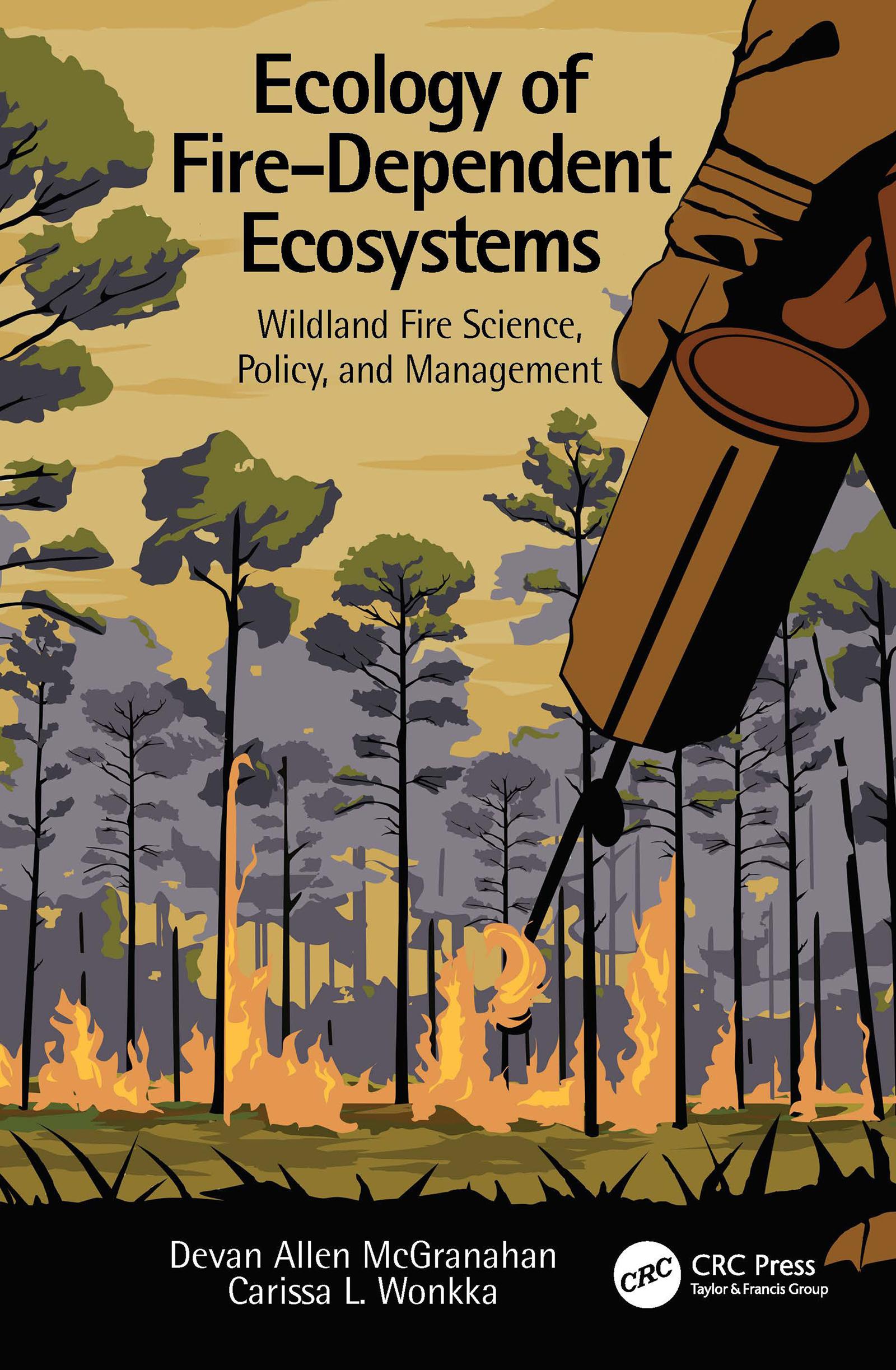
Ecology of Fire-Dependent Ecosystems is brimming with intriguing ecological stories of how life has evolved with and diversified within the varied fire regimes that are experienced on earth. Moreover, the book places itself as a communication between students, fire scientists, and fire fighters, and each of these groups will find some familiar ground, and some challenging aspects in this text: something which ultimately will help to bring us closer together and enrich our different approaches to understanding and managing our changing planet.
-- Sally Archibald, Professor, University of the Witwatersrand, Johannesburg, South Africa
Most textbooks are as dry as kindling and about as much fun to sink your teeth into. This is not that kind of textbook. Devan Allen McGranahan and Carissa L. Wonkka have taken a complex topic and somehow managed to synthesize it into a comprehensive, yet digestible form. This is a book you can read cover to cover – I know, I did it. As a result, I took an enlightening journey through the history and fundamentals of fire and its role in the natural and human world, ending with a thoughtful review of the evolving relationship between humans and wildland fire.
-- Chris Helzer, Nebraska Director of Science, The Nature Conservancy, and author of The Prairie Ecologist blog
Ecology of Fire-Dependent Ecosystems: Wildland Fire Science, Policy, and Management is intended for use in upper-level courses in fire ecology and wildland fire management and as a reference for researchers, managers, and other professionals involved with wildland fire science, practice, and policy. The book helps guide students and scientists to design and conduct robust wildland fire research projects and critically interpret and apply fire science in any management, education, or policy situation. It emphasizes variability in wildland fire as an ecological regime and provides tools for students, researchers, and managers to assess and connect fire environment and fire behaviour to fire effects.
Fire has not only shaped social and ecological communities but pushed ecosystems beyond previous boundaries, yet understanding the nature and effects of fire as an ecological disturbance has been slow, hampered by the complexity of the dynamic interactions between vegetation and climate and the fear of the destruction fire can bring. This book will help those who study, manage, and use wildland fire to develop new answers and novel solutions, based on an understanding of how fire functions in natural and social environments. It reviews literature, synthesizes concepts, and identifies research gaps and policy needs. The text also explores the interaction of fire and human culture, demonstrating how fire policy can be made adaptable to cultural and socio-ecological objectives.
Paga fácilmente con tarjeta, Klarna, Apple Pay o Google Pay. ¿No estás contento? Siempre tienes 14 días de garantía de devolución. Lee más en nuestros términos. Si tienes preguntas, escríbenos a hello@memmo.org.
Memmo hace que estudiar sea más fácil, estés donde estés. Aquí tienes tus libros de texto y herramientas de estudio inteligentes en un solo lugar: resúmenes, quizzes, podcasts y flashcards. Y también a Ted, tu compañero de estudio que responde a todo lo que te preguntes. Más de 50 000 estudiantes ya estudian aquí. Está hecho para que aprendas más rápido y te estreses menos.