
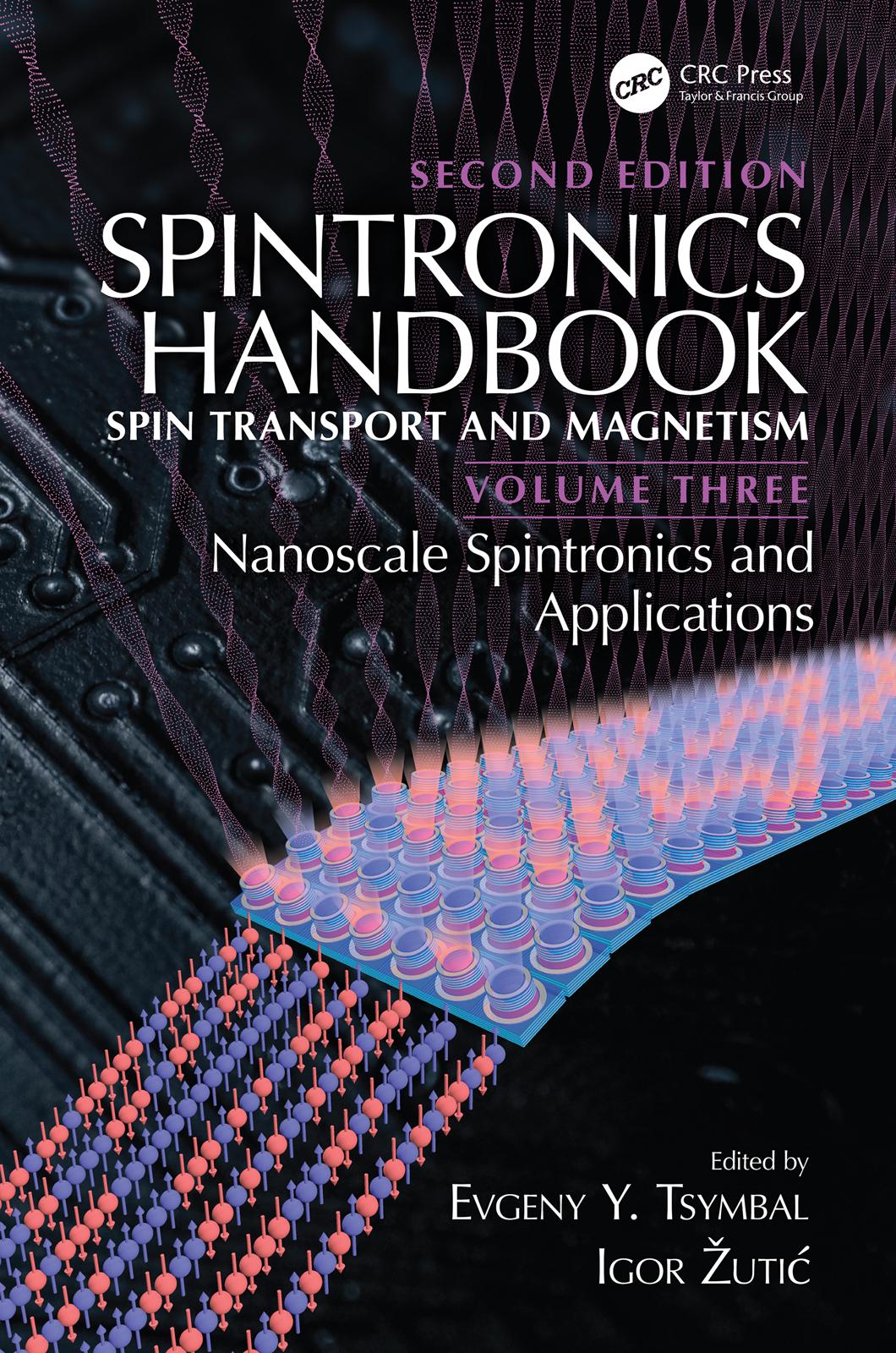
Spintronics Handbook, Second Edition offers an update on the single most comprehensive survey of the two intertwined fields of spintronics and magnetism, covering the diverse array of materials and structures, including silicon, organic semiconductors, carbon nanotubes, graphene, and engineered nanostructures. It focuses on seminal pioneering work, together with the latest in cutting-edge advances, notably extended discussion of two-dimensional materials beyond graphene, topological insulators, skyrmions, and molecular spintronics. The main sections cover physical phenomena, spin-dependent tunneling, control of spin and magnetism in semiconductors, and spin-based applications.
Features:
- Presents the most comprehensive reference text for the overlapping fields of spintronics (spin transport) and
magnetism. - Covers the full spectrum of materials and structures, from silicon and organic semiconductors to carbon nanotubes, graphene, and engineered nanostructures.
- Extends coverage of two-dimensional materials beyond graphene, including molybdenum disulfide and study of their spin relaxation mechanisms
- Includes new dedicated chapters on cutting-edge topics such as spin-orbit torques, topological insulators, half metals, complex oxide materials and skyrmions.
- Discusses important emerging areas of spintronics with superconductors, spin-wave spintronics, benchmarking of spintronics devices, and theory and experimental approaches to molecular spintronics.
Evgeny Tsymbal's research is focused on computational materials science aiming at the understanding of fundamental properties of advanced ferromagnetic and ferroelectric nanostructures and materials relevant to nanoelectronics and spintronics. He is a George Holmes University Distinguished Professor at the Department of Physics and Astronomy of the University of Nebraska-Lincoln (UNL), Director of the UNL’s Materials Research Science and Engineering Center (MRSEC), and Director of the multi-institutional Center for NanoFerroic Devices (CNFD).
Igor Žutić received his Ph.D. in theoretical physics at the University of Minnesota. His work spans a range of topics from high-temperature superconductors and ferromagnetism that can get stronger as the temperature is increased, to prediction of various spin-based devices. He is a recipient of 2006 National Science Foundation CAREER Award, 2005 National Research Council/American Society for Engineering Education Postdoctoral Research Award, and the National Research Council Fellowship (2003-2005). His research is supported by the National Science Foundation, the Office of Naval Research, the Department of Energy, and the Airforce Office of Scientific Research.
Paga fácilmente con tarjeta, Klarna, Apple Pay o Google Pay. ¿No estás contento? Siempre tienes 14 días de garantía de devolución. Lee más en nuestros términos. Si tienes preguntas, escríbenos a hello@memmo.org.
Memmo hace que estudiar sea más fácil, estés donde estés. Aquí tienes tus libros de texto y herramientas de estudio inteligentes en un solo lugar: resúmenes, quizzes, podcasts y flashcards. Y también a Ted, tu compañero de estudio que responde a todo lo que te preguntes. Más de 50 000 estudiantes ya estudian aquí. Está hecho para que aprendas más rápido y te estreses menos.