
Before Memmo my notes were scattered across PDFs. Now a workspace pulls everything into one place — I see exactly what's still left to study.
A biohistoric investigation of a controversial museum collection
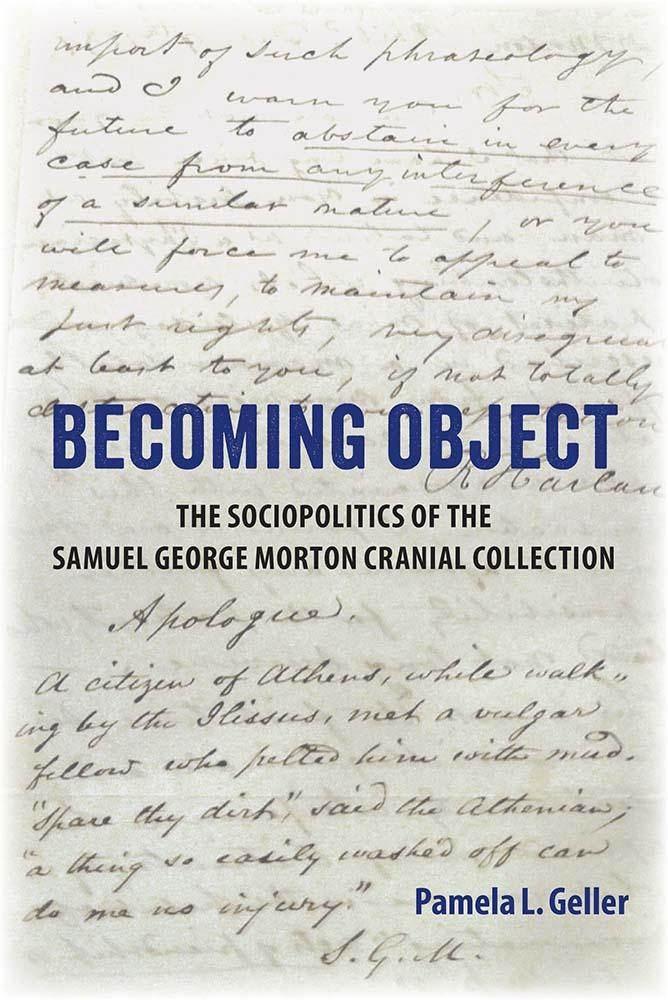
This book considers the vast collection of skulls amassed by Samuel Morton in the first half of the nineteenth century. Craniometric studies undertaken by this Philadelphia physician and natural historian, as previous writers have noted, advanced scientific racism. In Becoming Object, Pamela Geller shows that while the characterization is accurate, it is also oversimplified. Geller uses a biohistoric approach, which examines skeletal remains and archival sources, to take a close look at the times in which Morton lived, his work, and its complicated legacy.
During a pivotal moment in US history—an interlude between the nation’s cohesion and its civil unraveling—Morton and colleagues encouraged and developed biomedical interventions, public health initiatives, and scientific standards. Yet they also represented certain populations as biologically inferior; diseases were tied to non-white races, suffering was gendered female, and poverty was presumed inherited. Efforts by Morton and colleagues made it easier to rationalize the deaths of disenfranchised individuals, collect their skulls from almshouse hospitals and battlefields, and transform them into objects. Ultimately, these men’s studies of diseases and skulls contributed to an understanding of American citizenship that valued whiteness, Christianity, and heroic masculinity defined by violence.
Though medicine came to repudiate Morton’s work, his thinking became foundational for anthropology. The Morton Collection, a tangible reminder of his legacy, has become a barometer of the discipline’s relationship to white supremacy and colonialism. To advance today’s decolonial efforts, Becoming Object turns to the Morton Collection to document the diverse lives excluded from the body politic. To recount their stories, as Geller does, is to counter official histories, while the silences that remain hint at the subtle machinations of necropolitics.
Before Memmo my notes were scattered across PDFs. Now a workspace pulls everything into one place — I see exactly what's still left to study.
Memmo's summaries are gold before exams. I don't have to re-read 800 pages two weeks before — just the important parts.
The AI chat has saved me the night before an exam more than once. I just keep asking until I get it — no waiting on a study group to reply.
The quizzes hit exactly what I need to know. Memmo tracks what I get stuck on — so I only practice what's worth it.
Flashcards with spaced repetition are magic. Memmo knows when I'm about to forget something and brings it back.
The AI podcasts are my favorite. I listen on my way to school and get a recap without sitting at a computer.

Handbok i kvalitativa metoder
281 kr

Hållbar utveckling: en introduktion för ingenjörer och andra problemlösare
334 kr

Brymans Samhällsvetenskapliga metoder
390 kr

Projektledning
491 kr

Den orättvisa hälsan: om socioekonomiska skillnader i hälsa och livslängd
326 kr

Vetenskapsteori för nybörjare
196 kr

Organizational Leadership
429 kr

På väg mot läraryrket
172 kr

Det sociala livet i skolan: Socialpsykologiska perspektiv
253 kr

Betygsättningens didaktik
151 kr

Personality
402 kr

Studying Leadership
404 kr

Managing Innovation
477 kr

Introduktion till samhällsvetenskaplig metod
347 kr

The Psychology of Sex and Gender
698 kr

Evidens och kunskap för socialt arbete
207 kr

Introduction to Leadership
605 kr