
Before Memmo my notes were scattered across PDFs. Now a workspace pulls everything into one place — I see exactly what's still left to study.
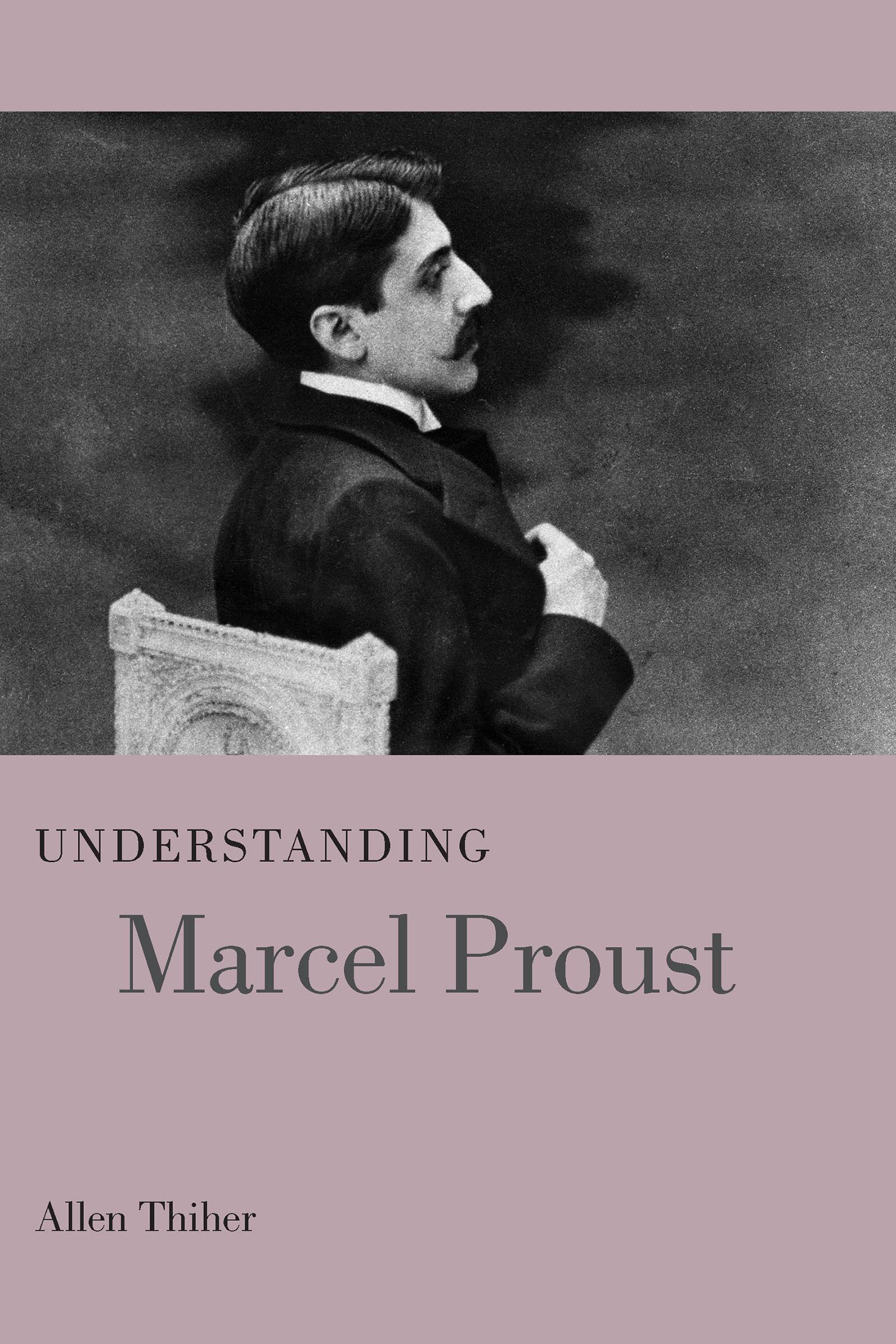
An overview of Proust's development as a writer and an in-depth study of his major novel, In Search of Lost Time
Understanding Marcel Proust includes an overview of Marcel Proust's development as a writer, addressing both works published and unpublished in his lifetime, and then offers an in-depth interpretation of Proust's major novel, In Search of Lost Time, relating it to the Western literary tradition while also demonstrating its radical newness as a narrative.
In his introduction Allen Thiher outlines Proust's development in the context of the political and artistic life of the Third Republic, arguing that everything Proust wrote before In Search of Lost Time was an experiment in sorting out whether he wanted to be a writer of critical theory or of fiction. Ultimately, Thiher observes, all these experiments had a role in the elaboration of the novel. Proust became both theorist and fiction writer by creating a bildungsroman narrating a writer's education.
What is perhaps most original about Thiher's interpretation, however, is his demonstration that Proust removed his aged narrator from the novel's temporal flow to achieve a kind of fictional transcendence. Proust never situates his narrator in historical time, which allows him to demonstrate concretely what he sees as the function of art: the truth of the absolute particular removed from time's determinations. The artist that the narrator hopes to become at the end of the novel must pursue his own individual truths—those in fact that the novel has narrated, for him and the reader, up to the novel's conclusion.
Written in a language accessible to upper-level undergraduates as well as literate general readers, Understanding Marcel Proust simultaneously addresses a scholarly public aware of the critical arguments that Proust's work has generated. Thiher's study should make Proust's In Search of Lost Time more widely accessible by explicating its structure and themes.
Before Memmo my notes were scattered across PDFs. Now a workspace pulls everything into one place — I see exactly what's still left to study.
Memmo's summaries are gold before exams. I don't have to re-read 800 pages two weeks before — just the important parts.
The AI chat has saved me the night before an exam more than once. I just keep asking until I get it — no waiting on a study group to reply.
The quizzes hit exactly what I need to know. Memmo tracks what I get stuck on — so I only practice what's worth it.
Flashcards with spaced repetition are magic. Memmo knows when I'm about to forget something and brings it back.
The AI podcasts are my favorite. I listen on my way to school and get a recap without sitting at a computer.

Handbok i kvalitativa metoder
281 kr

Hållbar utveckling: en introduktion för ingenjörer och andra problemlösare
334 kr

Brymans Samhällsvetenskapliga metoder
390 kr

Projektledning
491 kr

Den orättvisa hälsan: om socioekonomiska skillnader i hälsa och livslängd
326 kr

Organizational Leadership
429 kr

Vetenskapsteori för nybörjare
196 kr

På väg mot läraryrket
172 kr

Det sociala livet i skolan: Socialpsykologiska perspektiv
253 kr

Betygsättningens didaktik
151 kr

Personality
402 kr

Studying Leadership
404 kr

Managing Innovation
477 kr

Introduktion till samhällsvetenskaplig metod
347 kr

The Psychology of Sex and Gender
698 kr

Evidens och kunskap för socialt arbete
207 kr

Introduction to Leadership
605 kr