
Before Memmo my notes were scattered across PDFs. Now a workspace pulls everything into one place — I see exactly what's still left to study.
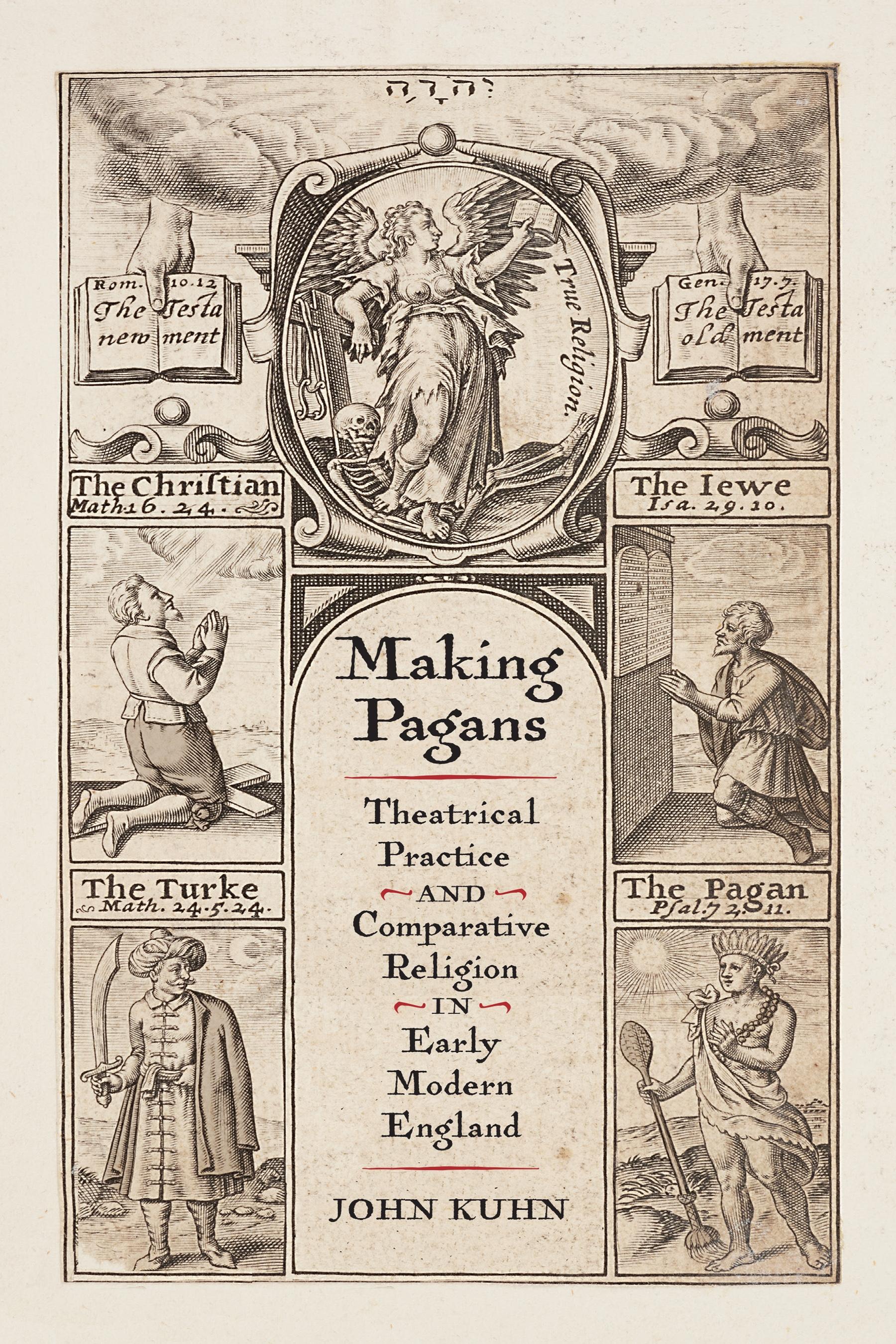
How early modern theatrical practice helped construct the category of “pagan” as a tool of European self-definition and colonial ambition
In Making Pagans, John Kuhn argues that drama played a powerful role in the articulation of religious difference in the seventeenth century. Tracing connections between the history of stagecraft and ethnological disciplines such as ethnography, antiquarianism, and early comparative religious writing, Kuhn shows how early modern repertory systems that leaned heavily on thrift and reuse produced an enduring theatrical vocabulary for understanding religious difference through the representation of paganism—a key term in the new taxonomy of world religions emerging at this time, and a frequent subject and motif in English drama of the era.
Combining properties such as triumphal chariots, trick altars, and moving statues with music, special effects, and other elements, the spectacular set-pieces that were mostly developed for plays set in antiquity, depicting England’s pre-Christian past, were frequently repurposed in new plays, in representations of Native Americans and Africans in colonial contact zones. Kuhn argues that the recycling of these set-pieces encouraged audiences to process new cultural sites through the lens of old performance tropes, and helped produce fictitious, quasi-ethnographic knowledge for spectators, generating the idea of a homogeneous, trans-historical, trans-geographical “paganism.” Examining the common scenes of pagan ritual that filled England's seventeenth-century stages—magical conjurations, oracular prophecies, barbaric triumphal parades, and group suicides—Kuhn traces these tropes across dozens of plays, from a range of authors including Ben Jonson, Christopher Marlowe, John Dryden, and Philip Massinger.
Drawing together theater history, Atlantic studies, and the history of comparative religion, Making Pagans reconceptualizes the material and iterative practices of the theater as central to the construction of radical religious difference in early modernity and of the category of paganism as a tool of European self-definition and colonial ambition.
Before Memmo my notes were scattered across PDFs. Now a workspace pulls everything into one place — I see exactly what's still left to study.
Memmo's summaries are gold before exams. I don't have to re-read 800 pages two weeks before — just the important parts.
The AI chat has saved me the night before an exam more than once. I just keep asking until I get it — no waiting on a study group to reply.
The quizzes hit exactly what I need to know. Memmo tracks what I get stuck on — so I only practice what's worth it.
Flashcards with spaced repetition are magic. Memmo knows when I'm about to forget something and brings it back.
The AI podcasts are my favorite. I listen on my way to school and get a recap without sitting at a computer.

Handbok i kvalitativa metoder
281 kr

Hållbar utveckling: en introduktion för ingenjörer och andra problemlösare
334 kr

Brymans Samhällsvetenskapliga metoder
390 kr

Projektledning
491 kr

Den orättvisa hälsan: om socioekonomiska skillnader i hälsa och livslängd
326 kr

Vetenskapsteori för nybörjare
196 kr

Organizational Leadership
429 kr

På väg mot läraryrket
172 kr

Det sociala livet i skolan: Socialpsykologiska perspektiv
253 kr

Betygsättningens didaktik
151 kr

Personality
402 kr

Studying Leadership
404 kr

Managing Innovation
477 kr

Introduktion till samhällsvetenskaplig metod
347 kr

The Psychology of Sex and Gender
698 kr

Evidens och kunskap för socialt arbete
207 kr

Introduction to Leadership
605 kr