
Before Memmo my notes were scattered across PDFs. Now a workspace pulls everything into one place — I see exactly what's still left to study.
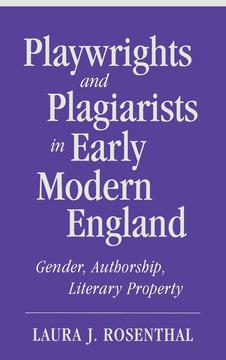
Passage of the first copyright law in 1710 marked a radical change in the perception of authorship. According to Laura J. Rosenthal, the new construction of the author as the owner of literary property bore different consequences for women than for men, for amateurs than for professionals, and for playwrights than for other authors.
Rosenthal explores distinctions between legitimate and illegitimate forms of literary appropriation in drama from 1650 to 1730. In considering the alleged plagiarists Margaret Cavendish (the Duchess of Newcastle), Aphra Behn, John Dryden, Colley Cibber, and Susanna Centlivre, Rosenthal maintains that accusations had less to do with the degree of repetition in texts than with the gender of the authors and the cultural location of the plays. Questions of literary property, then, became not just legal matters but part of a discourse aimed at conferring or withholding cultural authority.
Struggles over literary property must be seen in the context of competing conceptions of property in general, Rosenthal asserts, and she shows how both Filmerian and Lockean models gender the position of the owner. Drawing on feminist theory and from scholarship in history, philosophy, and political science, Rosenthal debates the relationship between women and property in modern England. Gender and class, she contends, continue to influence judgments as to what stories a playwright can own or use, as to whom critics praise as heirs to Shakespeare and Jonson, and as to whom they damn as plagiarists.
Before Memmo my notes were scattered across PDFs. Now a workspace pulls everything into one place — I see exactly what's still left to study.
Memmo's summaries are gold before exams. I don't have to re-read 800 pages two weeks before — just the important parts.
The AI chat has saved me the night before an exam more than once. I just keep asking until I get it — no waiting on a study group to reply.
The quizzes hit exactly what I need to know. Memmo tracks what I get stuck on — so I only practice what's worth it.
Flashcards with spaced repetition are magic. Memmo knows when I'm about to forget something and brings it back.
The AI podcasts are my favorite. I listen on my way to school and get a recap without sitting at a computer.

Handbok i kvalitativa metoder
281 kr

Hållbar utveckling: en introduktion för ingenjörer och andra problemlösare
334 kr

Brymans Samhällsvetenskapliga metoder
390 kr

Projektledning
491 kr

Den orättvisa hälsan: om socioekonomiska skillnader i hälsa och livslängd
326 kr

Vetenskapsteori för nybörjare
196 kr

Organizational Leadership
429 kr

På väg mot läraryrket
172 kr

Det sociala livet i skolan: Socialpsykologiska perspektiv
253 kr

Betygsättningens didaktik
151 kr

Personality
402 kr

Studying Leadership
404 kr

Managing Innovation
477 kr

Introduktion till samhällsvetenskaplig metod
347 kr

The Psychology of Sex and Gender
698 kr

Evidens och kunskap för socialt arbete
207 kr

Introduction to Leadership
605 kr