
Before Memmo my notes were scattered across PDFs. Now a workspace pulls everything into one place — I see exactly what's still left to study.
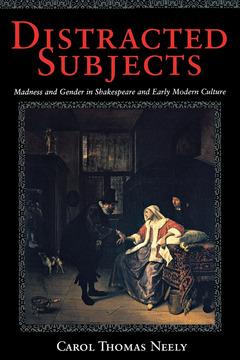
In the first book to provide a feminist analysis of early modern madness, Carol Thomas Neely reveals the mobility and heterogeneity of discourses of "distraction," the most common term for the condition in late-sixteenth- and early seventeenth-century England. Distracted Subjects shows how changing ideas of madness that circulated through medical, dramatic, and political texts transformed and gendered subjectivities. Supernatural causation is denied, new diagnoses appear, and stage representations proliferate. Drama sometimes leads and sometimes follows other cultural discourses—or forges its own prophetic figures of distraction.
The Spanish Tragedy first links madness to masculine tragic self-representation, and Hamlet invents a language to dramatize feminine somatic illness. Innovative women's melancholy is theorized in medical and witchcraft treatises and then elaborated in the extended portrait of the Jailer's Daughter's distraction in The Two Noble Kinsmen. Lovesickness, newly diagnosed in women, demands novel cures, and allows expressions of transgressive sexual desire in treatises and in plays such as As You Like It. The rituals of possession and exorcism, intensely debated off stage, are mocked and exploited on stage in reiterated comic scenes of confinement that madden men to enhance women's power.
Neely's final chapter provides a startling challenge to the critically alluring analogy between Bedlam and the early modern stage by documenting that Bethlem hospital offered care, not spectacle, whereas stage Bedlamites served metatheatrical and prophylactic, not mimetic, ends. An epilogue places this particular historical moment within the longer history of madness and shows how our own attitudes toward distraction are haunted by those earlier debates and representations.
Before Memmo my notes were scattered across PDFs. Now a workspace pulls everything into one place — I see exactly what's still left to study.
Memmo's summaries are gold before exams. I don't have to re-read 800 pages two weeks before — just the important parts.
The AI chat has saved me the night before an exam more than once. I just keep asking until I get it — no waiting on a study group to reply.
The quizzes hit exactly what I need to know. Memmo tracks what I get stuck on — so I only practice what's worth it.
Flashcards with spaced repetition are magic. Memmo knows when I'm about to forget something and brings it back.
The AI podcasts are my favorite. I listen on my way to school and get a recap without sitting at a computer.

Handbok i kvalitativa metoder
281 kr

Hållbar utveckling: en introduktion för ingenjörer och andra problemlösare
334 kr

Brymans Samhällsvetenskapliga metoder
390 kr

Projektledning
491 kr

Den orättvisa hälsan: om socioekonomiska skillnader i hälsa och livslängd
326 kr

Organizational Leadership
429 kr

Vetenskapsteori för nybörjare
196 kr

På väg mot läraryrket
172 kr

Det sociala livet i skolan: Socialpsykologiska perspektiv
253 kr

Betygsättningens didaktik
151 kr

Personality
402 kr

Studying Leadership
404 kr

Managing Innovation
477 kr

Introduktion till samhällsvetenskaplig metod
347 kr

The Psychology of Sex and Gender
698 kr

Evidens och kunskap för socialt arbete
207 kr

Introduction to Leadership
605 kr