
Before Memmo my notes were scattered across PDFs. Now a workspace pulls everything into one place — I see exactly what's still left to study.
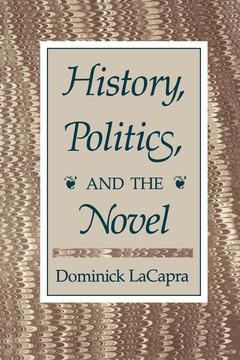
Although history was once considered a component of the study of literature, the two fields have grown steadily apart since the sixteenth century. Today few literary theorists and critics study history, and even fewer historians follow the work of their colleagues in literature departments; instead, historians continue to interpret the novel as literary critics and theorists did several decades ago. Dominick LaCapra, an intellectual historian well versed in literary theory and methodology, here addresses the complex role of the novel in history and criticism, seeking to establish a few guiding principles for the study of the historicity of literature.
LaCapra provides historically informed readings of eight major modern novels: Stendhal's Red and Black, Dostoevsky's Notes from Underground, Eliot's Middle-march, Flaubert's Sentimental Education, Mann's Death in Venice and Doctor Faustus, Woolf's To the Lighthouse, and Gaddis's The Recognitions. In each reading, he explores the question of how the text relates to its historical and literary contexts in symptomatic, critical, and possibly transformative ways. Eschewing both a narrow "intratextual" formalism and a reductive "extratextual" historicism, he attempts to motivate the very selection of relevant contexts for reading by drawing attention to the intellectual and sociopolitical import of our exchange with the past. Throughout, LaCapra consciously emulates the discursive strategy of these novels, thereby reinforcing his assertion that historians have much to learn from modes of discourse they have hitherto viewed as mere documentary symptoms of the past.
The work of a knowledgeable and discerning scholar, this bold attempt to create a more engaging dialogue between the past and present will be stimulating reading for intellectual historians and literary theorists.
Before Memmo my notes were scattered across PDFs. Now a workspace pulls everything into one place — I see exactly what's still left to study.
Memmo's summaries are gold before exams. I don't have to re-read 800 pages two weeks before — just the important parts.
The AI chat has saved me the night before an exam more than once. I just keep asking until I get it — no waiting on a study group to reply.
The quizzes hit exactly what I need to know. Memmo tracks what I get stuck on — so I only practice what's worth it.
Flashcards with spaced repetition are magic. Memmo knows when I'm about to forget something and brings it back.
The AI podcasts are my favorite. I listen on my way to school and get a recap without sitting at a computer.

Handbok i kvalitativa metoder
281 kr

Hållbar utveckling: en introduktion för ingenjörer och andra problemlösare
334 kr

Brymans Samhällsvetenskapliga metoder
390 kr

Projektledning
491 kr

Den orättvisa hälsan: om socioekonomiska skillnader i hälsa och livslängd
326 kr

Vetenskapsteori för nybörjare
196 kr

Organizational Leadership
429 kr

På väg mot läraryrket
172 kr

Det sociala livet i skolan: Socialpsykologiska perspektiv
253 kr

Betygsättningens didaktik
151 kr

Personality
402 kr

Studying Leadership
404 kr

Managing Innovation
477 kr

Introduktion till samhällsvetenskaplig metod
347 kr

The Psychology of Sex and Gender
698 kr

Evidens och kunskap för socialt arbete
207 kr

Introduction to Leadership
605 kr