
Before Memmo my notes were scattered across PDFs. Now a workspace pulls everything into one place — I see exactly what's still left to study.
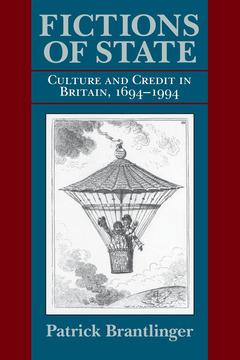
In this ambitious book, Patrick Brantlinger offers a cultural history of Great Britain focused on the concept of "public credit," from the 1694 founding of the Bank of England to the present. He draws on literary texts ranging from Augustan satire such as Gulliver's Travels to postmodern satire such as Martin Amis's Money: A Suicide Note. All critique the misrecognition of public credit as wealth. The economic foundations of modern nation-states involved national debt, public credit, and paper money. Brantlinger traces the emergence of modern, imperial Great Britain from those foundations. He analyzes the process whereby nationalism, both the cause and the result of wars and imperial expansion, multiplied national debt and produced crises of public credit resolved only through more nationalism and war. During the first half of the eighteenth century, conservatives attacked public credit as fetishistic and characterized national debt as alchemical. From the 1850s, the stabilizing theories of public credit authored by David Hume, Adam Smith, Henry Thornton, and others, helped initiate the first "social science" economics. In the nineteenth century, literary criticism both paralleled and questioned early capitalist discourse on public credit and nationalism, while the Victorian novel refigured debt as the individual, private credit and debt. During the era of high modernism and Keynesian economics, the notion of high culture as genuine value recast the debate over money and national indebtedness. Brantlinger relates this cultural-historical trajectory to Marxist, poststructuralist, and postcolonial theories about the decline of the European empires after World War II, the global debt crisis, and the weakening of western nation-states in the postmodern era.
Before Memmo my notes were scattered across PDFs. Now a workspace pulls everything into one place — I see exactly what's still left to study.
Memmo's summaries are gold before exams. I don't have to re-read 800 pages two weeks before — just the important parts.
The AI chat has saved me the night before an exam more than once. I just keep asking until I get it — no waiting on a study group to reply.
The quizzes hit exactly what I need to know. Memmo tracks what I get stuck on — so I only practice what's worth it.
Flashcards with spaced repetition are magic. Memmo knows when I'm about to forget something and brings it back.
The AI podcasts are my favorite. I listen on my way to school and get a recap without sitting at a computer.

Handbok i kvalitativa metoder
281 kr

Hållbar utveckling: en introduktion för ingenjörer och andra problemlösare
334 kr

Brymans Samhällsvetenskapliga metoder
390 kr

Projektledning
491 kr

Den orättvisa hälsan: om socioekonomiska skillnader i hälsa och livslängd
326 kr

Organizational Leadership
429 kr

Vetenskapsteori för nybörjare
196 kr

På väg mot läraryrket
172 kr

Det sociala livet i skolan: Socialpsykologiska perspektiv
253 kr

Betygsättningens didaktik
151 kr

Personality
402 kr

Studying Leadership
404 kr

Managing Innovation
477 kr

Introduktion till samhällsvetenskaplig metod
347 kr

The Psychology of Sex and Gender
698 kr

Evidens och kunskap för socialt arbete
207 kr

Introduction to Leadership
605 kr