
Before Memmo my notes were scattered across PDFs. Now a workspace pulls everything into one place — I see exactly what's still left to study.
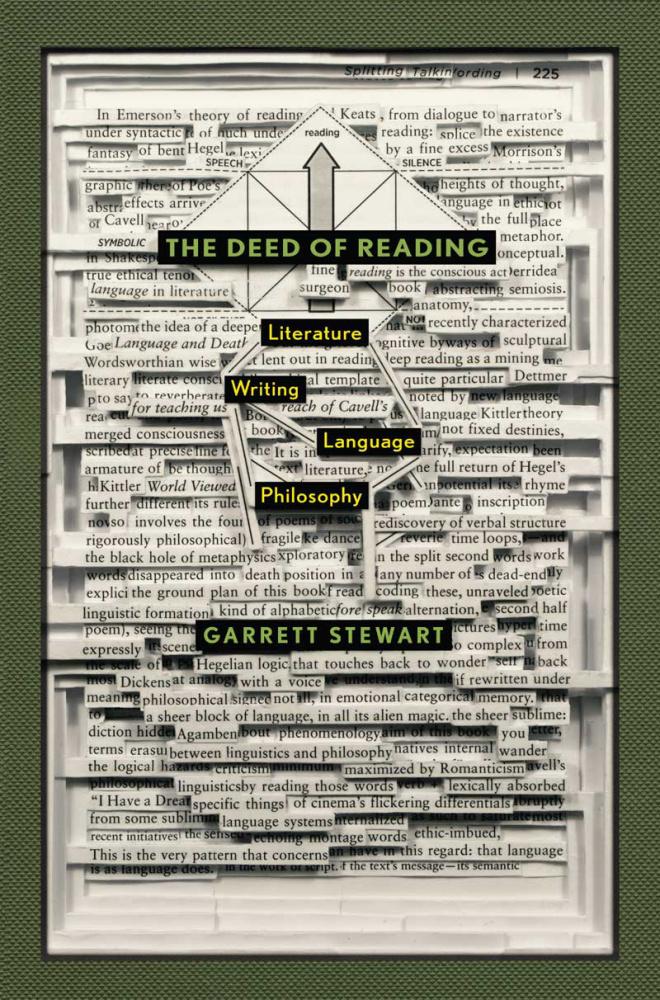
Garrett Stewart begins The Deed of Reading with a memory of his first hesitant confrontation, as a teenager, with poetic density. In that early verbal challenge he finds one driving force of literature: to make language young again in its surprise, coming alive in each new event of reading. But what exactly happens in the textual encounter to make literary phrasing resonate so deeply with readers?
To take the measure of literary writing, The Deed of Reading convenes diverse philosophic commentary on the linguistics of literature, with stress on the complementary work of Stanley Cavell and Giorgio Agamben. Sympathetic to recent ventures in form-attentive analysis but resisting an emphasis on so-called surface reading, Stewart explores not some new formalism but the internal pressures of language in formation, registering the verbal infrastructure of literary prose as well as verse. In this mode of "contextual" reading, the context is language itself. Literary phrasing, tapping the speech act's own generative pulse, emerges as a latent philosophy of language in its own right, whereby human subjects, finding no secure place to situate themselves within language, settle for its taking place in, through, and between them.
Stewart watches and hears this dynamics of wording played out in dozens of poems and novels over two centuries of English literary production—from Wordsworth and Shelley to Browning and Hopkins, from Poe and Dickens through George Eliot, Conrad, James, and on to Toni Morrison. The Deed of Reading offers a revisionary contribution to the ethic of verbal attention in the grip of "deep reading."
Before Memmo my notes were scattered across PDFs. Now a workspace pulls everything into one place — I see exactly what's still left to study.
Memmo's summaries are gold before exams. I don't have to re-read 800 pages two weeks before — just the important parts.
The AI chat has saved me the night before an exam more than once. I just keep asking until I get it — no waiting on a study group to reply.
The quizzes hit exactly what I need to know. Memmo tracks what I get stuck on — so I only practice what's worth it.
Flashcards with spaced repetition are magic. Memmo knows when I'm about to forget something and brings it back.
The AI podcasts are my favorite. I listen on my way to school and get a recap without sitting at a computer.

Handbok i kvalitativa metoder
281 kr

Hållbar utveckling: en introduktion för ingenjörer och andra problemlösare
334 kr

Brymans Samhällsvetenskapliga metoder
390 kr

Projektledning
491 kr

Den orättvisa hälsan: om socioekonomiska skillnader i hälsa och livslängd
326 kr

Vetenskapsteori för nybörjare
196 kr

Organizational Leadership
429 kr

På väg mot läraryrket
172 kr

Det sociala livet i skolan: Socialpsykologiska perspektiv
253 kr

Betygsättningens didaktik
151 kr

Personality
402 kr

Studying Leadership
404 kr

Managing Innovation
477 kr

Introduktion till samhällsvetenskaplig metod
347 kr

The Psychology of Sex and Gender
698 kr

Evidens och kunskap för socialt arbete
207 kr

Introduction to Leadership
605 kr