
Before Memmo my notes were scattered across PDFs. Now a workspace pulls everything into one place — I see exactly what's still left to study.
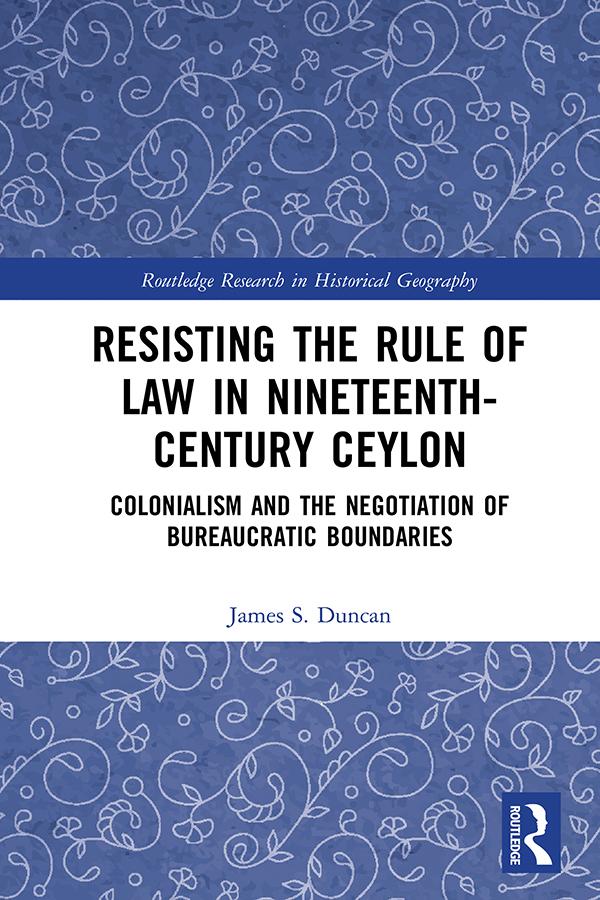
This book offers in-depth insights on the struggles implementing the rule of law in nineteenth century Ceylon, introduced into the colonies by the British as their “greatest gift.” The book argues that resistance can be understood as a form of negotiation to lessen oppressive colonial conditions, and that the cumulative impact caused continual adjustments to the criminal justice system, weighing it down and distorting it.
The tactical use of rule of law is explored within the three bureaucracies: the police, the courts and the prisons. Policing was often “governed at a distance” due to fiscal constraints and economic priorities and the enforcement of law was often delegated to underpaid Ceylonese. Spaces of resistance opened up as Ceylon was largely left to manage its own affairs. Villagers, minor officials, as well as senior British government officials, alternately used or subverted the rule of law to achieve their own goals. In the courts, the imported system lacked political legitimacy and consequently the Ceylonese undermined it by embracing it with false cases and information, in the interests of achieving justice as they saw it. In the prisons, administrators developed numerous biopolitical techniques and medical experiments in order to punish prisoners’ bodies to their absolute lawful limit. This limit was one which prison officials, prisoners, and doctors negotiated continuously over the decades.
The book argues that the struggles around rule of law can best be understood not in terms of a dualism of bureaucrats versus the public, but rather as a set of shifting alliances across permeable bureaucratic boundaries. It offers innovative perspectives, comparing the Ceylonese experiences to those of Britain and India, and where appropriate to other European colonies. This book will appeal to those interested in law, history, postcolonial studies, cultural studies, cultural and political geography.
Before Memmo my notes were scattered across PDFs. Now a workspace pulls everything into one place — I see exactly what's still left to study.
Memmo's summaries are gold before exams. I don't have to re-read 800 pages two weeks before — just the important parts.
The AI chat has saved me the night before an exam more than once. I just keep asking until I get it — no waiting on a study group to reply.
The quizzes hit exactly what I need to know. Memmo tracks what I get stuck on — so I only practice what's worth it.
Flashcards with spaced repetition are magic. Memmo knows when I'm about to forget something and brings it back.
The AI podcasts are my favorite. I listen on my way to school and get a recap without sitting at a computer.

Handbok i kvalitativa metoder
281 kr

Hållbar utveckling: en introduktion för ingenjörer och andra problemlösare
334 kr

Brymans Samhällsvetenskapliga metoder
390 kr

Projektledning
491 kr

Den orättvisa hälsan: om socioekonomiska skillnader i hälsa och livslängd
326 kr

Vetenskapsteori för nybörjare
196 kr

Organizational Leadership
429 kr

På väg mot läraryrket
172 kr

Det sociala livet i skolan: Socialpsykologiska perspektiv
253 kr

Betygsättningens didaktik
151 kr

Personality
402 kr

Studying Leadership
404 kr

Managing Innovation
477 kr

Introduktion till samhällsvetenskaplig metod
347 kr

The Psychology of Sex and Gender
698 kr

Evidens och kunskap för socialt arbete
207 kr

Introduction to Leadership
605 kr