
Before Memmo my notes were scattered across PDFs. Now a workspace pulls everything into one place — I see exactly what's still left to study.
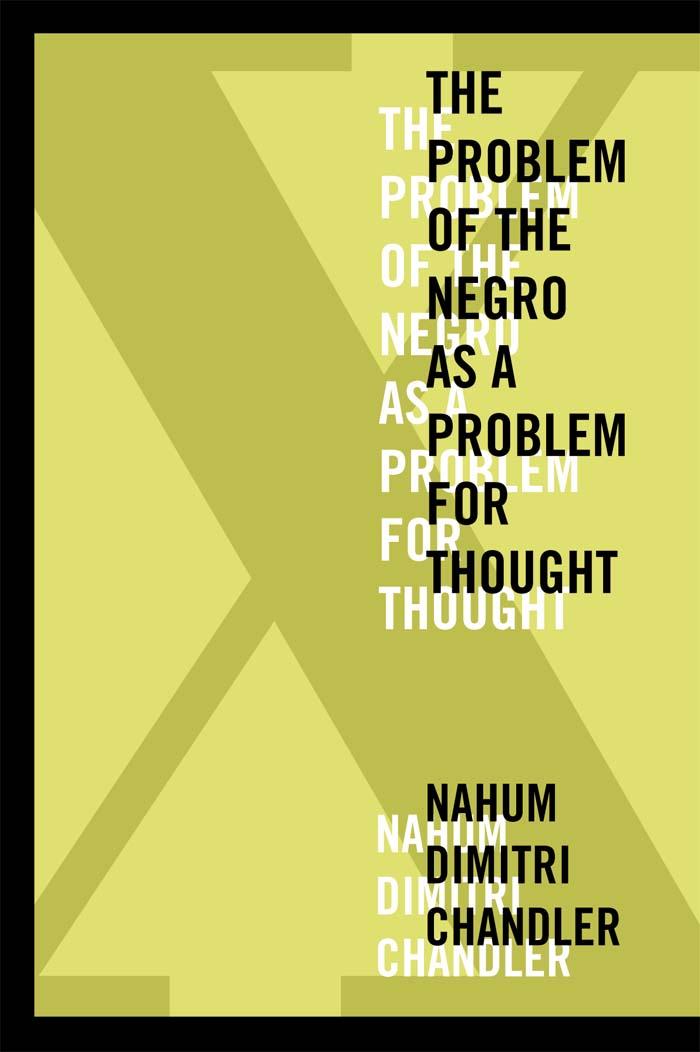
X—The Problem of the Negro as a Problem for Thought offers an original account of matters African American, and by implication the African diaspora in general, as an object of discourse and knowledge. It likewise challenges the conception of analogous objects of study across dominant ethnological disciplines (e.g., anthropology, history, and sociology) and the various forms of cultural, ethnic, and postcolonial studies.
With special reference to the work of W. E. B. Du Bois, Chandler shows how a concern with the Negro is central to the social and historical problematization that underwrote twentieth-century explorations of what it means to exist as an historical entity—referring to their antecedents in eighteenth-century thought and forward into their ongoing itinerary in the twenty-first century.
For Du Bois, “the problem of the color line” coincided with the inception of a supposedly modern horizon. The very idea of the human and its avatars—the idea of race and the idea of culture—emerged together with the violent, hierarchical inscription of the so-called African or Negro into a horizon of commonness beyond all natal premises, a horizon that we can still situate with the term global. In ongoing struggles with the idea of historical sovereignty, we can see the working out of then new concatenations of social and historical forms of difference, as both projects of categorical differentiation and the irruption of originary revisions of ways of being.
In a word, the world is no longer—and has never been—one. The world, if there is such—from the inception of something like “the Negro as a problem for thought”— could never be, only, one.
The problem of the Negro in “America” is thus an exemplary instance of modern historicity in its most fundamental sense. It renders legible for critical practice the radical order of an ineluctable and irreversible complication at the heart of being—its appearance as both life and history—as the very mark of our epoch.
Before Memmo my notes were scattered across PDFs. Now a workspace pulls everything into one place — I see exactly what's still left to study.
Memmo's summaries are gold before exams. I don't have to re-read 800 pages two weeks before — just the important parts.
The AI chat has saved me the night before an exam more than once. I just keep asking until I get it — no waiting on a study group to reply.
The quizzes hit exactly what I need to know. Memmo tracks what I get stuck on — so I only practice what's worth it.
Flashcards with spaced repetition are magic. Memmo knows when I'm about to forget something and brings it back.
The AI podcasts are my favorite. I listen on my way to school and get a recap without sitting at a computer.

Handbok i kvalitativa metoder
281 kr

Hållbar utveckling: en introduktion för ingenjörer och andra problemlösare
334 kr

Brymans Samhällsvetenskapliga metoder
390 kr

Projektledning
491 kr

Den orättvisa hälsan: om socioekonomiska skillnader i hälsa och livslängd
326 kr

Organizational Leadership
429 kr

Vetenskapsteori för nybörjare
196 kr

På väg mot läraryrket
172 kr

Det sociala livet i skolan: Socialpsykologiska perspektiv
253 kr

Betygsättningens didaktik
151 kr

Personality
402 kr

Studying Leadership
404 kr

Managing Innovation
477 kr

Introduktion till samhällsvetenskaplig metod
347 kr

The Psychology of Sex and Gender
698 kr

Evidens och kunskap för socialt arbete
207 kr

Introduction to Leadership
605 kr