
Before Memmo my notes were scattered across PDFs. Now a workspace pulls everything into one place — I see exactly what's still left to study.
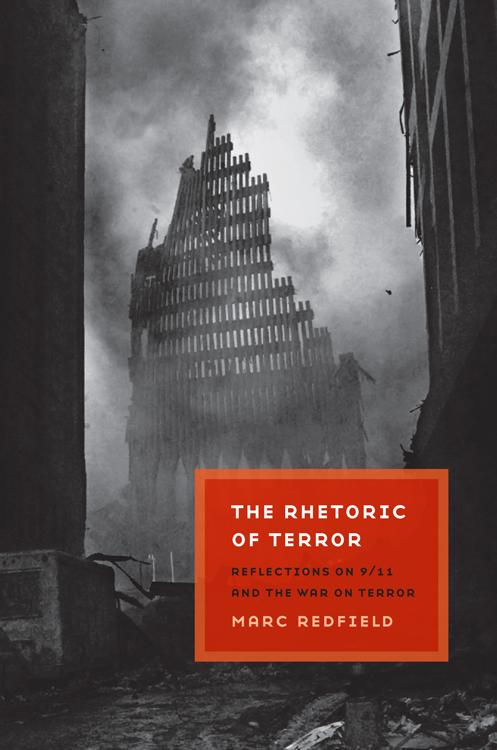
The terrorist attacks of September 11, 2001, did symbolic as well as literal damage. A trace of this cultural shock echoes in the American idiom “9/11”: a bare name-date conveying both a trauma (the unspeakable happened then) and a claim on our knowledge. In the first of the two interlinked essays making up The Rhetoric of Terror, Marc Redfield proposes the notion of “virtual trauma” to describe the cultural wound that this name-date both deflects and relays. Virtual trauma describes the shock of an event at once terribly real and utterly mediated. In consequence, a tormented self-reflexivity has tended to characterize representations of 9/11 in texts, discussions, and films, such as World Trade Center and United 93.
In the second half of the book, Redfield examines the historical and philosophical infrastructure of the notion of “war on terror.” Redfield argues that the declaration of war on terror is the exemplary postmodern sovereign speech act: it unleashes war as terror and terror as war, while remaining a crazed, even in a certain sense fictional performative utterance. Only a pseudosovereign—the executive officer of the world’s superpower—could have declared this absolute, phantasmatic, yet terribly damaging war. Though politicized terror and absolute war have their roots in the French Revolution and the emergence of the modern nation-state, Redfield suggests that the idea of a war on terror relays the complex, spectral afterlife of sovereignty in an era of biopower, global capital, and telecommunication.
A moving, wide-ranging, and rigorous meditation on the cultural tragedy of our era, The Rhetoric of Terror also unfolds as an act of mourning for Jacques Derrida. Derrida’s groundbreaking philosophical analysis of iterability—iterability as the exposure to repetition with a difference elsewhere that makes all technics, signification, and psychic life possible—helps us understand why questions of mediation and aesthetics so rapidly become so fraught in our culture; why efforts to repress our essential political, psychic, and ontological vulnerability generate recursive spasms of violence; why ethical living-together involves uninsurable acts of hospitality. The Rhetoric of Terror closes with an affirmation of eirenic cosmopolitanism.
Before Memmo my notes were scattered across PDFs. Now a workspace pulls everything into one place — I see exactly what's still left to study.
Memmo's summaries are gold before exams. I don't have to re-read 800 pages two weeks before — just the important parts.
The AI chat has saved me the night before an exam more than once. I just keep asking until I get it — no waiting on a study group to reply.
The quizzes hit exactly what I need to know. Memmo tracks what I get stuck on — so I only practice what's worth it.
Flashcards with spaced repetition are magic. Memmo knows when I'm about to forget something and brings it back.
The AI podcasts are my favorite. I listen on my way to school and get a recap without sitting at a computer.

Handbok i kvalitativa metoder
281 kr

Hållbar utveckling: en introduktion för ingenjörer och andra problemlösare
334 kr

Brymans Samhällsvetenskapliga metoder
390 kr

Projektledning
491 kr

Den orättvisa hälsan: om socioekonomiska skillnader i hälsa och livslängd
326 kr

Vetenskapsteori för nybörjare
196 kr

Organizational Leadership
429 kr

På väg mot läraryrket
172 kr

Det sociala livet i skolan: Socialpsykologiska perspektiv
253 kr

Betygsättningens didaktik
151 kr

Personality
402 kr

Studying Leadership
404 kr

Managing Innovation
477 kr

Introduktion till samhällsvetenskaplig metod
347 kr

The Psychology of Sex and Gender
698 kr

Evidens och kunskap för socialt arbete
207 kr

Introduction to Leadership
605 kr