
Before Memmo my notes were scattered across PDFs. Now a workspace pulls everything into one place — I see exactly what's still left to study.
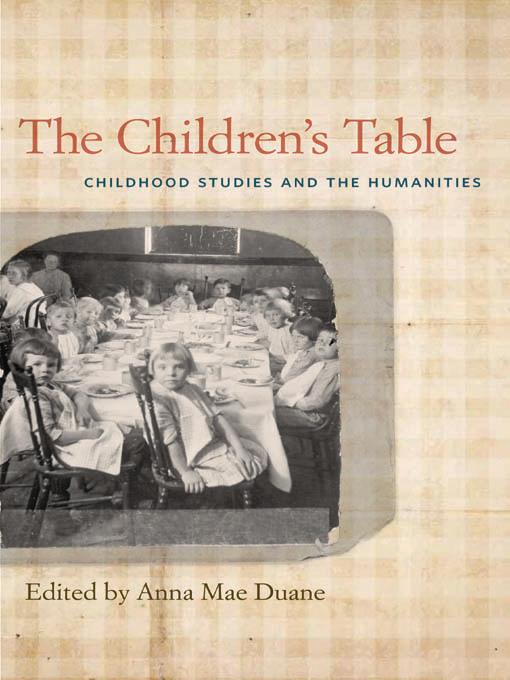
Like the occupants of the children's table at a family dinner, scholars working in childhood studies can seem sidelined from the "adult" labor of humanities scholarship. The Children's Table brings together scholars from architecture, philosophy, law, and literary and cultural criticism to provide an overview of the innovative work being done in childhood studies—a transcript of what is being said at the children's table. Together, these scholars argue for rethinking the academic seating arrangement in a way that acknowledges the centrality of childhood to the work of the humanities.
The figure we now recognize as a child was created in tandem with forms of modernity that the Enlightenment generated and that the humanities are now working to rethink. Thus the growth of childhood studies allows for new approaches to some of the most important and provocative issues in humanities scholarship: the viability of the social contract, the definition of agency, the performance of identity, and the construction of gender, sexuality, and race. Because defining childhood is a means of defining and distributing power and obligation, studying childhood requires a radically altered approach to what constitutes knowledge about the human subject.
The diverse essays in The Children's Table share a unifying premise: to include the child in any field of study realigns the shape of that field, changing the terms of inquiry and forcing a different set of questions. Taken as a whole, the essays argue that, at this key moment in the state of the humanities, rethinking the child is both necessary and revolutionary.
Contributors: Annette Ruth Appell, Sophie Bell, Robin Bernstein, Sarah Chinn, Lesley Ginsberg, Lucia Hodgson, Susan Honeyman, Roy Kozlovsky, James Marten, Karen Sánchez-Eppler, Carol Singley, Lynne Vallone, John Wall.
Before Memmo my notes were scattered across PDFs. Now a workspace pulls everything into one place — I see exactly what's still left to study.
Memmo's summaries are gold before exams. I don't have to re-read 800 pages two weeks before — just the important parts.
The AI chat has saved me the night before an exam more than once. I just keep asking until I get it — no waiting on a study group to reply.
The quizzes hit exactly what I need to know. Memmo tracks what I get stuck on — so I only practice what's worth it.
Flashcards with spaced repetition are magic. Memmo knows when I'm about to forget something and brings it back.
The AI podcasts are my favorite. I listen on my way to school and get a recap without sitting at a computer.

Handbok i kvalitativa metoder
281 kr

Hållbar utveckling: en introduktion för ingenjörer och andra problemlösare
334 kr

Brymans Samhällsvetenskapliga metoder
390 kr

Projektledning
491 kr

Den orättvisa hälsan: om socioekonomiska skillnader i hälsa och livslängd
326 kr

Organizational Leadership
429 kr

Vetenskapsteori för nybörjare
196 kr

På väg mot läraryrket
172 kr

Det sociala livet i skolan: Socialpsykologiska perspektiv
253 kr

Betygsättningens didaktik
151 kr

Personality
402 kr

Studying Leadership
404 kr

Managing Innovation
477 kr

Introduktion till samhällsvetenskaplig metod
347 kr

The Psychology of Sex and Gender
698 kr

Evidens och kunskap för socialt arbete
207 kr

Introduction to Leadership
605 kr