
Before Memmo my notes were scattered across PDFs. Now a workspace pulls everything into one place — I see exactly what's still left to study.
"Surprisingly readable and studded with nuggets of insight."
The Daily Yomiuri
"This insightful, well-written, fascinating book offers new understandings, not only of Japan, but also of American culture. It is essential for those in anthropology, psychology, sociology, and psychiatry who are interested in culture, as well as those in law and the business community who deal with Japan."
Paul Ekman, Ph.D.,Director, Human Interaction Laboratory, Langley Porter Institute, University of California, San Francisco
"[A] thoughtful cross-cultural study of development...His work can only enhance the still evolving psychoanalytic theory of preoedipal development as it is being derived mostly from psychoanalytic research on child-parent interaction in American families."
Calvin F. Settlage, M.D.
"Johnson's ambitious and exhaustive synthesis of anthropological and psychological treatments of dependency raises interesting questions. . . Johnson alerts the reader to issues of universalism and relativity and leads us to ask, 'What would psychoanalysis be like, if it had originated in Japan?'"
Merry I. White, Edwin O. Reischauer Institute of Japanese Studies, Harvard University
". . . Johnson's erudite and critical re-examination of human dependence succeeds to re-profile dependence meaningfully and revives our interest in this major aspect of human experience. Indeed, much food for thought for both psychoanalysts and anthropologists."
Henri Parens, M.D., Philadelphia Psychoanalytic Institute
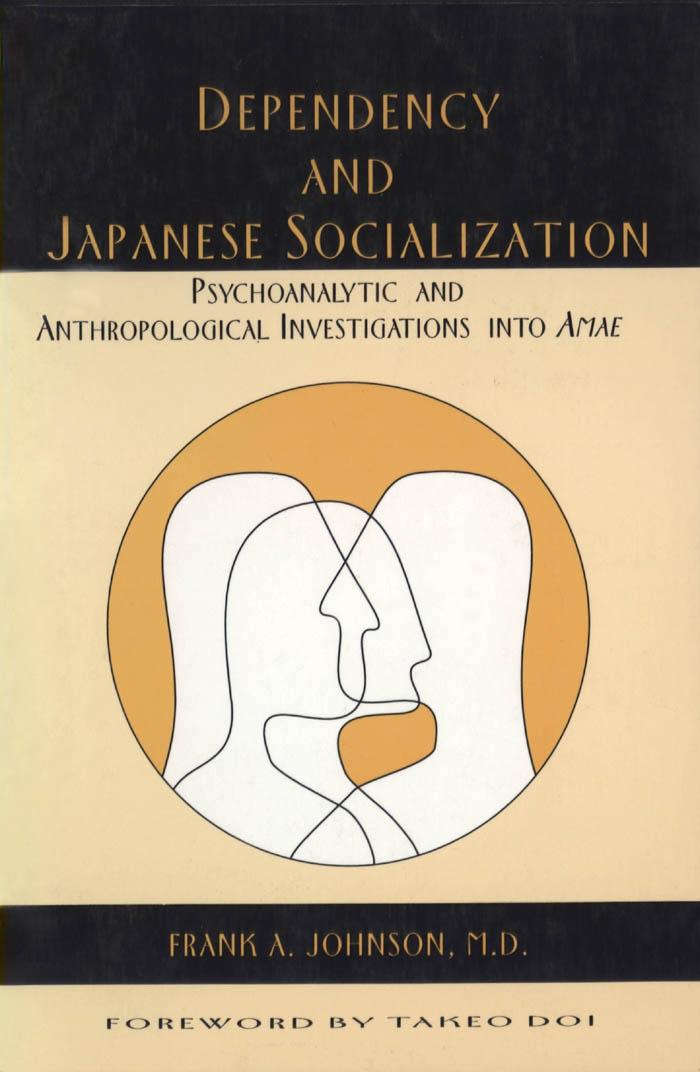
Western ideologies traditionally emphasize the concepts of individualism, privacy, freedom, and independence, while the prevailing ethos relegates dependency to a disparaged status. In Japanese society, the divergence from these western ideals can be found in the concept of amae (perhaps best translated as indulgent dependency) which is part of the Japanese social fiber and pervades their experience.
For the Western reader, the concept of amae is somewhat alien and unfamiliar, but in order to understand the Japanese fully, it is essential to acquire a familiarity with the intensity that accompanies interdependent affiliations within their culture. To place amae in the proper context, Johnson critically examines the western attitudes toward dependency from the perspectives of psychoanalysis, psychiatry, developmental psychology, and anthropology. Johnson traces the development of the concept and uses of the term dependency in academic and developmental psychology in the West, including its recent eclipse by more operationally useful terms attachment and interdependency.
This timely books makes use of the work of Japanese psychiatrist Takeo Doi, whose book The Anatomy of Dependence introduced the concept of amae to the West. Johnson goes on to illuminate the collective manner in which Japanese think and behave which is central to their socialization and educational practices, especially as seen in the stunning success of Japanese trading practices during the past twenty years. A major emphasis is placed upon the positive aspects of amae, which are compared and contrasted with attitudes toward dependency seen among other nationalities, cultures, and groups in both Western and Asian societies.
Complete with a glossary of Japanese terms, Dependency and Japanese Socialization provides a comprehensive investigation into Japanese behavior.
Before Memmo my notes were scattered across PDFs. Now a workspace pulls everything into one place — I see exactly what's still left to study.
Memmo's summaries are gold before exams. I don't have to re-read 800 pages two weeks before — just the important parts.
The AI chat has saved me the night before an exam more than once. I just keep asking until I get it — no waiting on a study group to reply.
The quizzes hit exactly what I need to know. Memmo tracks what I get stuck on — so I only practice what's worth it.
Flashcards with spaced repetition are magic. Memmo knows when I'm about to forget something and brings it back.
The AI podcasts are my favorite. I listen on my way to school and get a recap without sitting at a computer.

Handbok i kvalitativa metoder
281 kr

Hållbar utveckling: en introduktion för ingenjörer och andra problemlösare
334 kr

Brymans Samhällsvetenskapliga metoder
390 kr

Projektledning
491 kr

Den orättvisa hälsan: om socioekonomiska skillnader i hälsa och livslängd
326 kr

Vetenskapsteori för nybörjare
196 kr

Organizational Leadership
429 kr

På väg mot läraryrket
172 kr

Det sociala livet i skolan: Socialpsykologiska perspektiv
253 kr

Betygsättningens didaktik
151 kr

Personality
402 kr

Studying Leadership
404 kr

Managing Innovation
477 kr

Introduktion till samhällsvetenskaplig metod
347 kr

The Psychology of Sex and Gender
698 kr

Evidens och kunskap för socialt arbete
207 kr

Introduction to Leadership
605 kr