
Before Memmo my notes were scattered across PDFs. Now a workspace pulls everything into one place — I see exactly what's still left to study.
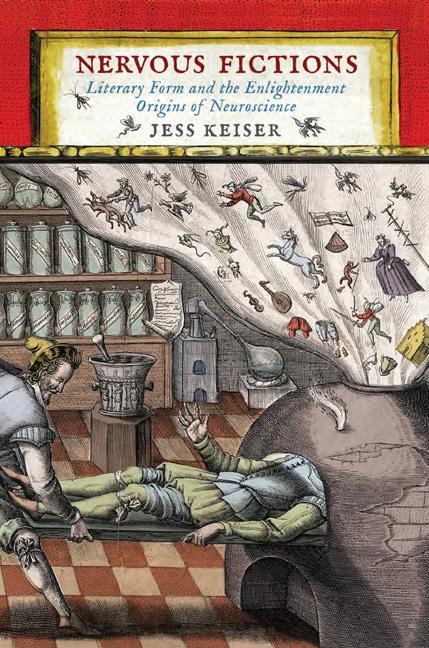
"The brain contains ten thousand cells," wrote the poet Matthew Prior in 1718, "in each some active fancy dwells." In the seventeenth and eighteenth centuries, just as scientists began to better understand the workings of the nerves, the nervous system became the site for a series of elaborate fantasies. The pineal gland is transformed into a throne for the sovereign soul. Animal spirits march the nerves like parading soldiers. An internal archivist searches through cerebral impressions to locate certain memories. An anatomist discovers that the brain of a fashionable man is stuffed full of beautiful clothes and billet-doux. A hypochondriac worries that his own brain will be disassembled like a watch. A sentimentalist sees the entire world as a giant nervous system comprising sympathetic spectators.
Nervous Fictions is the first account of the Enlightenment origins of neuroscience and the "active fancies" it generated. By surveying the work of scientists (Willis, Newton, Cheyne), philosophers (Descartes, Cavendish, Locke), satirists (Swift, Pope), and novelists (Haywood, Fielding, Sterne), Keiser shows how attempts to understand the brain’s relationship to the mind produced in turn new literary forms. Early brain anatomists turned to tropes to explicate psyche and cerebrum, just as poets and novelists found themselves exploring new kinds of mental and physical interiority. In this respect, literary language became a tool to aid scientific investigation, while science spurred literary invention.
Before Memmo my notes were scattered across PDFs. Now a workspace pulls everything into one place — I see exactly what's still left to study.
Memmo's summaries are gold before exams. I don't have to re-read 800 pages two weeks before — just the important parts.
The AI chat has saved me the night before an exam more than once. I just keep asking until I get it — no waiting on a study group to reply.
The quizzes hit exactly what I need to know. Memmo tracks what I get stuck on — so I only practice what's worth it.
Flashcards with spaced repetition are magic. Memmo knows when I'm about to forget something and brings it back.
The AI podcasts are my favorite. I listen on my way to school and get a recap without sitting at a computer.

Handbok i kvalitativa metoder
281 kr

Hållbar utveckling: en introduktion för ingenjörer och andra problemlösare
334 kr

Brymans Samhällsvetenskapliga metoder
390 kr

Projektledning
491 kr

Den orättvisa hälsan: om socioekonomiska skillnader i hälsa och livslängd
326 kr

Vetenskapsteori för nybörjare
196 kr

Organizational Leadership
429 kr

På väg mot läraryrket
172 kr

Det sociala livet i skolan: Socialpsykologiska perspektiv
253 kr

Betygsättningens didaktik
151 kr

Personality
402 kr

Studying Leadership
404 kr

Managing Innovation
477 kr

Introduktion till samhällsvetenskaplig metod
347 kr

The Psychology of Sex and Gender
698 kr

Evidens och kunskap för socialt arbete
207 kr

Introduction to Leadership
605 kr