
Before Memmo my notes were scattered across PDFs. Now a workspace pulls everything into one place — I see exactly what's still left to study.
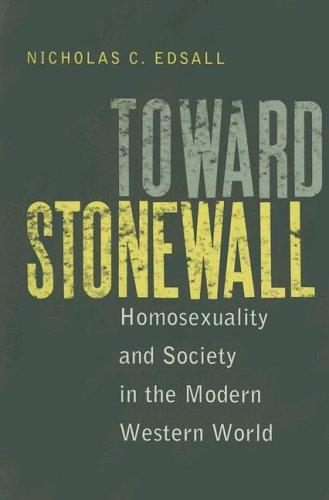
As recently as the 1970s, gay and lesbian history was a relatively unexplored field for serious scholars. The past quarter century, however, has seen enormous growth in gay and lesbian studies. The literature is now voluminous; it is also widely scattered and not always easily accessible. In Toward Stonewall, Nicholas Edsall provides a much-needed synthesis, drawing upon both scholarly and popular writings to chart the development of homosexual subcultures in the modern era and the uneasy place they have occupied in Western society.
Edsall’s survey begins three hundred years ago in northwestern Europe, when homosexual subcultures recognizably similar to those of our own era began to emerge, and it follows their surprisingly diverse paths through the Enlightenment to the early nineteenth century. The book then turns to the Victorian era, tracing the development of articulate and self-aware homosexual subcultures. With a greater sense of identity and organization came new forms of resistance: this was the age that saw the persecution of Oscar Wilde, among others, as well as the medical establishment’s labeling of homosexuality as a sign of degeneracy.
The book’s final section locates the foundations of present-day gay sub-cultures in a succession of twentieth-century scenes and events—in pre-Nazi Germany, in the lesbian world of interwar Paris, in the law reforms of 1960s England—culminating in the emergence of popular movements in the postwar United States.
Rather than examining these groups in isolation, the book considers them in their social contexts and as comparable to other subordinate groups and minority movements. In the process, Toward Stonewall illuminates not only the subcultures that are its primary subject but the larger societies from which they emerged.
Before Memmo my notes were scattered across PDFs. Now a workspace pulls everything into one place — I see exactly what's still left to study.
Memmo's summaries are gold before exams. I don't have to re-read 800 pages two weeks before — just the important parts.
The AI chat has saved me the night before an exam more than once. I just keep asking until I get it — no waiting on a study group to reply.
The quizzes hit exactly what I need to know. Memmo tracks what I get stuck on — so I only practice what's worth it.
Flashcards with spaced repetition are magic. Memmo knows when I'm about to forget something and brings it back.
The AI podcasts are my favorite. I listen on my way to school and get a recap without sitting at a computer.

Handbok i kvalitativa metoder
281 kr

Hållbar utveckling: en introduktion för ingenjörer och andra problemlösare
334 kr

Brymans Samhällsvetenskapliga metoder
390 kr

Projektledning
491 kr

Den orättvisa hälsan: om socioekonomiska skillnader i hälsa och livslängd
326 kr

Vetenskapsteori för nybörjare
196 kr

Organizational Leadership
429 kr

På väg mot läraryrket
172 kr

Det sociala livet i skolan: Socialpsykologiska perspektiv
253 kr

Betygsättningens didaktik
151 kr

Personality
402 kr

Studying Leadership
404 kr

Managing Innovation
477 kr

Introduktion till samhällsvetenskaplig metod
347 kr

The Psychology of Sex and Gender
698 kr

Evidens och kunskap för socialt arbete
207 kr

Introduction to Leadership
605 kr