
Before Memmo my notes were scattered across PDFs. Now a workspace pulls everything into one place — I see exactly what's still left to study.
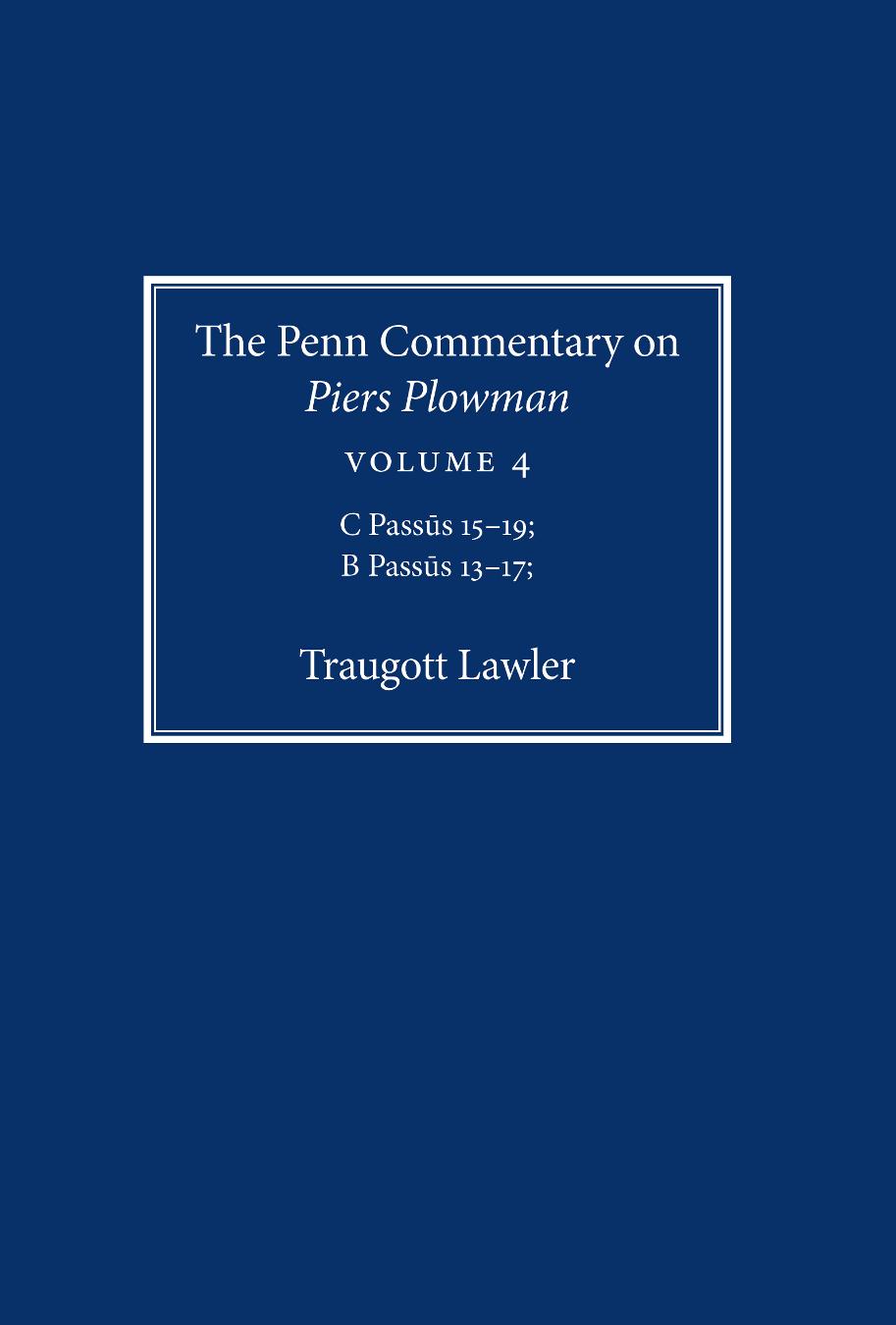
The detailed and wide-ranging Penn Commentary on "Piers Plowman" places the allegorical dream-vision of the poem within the literary, historical, social, and intellectual contexts of late medieval England, and within the long history of critical interpretation of the work, assessing past scholarship while offering original materials and insights throughout. The authors' line-by-line, section by section, and passus by passus commentary on all three versions of the poem and on the stages of its multiple revisions reveals new aspects of the poem's meaning while assessing and summarizing a complex and often divisive scholarly tradition. The volumes offer an up-to-date, original, and open-ended guide to a poem whose engagement with its social world is unrivaled in English literature, and whose literary, religious, and intellectual accomplishments are uniquely powerful.
The Penn Commentary is designed to be equally useful to readers of the A, B, or C texts of the poem. It is geared to readers eager to have detailed experience of Piers Plowman and other medieval literature, possessing some basic knowledge of Middle English language and literature, and interested in pondering further the particularly difficult relationships to both that this poem possesses. Others, with interest in poetry of all periods, will find the extended and detailed commentary useful precisely because it does not seek to avoid the poem's challenges but seeks instead to provoke thought about its intricacy and poetic achievements.
Covering passūs C.15-19 and B.13-17, Volume 4 of the Penn Commentary on "Piers Plowman" creates a complete vade mecum for readers, identifying and translating all Latin quotations, uncovering allusions, providing full cross-reference to other parts of the poem, drawing in relevant scholarship, and unraveling difficult passages. Like the other commentaries in the series, this volume contains an extensive overview and analysis of each passus, and the subdivisions within, large and small, and discusses all differences between the two versions. It pays careful attention to the poem at the literal level as well as to Latin texts that are analogues or even possible sources of Langland's thought and it emphasizes the comedy of the poem, of which these passūs offer a number of examples.
Before Memmo my notes were scattered across PDFs. Now a workspace pulls everything into one place — I see exactly what's still left to study.
Memmo's summaries are gold before exams. I don't have to re-read 800 pages two weeks before — just the important parts.
The AI chat has saved me the night before an exam more than once. I just keep asking until I get it — no waiting on a study group to reply.
The quizzes hit exactly what I need to know. Memmo tracks what I get stuck on — so I only practice what's worth it.
Flashcards with spaced repetition are magic. Memmo knows when I'm about to forget something and brings it back.
The AI podcasts are my favorite. I listen on my way to school and get a recap without sitting at a computer.

Handbok i kvalitativa metoder
281 kr

Hållbar utveckling: en introduktion för ingenjörer och andra problemlösare
334 kr

Brymans Samhällsvetenskapliga metoder
390 kr

Projektledning
491 kr

Den orättvisa hälsan: om socioekonomiska skillnader i hälsa och livslängd
326 kr

Vetenskapsteori för nybörjare
196 kr

Organizational Leadership
429 kr

På väg mot läraryrket
172 kr

Det sociala livet i skolan: Socialpsykologiska perspektiv
253 kr

Betygsättningens didaktik
151 kr

Personality
402 kr

Studying Leadership
404 kr

Managing Innovation
477 kr

Introduktion till samhällsvetenskaplig metod
347 kr

The Psychology of Sex and Gender
698 kr

Evidens och kunskap för socialt arbete
207 kr

Introduction to Leadership
605 kr