
Before Memmo my notes were scattered across PDFs. Now a workspace pulls everything into one place — I see exactly what's still left to study.
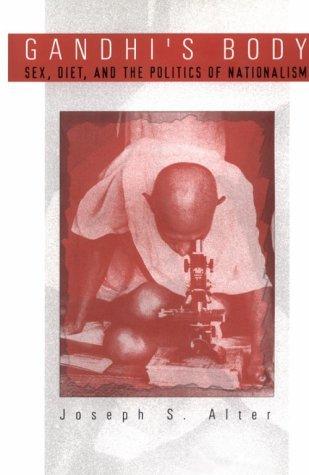
No single person is more directly associated with India and India's struggle for independence than Mahatma Gandhi. His name has equally become synonymous with the highest principles of global equality, human dignity, and freedom.
Joseph Alter argues, however, that Gandhi has not been completely understood by biographers and political scholars, and in Gandhi's Body he undertakes a reevaluation of the Mahatma's life and thought. In his revisionist and iconoclastic approach, Alter moves away from the usual focus on nonviolence, peace, and social reform and takes seriously what most scholars who have studied Gandhi tend to ignore: Gandhi's preoccupation with sex, his obsession with diet reform, and his vehement advocacy for naturopathy. Alter concludes that a distinction cannot be made between Gandhi's concern with health, faith in nonviolence, and his sociopolitical agenda.
In this original and provocative study, Joseph Alter demonstrates that these seemingly idiosyncratic aspects of Gandhi's personal life are of central importance to understanding his politics—and not only Gandhi's politics but Indian nationalism in general. Using the Mahatma's own writings, Alter places Gandhi's bodily practices in the context of his philosophy; for example, he explores the relationship between Gandhi's fasting and his ideas about the metaphysics of emptiness and that between his celibacy and his beliefs about nonviolence.
Alter also places Gandhi's ideas and practices in their national and transnational contexts. He discusses how and why nature cure became extremely popular in India during the early part of the twentieth century, tracing the influence of two German naturopaths on Gandhi's thinking and on the practice of yoga in India. More important, he argues that the reconstruction of yoga in terms of European naturopathy was brought about deliberately by a number of activists in India—of whom Gandhi was only the most visible—interested in creating a "scientific" health regimen, distinct from Western precedents, that would make the Indian people fit for self-rule. Gandhi's Body counters established arguments that Indian nationalism was either a completely indigenous Hindu-based movement or simply a derivative of Western ideals.
Before Memmo my notes were scattered across PDFs. Now a workspace pulls everything into one place — I see exactly what's still left to study.
Memmo's summaries are gold before exams. I don't have to re-read 800 pages two weeks before — just the important parts.
The AI chat has saved me the night before an exam more than once. I just keep asking until I get it — no waiting on a study group to reply.
The quizzes hit exactly what I need to know. Memmo tracks what I get stuck on — so I only practice what's worth it.
Flashcards with spaced repetition are magic. Memmo knows when I'm about to forget something and brings it back.
The AI podcasts are my favorite. I listen on my way to school and get a recap without sitting at a computer.

Handbok i kvalitativa metoder
281 kr

Hållbar utveckling: en introduktion för ingenjörer och andra problemlösare
334 kr

Brymans Samhällsvetenskapliga metoder
390 kr

Projektledning
491 kr

Den orättvisa hälsan: om socioekonomiska skillnader i hälsa och livslängd
326 kr

Vetenskapsteori för nybörjare
196 kr

Organizational Leadership
429 kr

På väg mot läraryrket
172 kr

Det sociala livet i skolan: Socialpsykologiska perspektiv
253 kr

Betygsättningens didaktik
151 kr

Personality
402 kr

Studying Leadership
404 kr

Managing Innovation
477 kr

Introduktion till samhällsvetenskaplig metod
347 kr

The Psychology of Sex and Gender
698 kr

Evidens och kunskap för socialt arbete
207 kr

Introduction to Leadership
605 kr