
Before Memmo my notes were scattered across PDFs. Now a workspace pulls everything into one place — I see exactly what's still left to study.
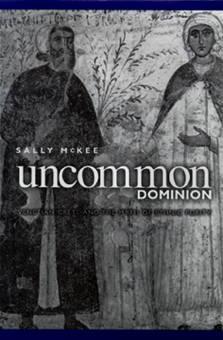
From 1211 until its loss to the Ottomans in 1669, the Greek island we know as Crete was the Venetian colony of Candia. Ruled by a paid civil service fully accountable to the Venetian Senate, Candia was distinct from nearly every other colony of the medieval period for the unprecedented degree to which the colonial power was involved in its governance.
Yet, for Sally McKee, the importance of the Cretan colony only begins with the anomalous manner of the Venetian state's rule. Uncommon Dominion tells the story of Venetian Crete, the home of two recognizably distinct ethnic communities, the Latins and the Greeks. The application of Venetian law to the colony made it possible for the colonial power to create and maintain a fiction of ethnic distinctness. The Greeks were subordinate to the Latins economically, politically, and juridically, yet within a century of Venetian colonization, the ethnic differences between Latin and Greek Cretans in daily material life were significantly blurred. Members of the groups intermarried, many of them learned each other's language, and some even chose to worship by the rites of the other's church. Holding up ample evidence of acculturation and miscegenation by the colony's inhabitants, McKee uncovers the colonial forces that promoted the persistence of ethnic labeling despite the lack of any clear demarcation between the two predominant communities. As McKee argues, the concept of ethnic identity was largely determined by gender, religion, and social status, especially by the Latin and Greek elites in their complex and frequently antagonistic social relationships.
Drawing expertly from notarial and court records, as well as legislative and literary sources, Uncommon Dominion offers a unique study of ethnicity in the medieval and early modern periods. Students and scholars in medieval, colonial, and postcolonial studies will find much of use in studying this remarkable colonial experiment.
Before Memmo my notes were scattered across PDFs. Now a workspace pulls everything into one place — I see exactly what's still left to study.
Memmo's summaries are gold before exams. I don't have to re-read 800 pages two weeks before — just the important parts.
The AI chat has saved me the night before an exam more than once. I just keep asking until I get it — no waiting on a study group to reply.
The quizzes hit exactly what I need to know. Memmo tracks what I get stuck on — so I only practice what's worth it.
Flashcards with spaced repetition are magic. Memmo knows when I'm about to forget something and brings it back.
The AI podcasts are my favorite. I listen on my way to school and get a recap without sitting at a computer.

Handbok i kvalitativa metoder
281 kr

Hållbar utveckling: en introduktion för ingenjörer och andra problemlösare
334 kr

Brymans Samhällsvetenskapliga metoder
390 kr

Projektledning
491 kr

Den orättvisa hälsan: om socioekonomiska skillnader i hälsa och livslängd
326 kr

Organizational Leadership
429 kr

Vetenskapsteori för nybörjare
196 kr

På väg mot läraryrket
172 kr

Det sociala livet i skolan: Socialpsykologiska perspektiv
253 kr

Betygsättningens didaktik
151 kr

Personality
402 kr

Studying Leadership
404 kr

Managing Innovation
477 kr

Introduktion till samhällsvetenskaplig metod
347 kr

The Psychology of Sex and Gender
698 kr

Evidens och kunskap för socialt arbete
207 kr

Introduction to Leadership
605 kr