
Before Memmo my notes were scattered across PDFs. Now a workspace pulls everything into one place — I see exactly what's still left to study.
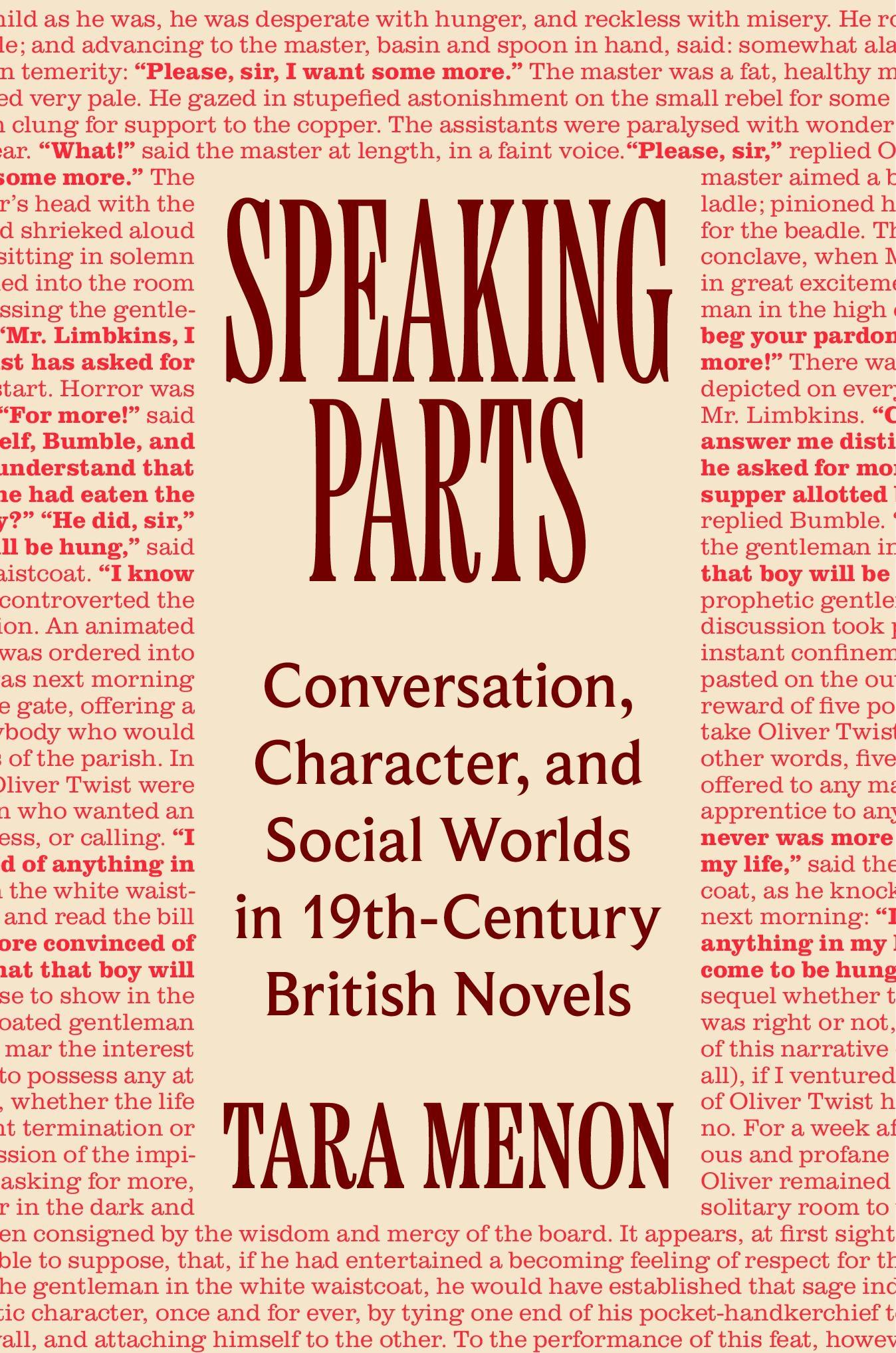
How direct speech in the novel shapes our understanding of literary characters and their social worlds
For many readers, to think of nineteenth-century fiction is to recall characters speaking: Elizabeth refusing Darcy in Pride and Prejudice; Jane excoriating Rochester in Jane Eyre; Dorothea and Celia discussing Mr. Casaubon in Middlemarch. And yet literary critics have had surprisingly little to say about the narrative effects of dialogue. In Speaking Parts, Tara Menon shows how direct speech—words enclosed in quotation marks that appear to be the exact utterances of characters—shapes our understanding of fictional characters and the social worlds they inhabit. Combining computational tools and close literary analysis, Menon reinstates direct speech to its rightful place in narrative theory, worthy of the critical seriousness afforded to such other features of narrative as free indirect discourse.
After quantifying direct speech in nearly one thousand British novels written between 1789 and 1901, Menon turns her attention to several canonical nineteenth-century works of fiction by Jane Austen, Charlotte Brontë, and George Eliot. She considers, among other things, the ways that Austen establishes sympathy for certain characters through her allotment of speech; the narrative significance of speaking characters not given proper names in Jane Eyre; and the social isolation of Dorothea in Middlemarch, as revealed by speech networks. Menon shows not only how the study of direct speech allows us to make new arguments about these well-known texts but also that data analysis of speech can change the way we think about characters, individual novels, and even genres.
Before Memmo my notes were scattered across PDFs. Now a workspace pulls everything into one place — I see exactly what's still left to study.
Memmo's summaries are gold before exams. I don't have to re-read 800 pages two weeks before — just the important parts.
The AI chat has saved me the night before an exam more than once. I just keep asking until I get it — no waiting on a study group to reply.
The quizzes hit exactly what I need to know. Memmo tracks what I get stuck on — so I only practice what's worth it.
Flashcards with spaced repetition are magic. Memmo knows when I'm about to forget something and brings it back.
The AI podcasts are my favorite. I listen on my way to school and get a recap without sitting at a computer.

Handbok i kvalitativa metoder
281 kr

Hållbar utveckling: en introduktion för ingenjörer och andra problemlösare
334 kr

Brymans Samhällsvetenskapliga metoder
390 kr

Projektledning
491 kr

Den orättvisa hälsan: om socioekonomiska skillnader i hälsa och livslängd
326 kr

Organizational Leadership
429 kr

Vetenskapsteori för nybörjare
196 kr

På väg mot läraryrket
172 kr

Det sociala livet i skolan: Socialpsykologiska perspektiv
253 kr

Betygsättningens didaktik
151 kr

Personality
402 kr

Studying Leadership
404 kr

Managing Innovation
477 kr

Introduktion till samhällsvetenskaplig metod
347 kr

The Psychology of Sex and Gender
698 kr

Evidens och kunskap för socialt arbete
207 kr

Introduction to Leadership
605 kr