
Before Memmo my notes were scattered across PDFs. Now a workspace pulls everything into one place — I see exactly what's still left to study.
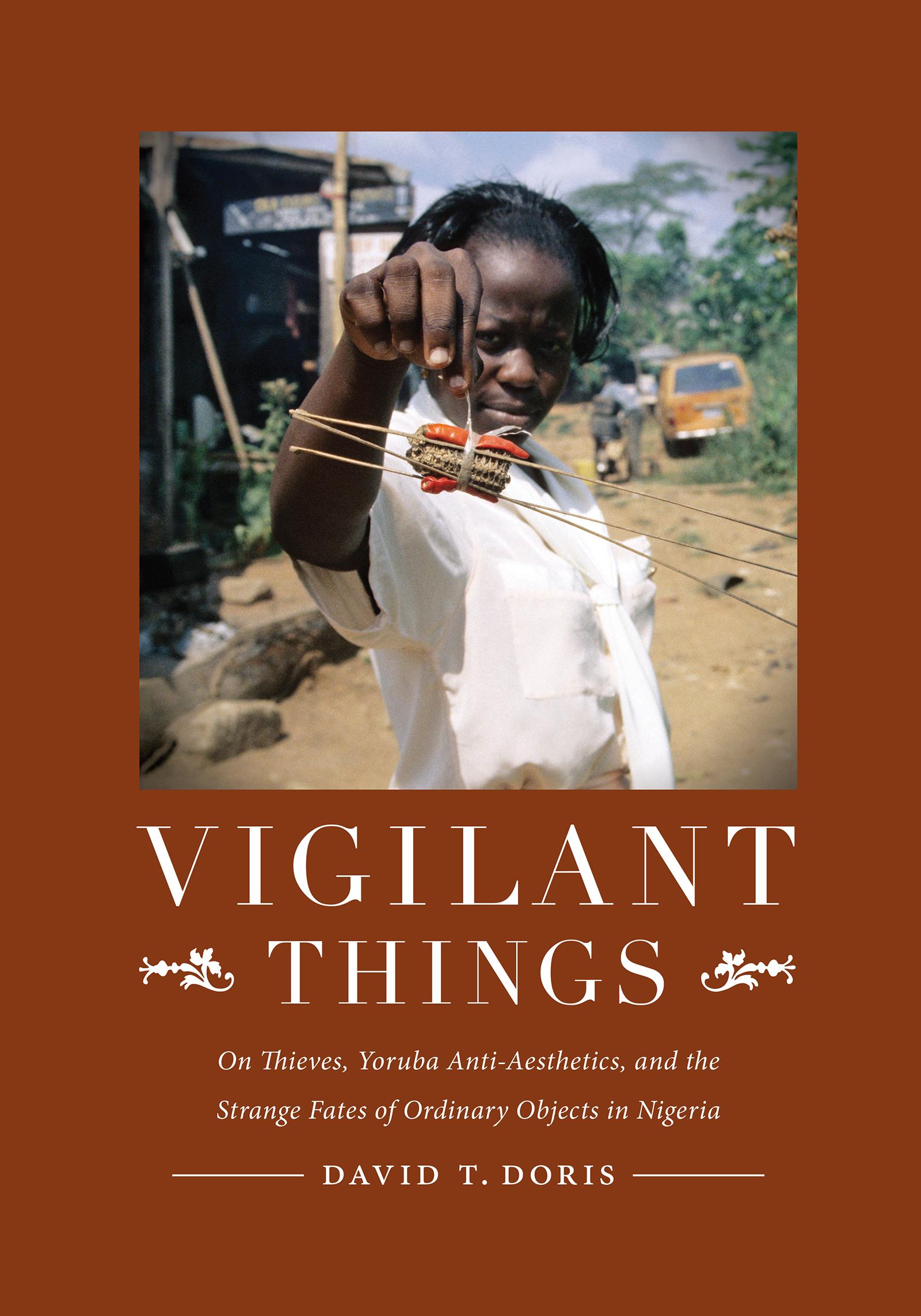
Winner of the 2012 Melville J. Herskovits award (African Studies Association)
Throughout southwestern Nigeria, Yoruba men and women create objects called aale to protect their properties—farms, gardens, market goods, firewood—from the ravages of thieves. Aale are objects of such unassuming appearance that a non-Yoruba viewer might not register their important presence in the Yoruba visual landscape: a dried seedpod tied with palm fronds to the trunk of a fruit tree, a burnt corncob suspended on a wire, an old shoe tied with a rag to a worn-out broom and broken comb, a ripe red pepper pierced with a single broom straw and set atop a pile of eggs. Consequently, aale have rarely been discussed in print, and then only as peripheral elements in studies devoted to other issues. Yet aale are in no way peripheral to Yoruba culture or aesthetics.
In Vigilant Things, David T. Doris argues that aale are keys to understanding how images function in Yoruba social and cultural life. The humble, often degraded objects that comprise aale reveal as eloquently as any canonical artwork the channels of power that underlie the surfaces of the visible. Aale are warnings, intended to trigger the work of conscience. Aale objects symbolically threaten suffering as the consequence of transgression—the suffering of disease, loss, barrenness, paralysis, accident, madness, fruitless labor, or death—and as such are often the useless residues of things that were once positively valued: empty snail shells, shards of pottery, fragments of rusted iron, and the like. If these objects share “suffering” and “uselessness” as constitutive elements, it is because they already have been made to suffer and become useless. Aale offer would-be thieves an opportunity to recognize themselves in advance of their actions and to avoid the thievery that would make the "useless" people.
Before Memmo my notes were scattered across PDFs. Now a workspace pulls everything into one place — I see exactly what's still left to study.
Memmo's summaries are gold before exams. I don't have to re-read 800 pages two weeks before — just the important parts.
The AI chat has saved me the night before an exam more than once. I just keep asking until I get it — no waiting on a study group to reply.
The quizzes hit exactly what I need to know. Memmo tracks what I get stuck on — so I only practice what's worth it.
Flashcards with spaced repetition are magic. Memmo knows when I'm about to forget something and brings it back.
The AI podcasts are my favorite. I listen on my way to school and get a recap without sitting at a computer.

Handbok i kvalitativa metoder
281 kr

Hållbar utveckling: en introduktion för ingenjörer och andra problemlösare
334 kr

Brymans Samhällsvetenskapliga metoder
390 kr

Projektledning
491 kr

Den orättvisa hälsan: om socioekonomiska skillnader i hälsa och livslängd
326 kr

Vetenskapsteori för nybörjare
196 kr

Organizational Leadership
429 kr

På väg mot läraryrket
172 kr

Det sociala livet i skolan: Socialpsykologiska perspektiv
253 kr

Betygsättningens didaktik
151 kr

Personality
402 kr

Studying Leadership
404 kr

Managing Innovation
477 kr

Introduktion till samhällsvetenskaplig metod
347 kr

The Psychology of Sex and Gender
698 kr

Evidens och kunskap för socialt arbete
207 kr

Introduction to Leadership
605 kr