
Before Memmo my notes were scattered across PDFs. Now a workspace pulls everything into one place — I see exactly what's still left to study.
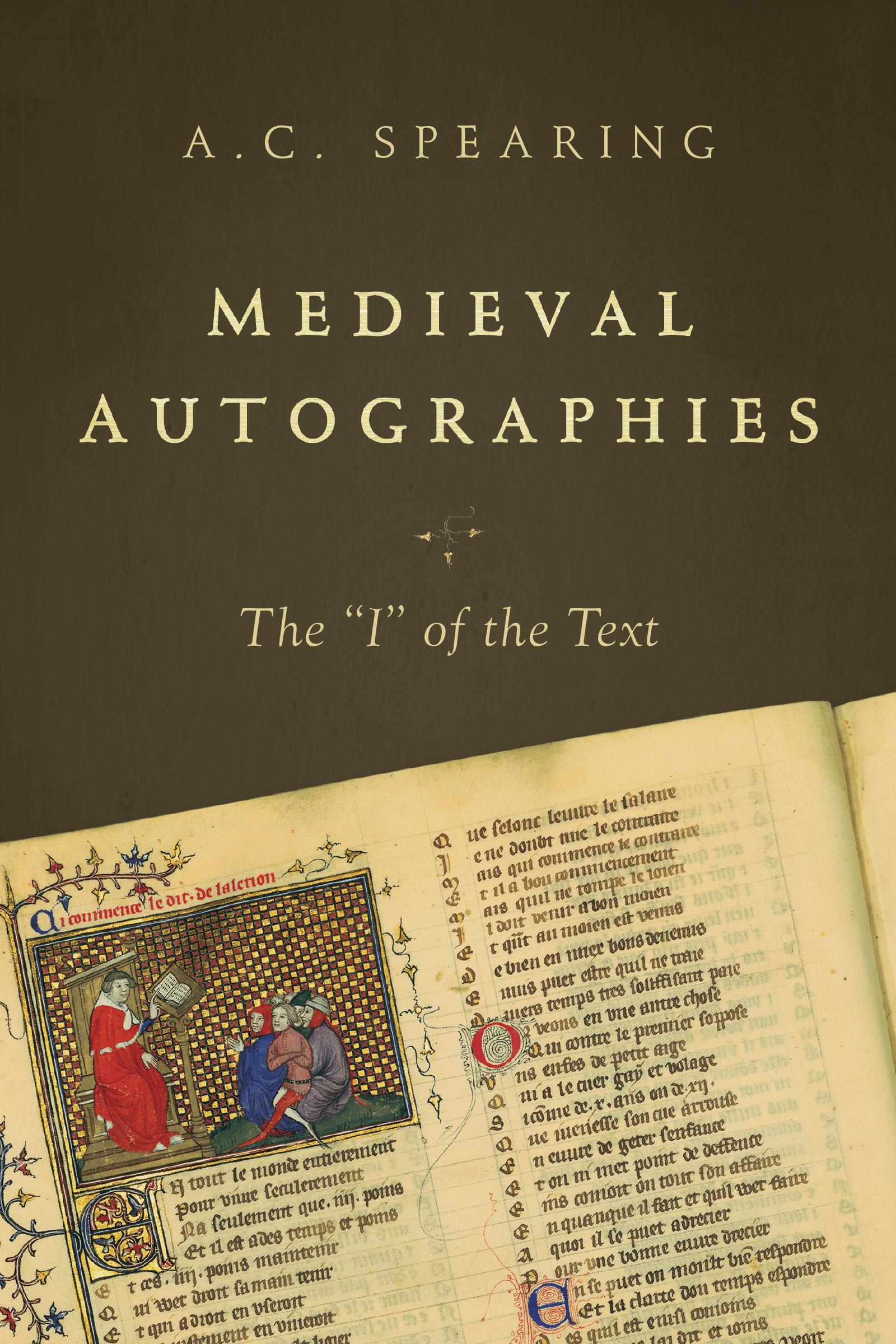
In Medieval Autographies, A. C. Spearing develops a new engagement of narrative theory with medieval English first-person writing, focusing on the roles and functions of the “I” as a shifting textual phenomenon, not to be defined either as autobiographical or as the label of a fictional speaker or narrator. Spearing identifies and explores a previously unrecognized category of medieval English poetry, calling it "autography.” He describes this form as emerging in the mid-fourteenth century and consisting of extended nonlyrical writings in the first person, embracing prologues, authorial interventions in and commentaries on third-person narratives, and descendants of the dit, a genre of French medieval poetry. He argues that autography arose as a means of liberation from the requirement to tell stories with preordained conclusions and as a way of achieving a closer relation to lived experience, with all its unpredictability and inconsistencies. Autographies, he claims, are marked by a cluster of characteristics including a correspondence to the texture of life as it is experienced, a montage-like unpredictability of structure, and a concern with writing and textuality.
Beginning with what may be the earliest extended first-person narrative in Middle English, Winner and Waster, the book examines instances of the dit as discussed by French scholars, analyzes Chaucer’s Wife of Bath’s Prologue as a textual performance, and devotes separate chapters to detailed readings of Hoccleve’s Regement of Princes prologue, his Complaint and Dialogue, and the witty first-person elements in Osbern Bokenham’s legends of saints. An afterword suggests possible further applications of the concept of autography, including discussion of the intermittent autographic commentaries on the narrative in Troilus and Criseyde and Capgrave’s Life of Saint Katherine.
Before Memmo my notes were scattered across PDFs. Now a workspace pulls everything into one place — I see exactly what's still left to study.
Memmo's summaries are gold before exams. I don't have to re-read 800 pages two weeks before — just the important parts.
The AI chat has saved me the night before an exam more than once. I just keep asking until I get it — no waiting on a study group to reply.
The quizzes hit exactly what I need to know. Memmo tracks what I get stuck on — so I only practice what's worth it.
Flashcards with spaced repetition are magic. Memmo knows when I'm about to forget something and brings it back.
The AI podcasts are my favorite. I listen on my way to school and get a recap without sitting at a computer.

Handbok i kvalitativa metoder
281 kr

Hållbar utveckling: en introduktion för ingenjörer och andra problemlösare
334 kr

Brymans Samhällsvetenskapliga metoder
390 kr

Projektledning
491 kr

Den orättvisa hälsan: om socioekonomiska skillnader i hälsa och livslängd
326 kr

Organizational Leadership
429 kr

Vetenskapsteori för nybörjare
196 kr

På väg mot läraryrket
172 kr

Det sociala livet i skolan: Socialpsykologiska perspektiv
253 kr

Betygsättningens didaktik
151 kr

Personality
402 kr

Studying Leadership
404 kr

Managing Innovation
477 kr

Introduktion till samhällsvetenskaplig metod
347 kr

The Psychology of Sex and Gender
698 kr

Evidens och kunskap för socialt arbete
207 kr

Introduction to Leadership
605 kr