
Before Memmo my notes were scattered across PDFs. Now a workspace pulls everything into one place — I see exactly what's still left to study.
Honorable Mention, 2026 Bernard S. Cohn Prize, Association for Asian Studies
Honorable Mention, 2024 Aldo and Jeanne Scaglione Prize for South Asian Studies, Modern Language Association
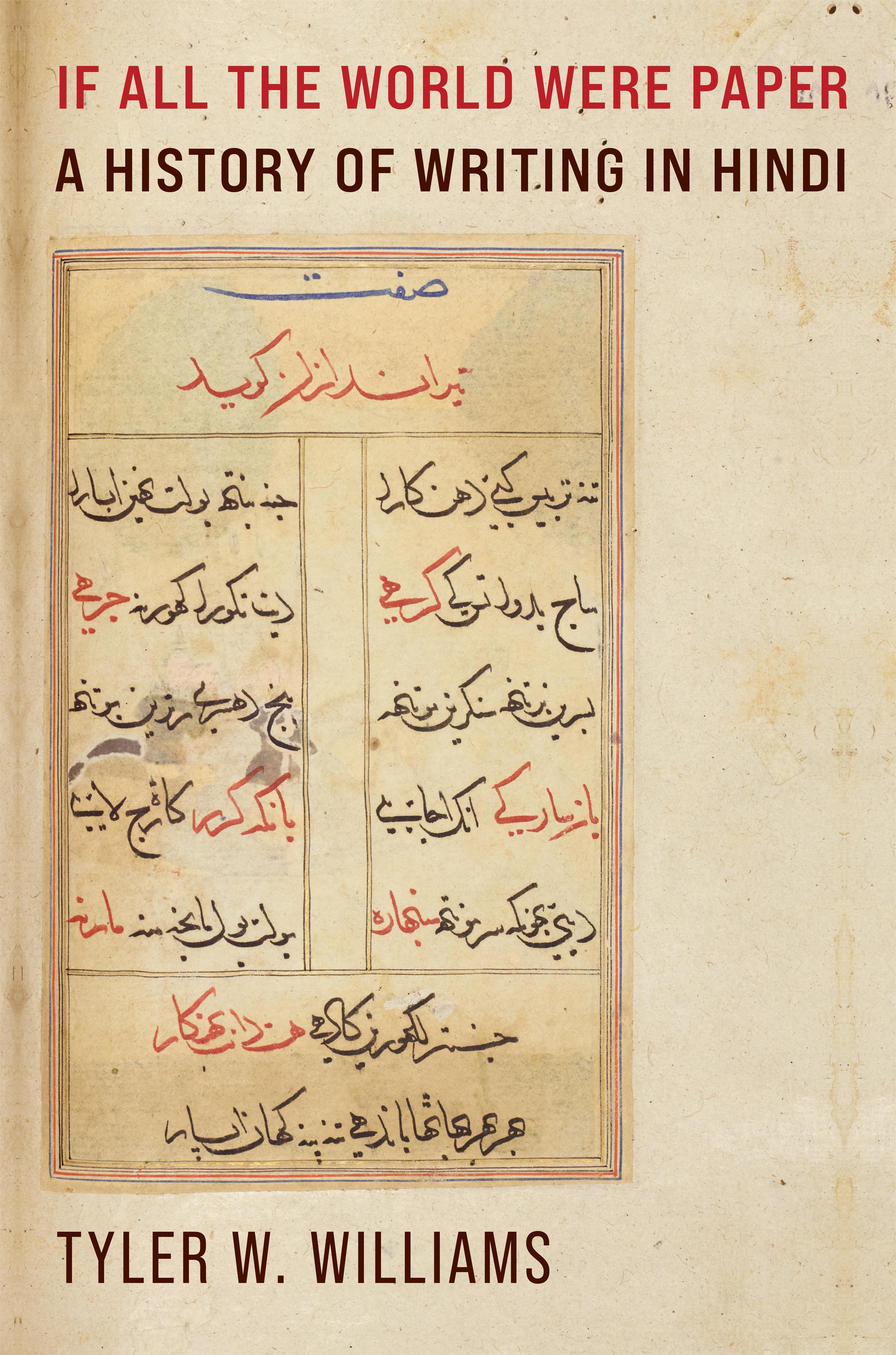
How do writing and literacy reshape the ways a language and its literature are imagined? If All the World Were Paper explores this question in the context of Hindi, the most widely spoken language in Southern Asia and the fourth most widely spoken language in the world today. Emerging onto the literary scene of India in the mid-fourteenth century, the vernacular of Hindi quickly acquired a place alongside “classical” languages like Sanskrit and Persian as a medium of literature and scholarship. The material and social processes through which it came to be written down and the particular form that it took—as illustrated storybooks, loose-leaf textbooks, personal notebooks, and holy scriptures—played a critical role in establishing Hindi as a language capable of transmitting poetry, erudition, and even revelation.
If All the World Were Paper combines close readings of literary and scholastic works with an examination of hundreds of handwritten books from precolonial India to tell the story of Hindi literature’s development and reveal the relationships among ideologies of writing, material practices, and literary genres. Tyler W. Williams forcefully argues for a new approach to the literary archive, demonstrating how the ways books were inscribed, organized, and used can tell us as much about their meaning and significance as the texts within them. This book sets out a novel program for engaging with the archive of Hindi and of South Asian languages more broadly at a moment when much of that archive faces existential threats.
Before Memmo my notes were scattered across PDFs. Now a workspace pulls everything into one place — I see exactly what's still left to study.
Memmo's summaries are gold before exams. I don't have to re-read 800 pages two weeks before — just the important parts.
The AI chat has saved me the night before an exam more than once. I just keep asking until I get it — no waiting on a study group to reply.
The quizzes hit exactly what I need to know. Memmo tracks what I get stuck on — so I only practice what's worth it.
Flashcards with spaced repetition are magic. Memmo knows when I'm about to forget something and brings it back.
The AI podcasts are my favorite. I listen on my way to school and get a recap without sitting at a computer.

Handbok i kvalitativa metoder
281 kr

Hållbar utveckling: en introduktion för ingenjörer och andra problemlösare
334 kr

Brymans Samhällsvetenskapliga metoder
390 kr

Projektledning
491 kr

Den orättvisa hälsan: om socioekonomiska skillnader i hälsa och livslängd
326 kr

Organizational Leadership
429 kr

Vetenskapsteori för nybörjare
196 kr

På väg mot läraryrket
172 kr

Det sociala livet i skolan: Socialpsykologiska perspektiv
253 kr

Betygsättningens didaktik
151 kr

Personality
402 kr

Studying Leadership
404 kr

Managing Innovation
477 kr

Introduktion till samhällsvetenskaplig metod
347 kr

The Psychology of Sex and Gender
698 kr

Evidens och kunskap för socialt arbete
207 kr

Introduction to Leadership
605 kr