
Before Memmo my notes were scattered across PDFs. Now a workspace pulls everything into one place — I see exactly what's still left to study.
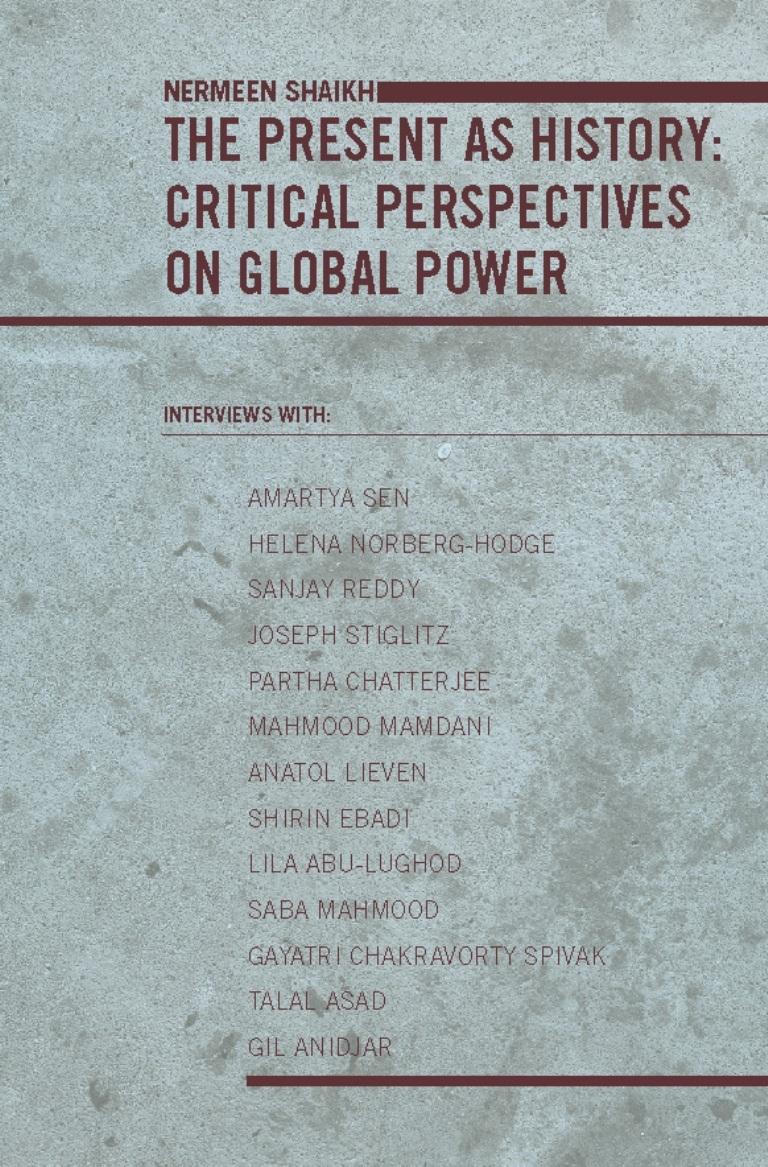
The Present as History is a rare opportunity to hear world-renowned scholars speak on the new imperialism, feminism and human rights, secularism and Islam, post-colonialism, and the global economy. They treat the United States as an object to be historically and politically interrogated rather than as the norm from which all else is to be evaluated and assess the Third World through its history of colonialism and neocolonialism rather than focusing on issues of culture and morality.
Amartya Sen discusses the shortcomings of the development agenda as it was conceived at the close of the Second World War, while Joseph Stiglitz explains economic globalization and the power of the International Monetary Fund in guiding its trajectory. Sanjay Reddy argues that global poverty estimates are flawed, and Helena Norberg-Hodge uses her experience in Tibet to lay bare the problems with development practice.
Political scientists Partha Chatterjee, Mahmood Mamdani, and Anatol Lieven chart the growth of hegemonic power from the colonial to the postcolonial period. Chatterjee examines the enduring effects of colonial administrative and governing practices, while Mamdani, focusing on the present global dispensation, explains the growth of terrorist movements around the world in the context of the Cold War. Lieven looks at the different strains of American nationalism and the continuities and ruptures between nineteenth-century empires and the present one. Iranian human rights lawyer Shirin Ebadi elaborates the relationship between Islam, democracy, and human rights while anthropologists Lila Abu-Lughod and Saba Mahmood respectively trace the historical use of women as an excuse for imperial intervention and discuss the relationship between liberalism, Islam, and secularism. Literary theorist and cultural critic Gayatri Chakravorty Spivak looks at the legacy of colonialism in the domain of language and education, and isolates the problems associated with human rights discourse and practice.
In conclusion, Talal Asad traces the genealogy of the term secularism, the special place of Islam within it, and its relationship to modernity. Gil Anidjar considers the distinction between religion and politics and elaborates the historical links between secularism and Christianity. Taken together, these interviews offer a valuable understanding of world history and a corrective to predominant conventional discourses on global power and justice.
Before Memmo my notes were scattered across PDFs. Now a workspace pulls everything into one place — I see exactly what's still left to study.
Memmo's summaries are gold before exams. I don't have to re-read 800 pages two weeks before — just the important parts.
The AI chat has saved me the night before an exam more than once. I just keep asking until I get it — no waiting on a study group to reply.
The quizzes hit exactly what I need to know. Memmo tracks what I get stuck on — so I only practice what's worth it.
Flashcards with spaced repetition are magic. Memmo knows when I'm about to forget something and brings it back.
The AI podcasts are my favorite. I listen on my way to school and get a recap without sitting at a computer.

Handbok i kvalitativa metoder
281 kr

Hållbar utveckling: en introduktion för ingenjörer och andra problemlösare
334 kr

Brymans Samhällsvetenskapliga metoder
390 kr

Projektledning
491 kr

Den orättvisa hälsan: om socioekonomiska skillnader i hälsa och livslängd
326 kr

Vetenskapsteori för nybörjare
196 kr

Organizational Leadership
429 kr

På väg mot läraryrket
172 kr

Det sociala livet i skolan: Socialpsykologiska perspektiv
253 kr

Betygsättningens didaktik
151 kr

Personality
402 kr

Studying Leadership
404 kr

Managing Innovation
477 kr

Introduktion till samhällsvetenskaplig metod
347 kr

The Psychology of Sex and Gender
698 kr

Evidens och kunskap för socialt arbete
207 kr

Introduction to Leadership
605 kr