
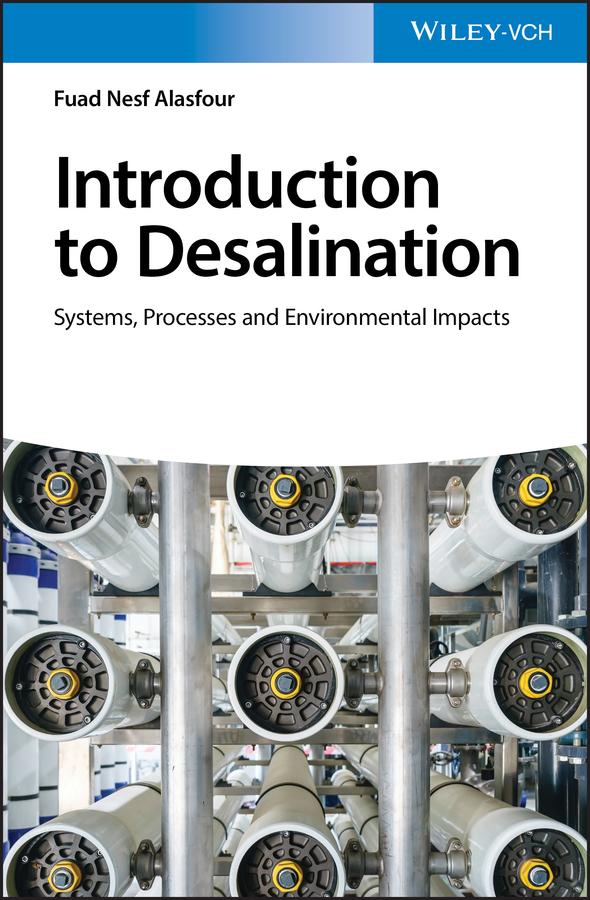
One book dealing with the fundamentals of thermal and membrane desalination systems and discussing their economical as well as environmental aspects.
With a growing population, climate change and greater water demand, desalination has increasingly become a part of the solution to regional water scarcity - seawater desalination capacity has roughly doubled in the past ten years. Desalination has also begun to receive more attention in academia, with research focusing on improving energy efficiency and system robustness and lowering capital costs.
With this book, an introduction is given to the basics and fundamentals of desalination systems. Both, thermal and membrane desalination systems, are covered and discussed in view of energy, exergy, economic and environmental aspects. In the beginning, Introduction to Desalination: Systems, Processes and Environmental Impacts describes multi effect evaporation, vapor compression and multi-stage flashing. Further chapters deal with common membrane-based separations like reverse osmosis and membrane filtration, forward osmosis, diffusion dialysis and pervaporation as well as thermo-osmosis, electrodialysis and electrodeionization. Subsequently, hybrid systems are discussed, and the economic analysis of such systems and their environmental impact are highlighted. Each chapter contains theoretical and practical examples and concludes with questions and problems for self-study.
* Needed: Desalination has become a part of the solution to regional water scarcity and an introductory book in this field is urgently needed.
* Balanced Approach: Presents the fundamentals of thermal and membrane desalination systems.
* Learning Material: Each chapter includes exercises for self-study and Instructors can find teaching material online.
Introduction to Desalination: Systems, Processes and Environmental Impacts is an important resource for master's students in engineering sciences, lecturers in chemical and mechanical engineering, engineers, environmental chemists, as well as process engineers, engineering scientists in industry, and environmental consultants.
With a growing population, climate change and greater water demand, desalination has increasingly become a part of the solution to regional water scarcity - seawater desalination capacity has roughly doubled in the past ten years. Desalination has also begun to receive more attention in academia, with research focusing on improving energy efficiency and system robustness and lowering capital costs.
With this book, an introduction is given to the basics and fundamentals of desalination systems. Both, thermal and membrane desalination systems, are covered and discussed in view of energy, exergy, economic and environmental aspects. In the beginning, Introduction to Desalination: Systems, Processes and Environmental Impacts describes multi effect evaporation, vapor compression and multi-stage flashing. Further chapters deal with common membrane-based separations like reverse osmosis and membrane filtration, forward osmosis, diffusion dialysis and pervaporation as well as thermo-osmosis, electrodialysis and electrodeionization. Subsequently, hybrid systems are discussed, and the economic analysis of such systems and their environmental impact are highlighted. Each chapter contains theoretical and practical examples and concludes with questions and problems for self-study.
* Needed: Desalination has become a part of the solution to regional water scarcity and an introductory book in this field is urgently needed.
* Balanced Approach: Presents the fundamentals of thermal and membrane desalination systems.
* Learning Material: Each chapter includes exercises for self-study and Instructors can find teaching material online.
Introduction to Desalination: Systems, Processes and Environmental Impacts is an important resource for master's students in engineering sciences, lecturers in chemical and mechanical engineering, engineers, environmental chemists, as well as process engineers, engineering scientists in industry, and environmental consultants.
Seiten: 408
Kategorie: Ingenjörsvetenskap
e-ISBN: 9783527811632
Versandgewicht: 1.2 kg
Versand in: 1-2 Tage
Zahle einfach mit Karte, Klarna, Apple Pay oder Google Pay. Nicht zufrieden? Du hast immer ein 14-tägiges Widerrufsrecht. Lies mehr in unseren AGB. Hast du Fragen, schreib uns eine E-Mail an hello@memmo.org.
Memmo macht das Lernen einfacher – wo auch immer du bist. Bei uns findest du deine Kursbücher und smarte Lerntools an einem Ort: Zusammenfassungen, Quizzes, Podcasts und Lernkarten. Und Ted, dein Lernbuddy, beantwortet alles, was du wissen möchtest. Über 50.000 Studierende lernen bereits hier – gemacht, damit du schneller lernst und weniger Stress hast.