
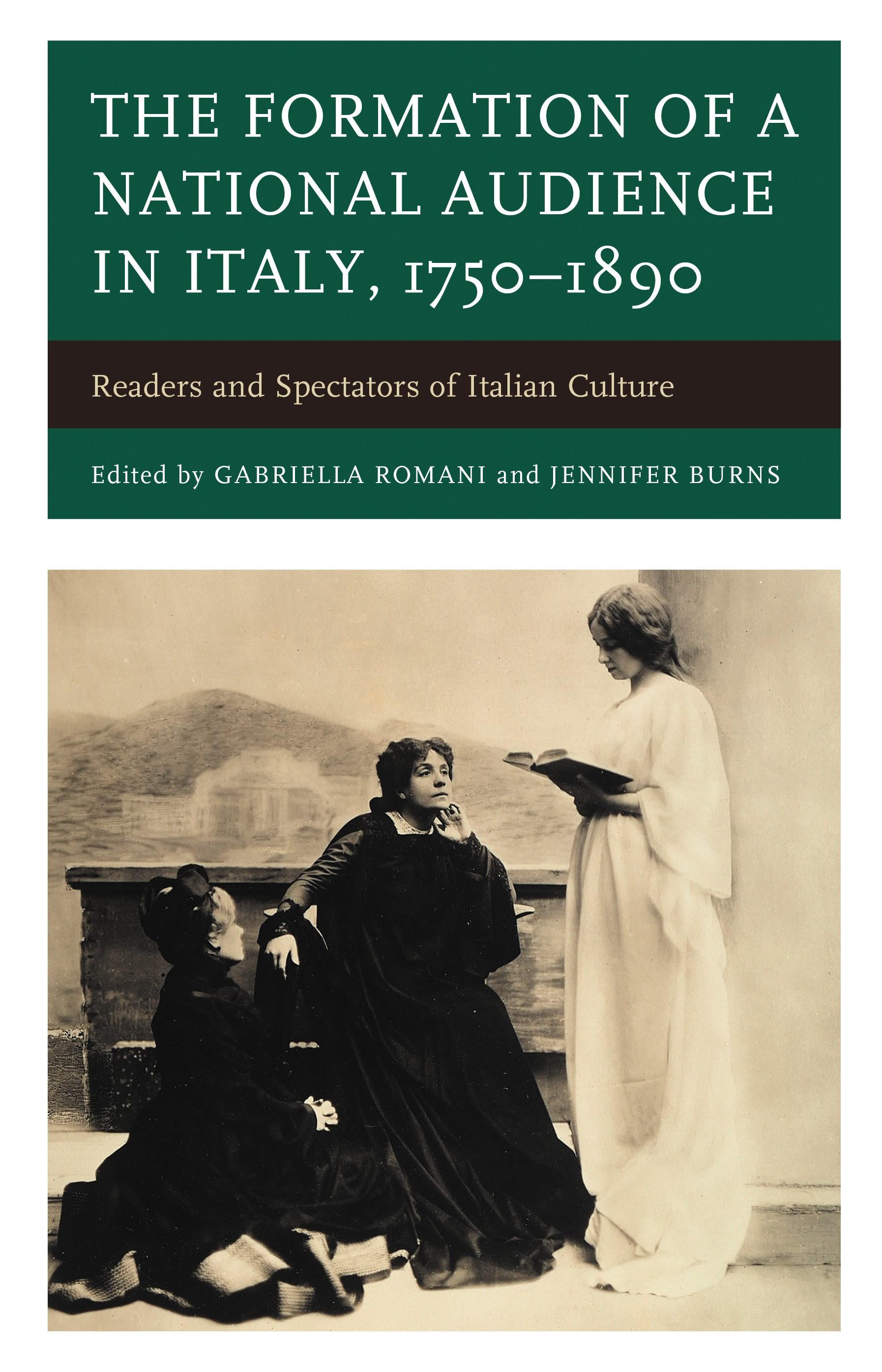
The late eighteenth and the nineteenth centuries witness significant advancement in the production and, crucially, the consumption of culture in Italy. During the long process towards and beyond Italy becoming a nation-state in 1861, new modes of writing and performing – the novel, the self-help manual, theatrical improvisation – develop in response to new practices and technologies of production and distribution. Key to the emergence of an inclusive national audience in Italy is, however, the audience itself. A wide and varied body of consumers of culture, animated by the notion of an Italian national cultural identity, create in this period an increasingly complex demand for different cultural products. This body is energized by the wider access to education and to the Italian language brought about by educational reforms, by growing urbanization, by enhanced social mobility, and by transcultural connections across European borders.
This book investigates this process, analyzing the ways in which authors, composers, publishers, performers, journalists, and editors engage with the anxieties and aspirations of their diverse audiences. Fourteen essays by specialists in the field, exploring individual contexts and cases, demonstrate how interests related to gender, social class, cultural background and practices of reading and spectatorship, exert determining influence upon the production of culture in this period. They describe how women, men, and children from across the social and regional strata of the emerging nation contribute incrementally but actively to the idea and the growing reality of an Italian national cultural life. They show that from newspapers to salon performances, from letters to treatises in social science, from popular novels to literary criticism, from philosophical discussions to opera theaters, there is evidence in Italy in this period of unprecedented participation, crossing academic and popular cultures, in the formation of a national audience in Italy. This cultural transformation later produces the mass culture in Italy which underpins the major movements of the twentieth century and which undergoes new challenges and reformulations in the Italy we know today.
This book investigates this process, analyzing the ways in which authors, composers, publishers, performers, journalists, and editors engage with the anxieties and aspirations of their diverse audiences. Fourteen essays by specialists in the field, exploring individual contexts and cases, demonstrate how interests related to gender, social class, cultural background and practices of reading and spectatorship, exert determining influence upon the production of culture in this period. They describe how women, men, and children from across the social and regional strata of the emerging nation contribute incrementally but actively to the idea and the growing reality of an Italian national cultural life. They show that from newspapers to salon performances, from letters to treatises in social science, from popular novels to literary criticism, from philosophical discussions to opera theaters, there is evidence in Italy in this period of unprecedented participation, crossing academic and popular cultures, in the formation of a national audience in Italy. This cultural transformation later produces the mass culture in Italy which underpins the major movements of the twentieth century and which undergoes new challenges and reformulations in the Italy we know today.
Zahle einfach mit Karte, Klarna, Apple Pay oder Google Pay. Nicht zufrieden? Du hast immer ein 14-tägiges Widerrufsrecht. Lies mehr in unseren AGB. Hast du Fragen, schreib uns eine E-Mail an hello@memmo.org.
Memmo macht das Lernen einfacher – wo auch immer du bist. Bei uns findest du deine Kursbücher und smarte Lerntools an einem Ort: Zusammenfassungen, Quizzes, Podcasts und Lernkarten. Und Ted, dein Lernbuddy, beantwortet alles, was du wissen möchtest. Über 50.000 Studierende lernen bereits hier – gemacht, damit du schneller lernst und weniger Stress hast.