
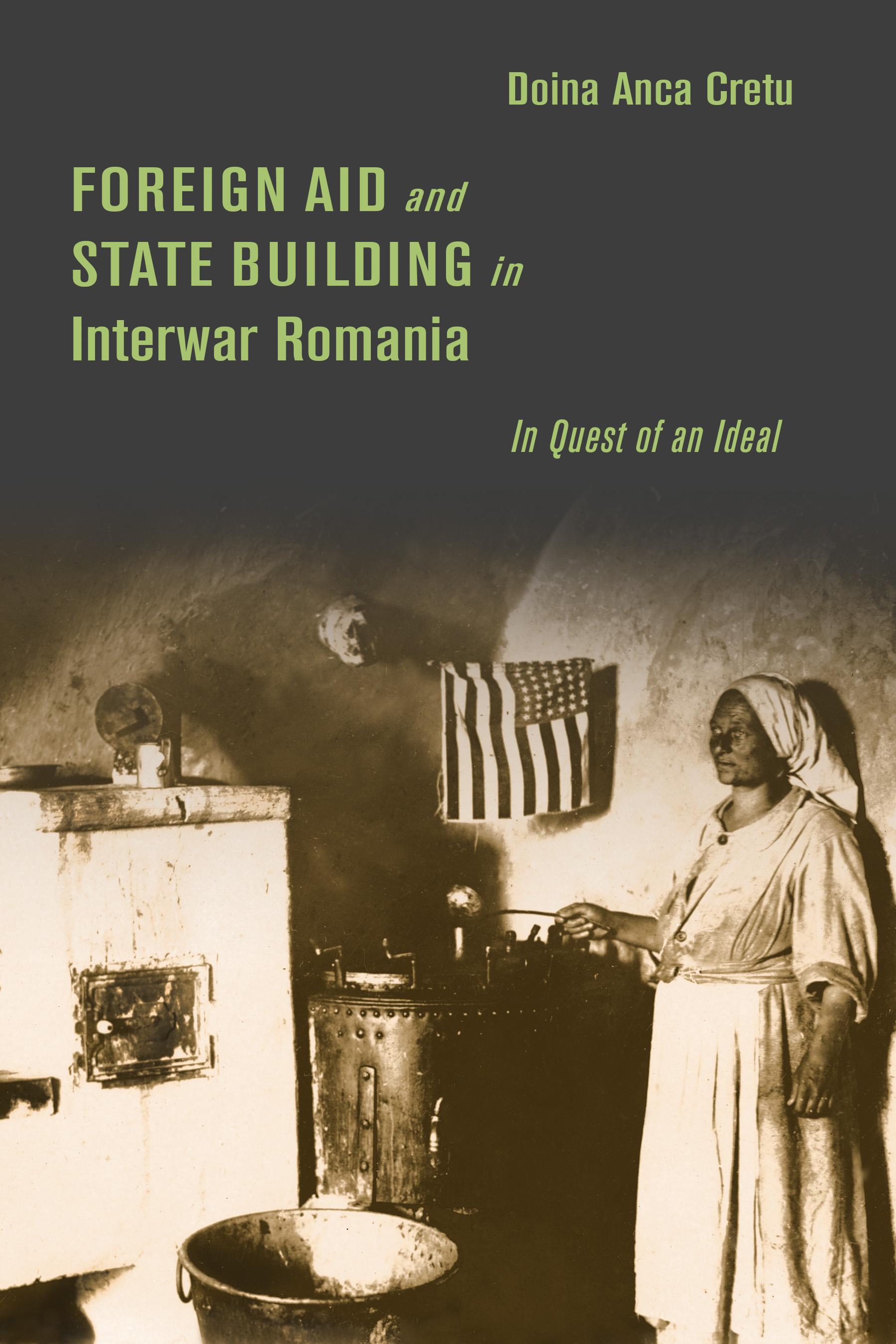
The decades following World War I were a period of political, social, and economic transformation for Central and Eastern Europe. This book considers the role of foreign aid in Romania between 1918 and 1940, offering a new history of the interrelation between state building and nongovernmental humanitarianism and philanthropy in the interwar period. Doina Anca Cretu argues that Romania was a laboratory for transnational intervention, as various state builders actively pursued, accessed, and often instrumentalized American assistance in order to accelerate reconstructive and modernizing projects after World War I.
At its core, this is a study of how local views, ambitions, and practical agendas framed trajectories of humanitarian and philanthropic endeavors in postimperial Central and Eastern Europe. Conversely, it is a reflection on the ways that architects and practitioners of foreign aid sought to transfer notions of democracy, civilization, and modernity within shifting local and national contexts in the aftermath of the war and after the collapse of European empires. At the intersection of the history of interwar Europe and international philanthropy and humanitarianism, this book's innovative and explicitly transnational approach provides a new framework for understanding the contours of European nationalism in the twentieth century.
Zahle einfach mit Karte, Klarna, Apple Pay oder Google Pay. Nicht zufrieden? Du hast immer ein 14-tägiges Widerrufsrecht. Lies mehr in unseren AGB. Hast du Fragen, schreib uns eine E-Mail an hello@memmo.org.
Memmo macht das Lernen einfacher – wo auch immer du bist. Bei uns findest du deine Kursbücher und smarte Lerntools an einem Ort: Zusammenfassungen, Quizzes, Podcasts und Lernkarten. Und Ted, dein Lernbuddy, beantwortet alles, was du wissen möchtest. Über 50.000 Studierende lernen bereits hier – gemacht, damit du schneller lernst und weniger Stress hast.