
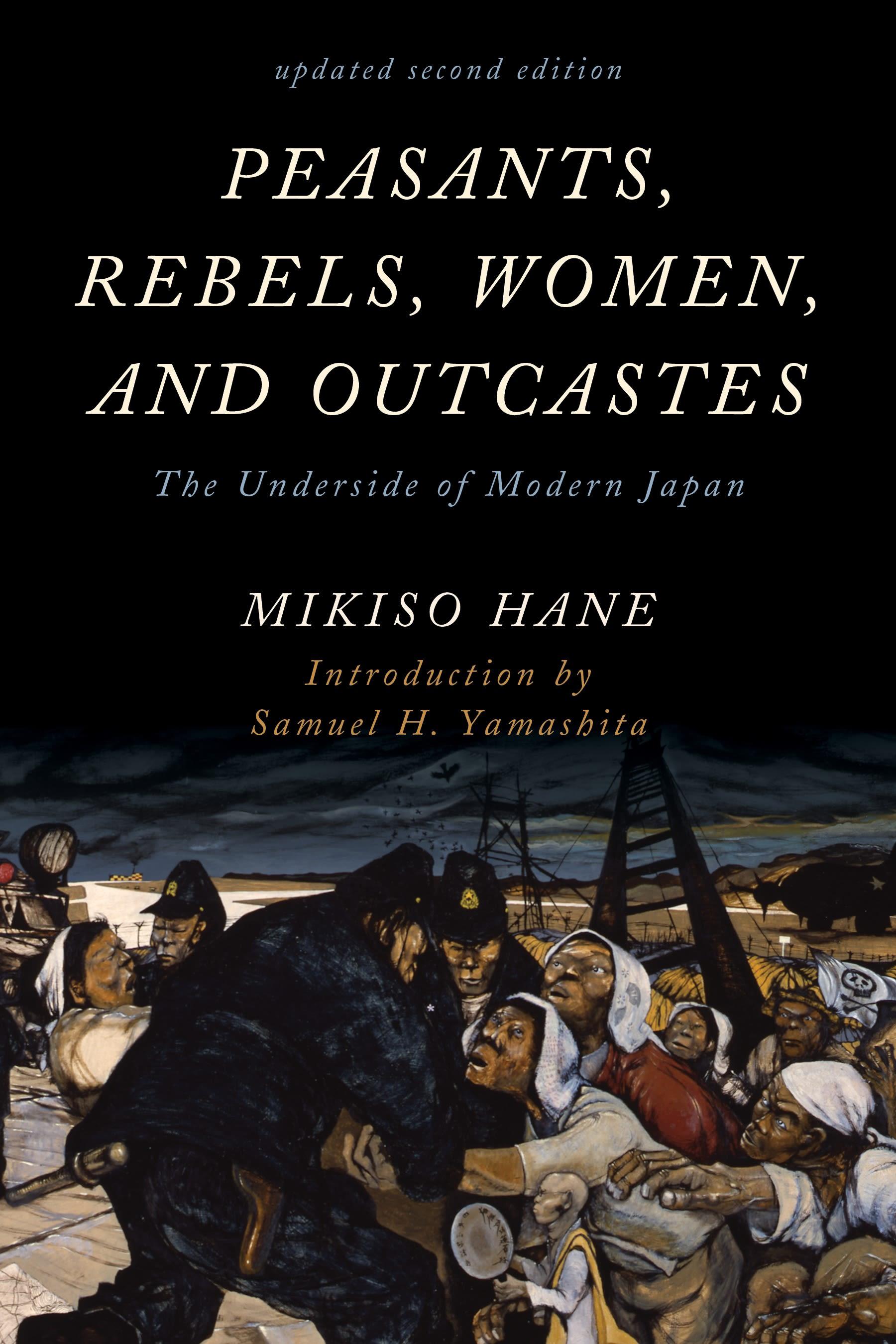
This compelling social history uses diaries, memoirs, fiction, trial testimony, personal recollections, and eyewitness accounts to weave a fascinating tale of what ordinary Japanese endured throughout their country’s era of economic growth. Through vivid, often wrenching accounts of peasants, miners, textile workers, rebels, and prostitutes, Mikiso Hane forces us to see Japan’s “modern century” (from the beginnings of contact with the West to World War II) through fresh eyes. In doing so, he mounts a formidable challenge to the success story of Japan’s “economic miracle.”
Starting with the Meiji restoration of 1868, Hane vividly illustrates how modernization actually widened the gulf, economically and socially, between rich and poor, between the mo-bo and mo-ga (“modern boy” and “modern girl”) of the cities and their rural counterparts. He interlaces his scholarly narrative with sharply etched individual stories that allow us see Japan from the bottom up. We feel the back-breaking labor of a typical farm family; the anguish of poverty-stricken parents forced to send their daughters to Japan’s new mills, factories, and brothels; the hopelessness in rural areas scourged by famine; the proud defiance of women battling against patriarchy; and the desperation of being on strike in a company town, in revolt in the countryside, or conscripted into the army.
This updated edition is enhanced by a substantive new introduction by Samuel H. Yamashita. By allowing the underprivileged to speak for themselves, Hane and Yamashita present us with a unique people’s history of an often-hidden world.
Starting with the Meiji restoration of 1868, Hane vividly illustrates how modernization actually widened the gulf, economically and socially, between rich and poor, between the mo-bo and mo-ga (“modern boy” and “modern girl”) of the cities and their rural counterparts. He interlaces his scholarly narrative with sharply etched individual stories that allow us see Japan from the bottom up. We feel the back-breaking labor of a typical farm family; the anguish of poverty-stricken parents forced to send their daughters to Japan’s new mills, factories, and brothels; the hopelessness in rural areas scourged by famine; the proud defiance of women battling against patriarchy; and the desperation of being on strike in a company town, in revolt in the countryside, or conscripted into the army.
This updated edition is enhanced by a substantive new introduction by Samuel H. Yamashita. By allowing the underprivileged to speak for themselves, Hane and Yamashita present us with a unique people’s history of an often-hidden world.
Zahle einfach mit Karte, Klarna, Apple Pay oder Google Pay. Nicht zufrieden? Du hast immer ein 14-tägiges Widerrufsrecht. Lies mehr in unseren AGB. Hast du Fragen, schreib uns eine E-Mail an hello@memmo.org.
Memmo macht das Lernen einfacher – wo auch immer du bist. Bei uns findest du deine Kursbücher und smarte Lerntools an einem Ort: Zusammenfassungen, Quizzes, Podcasts und Lernkarten. Und Ted, dein Lernbuddy, beantwortet alles, was du wissen möchtest. Über 50.000 Studierende lernen bereits hier – gemacht, damit du schneller lernst und weniger Stress hast.