
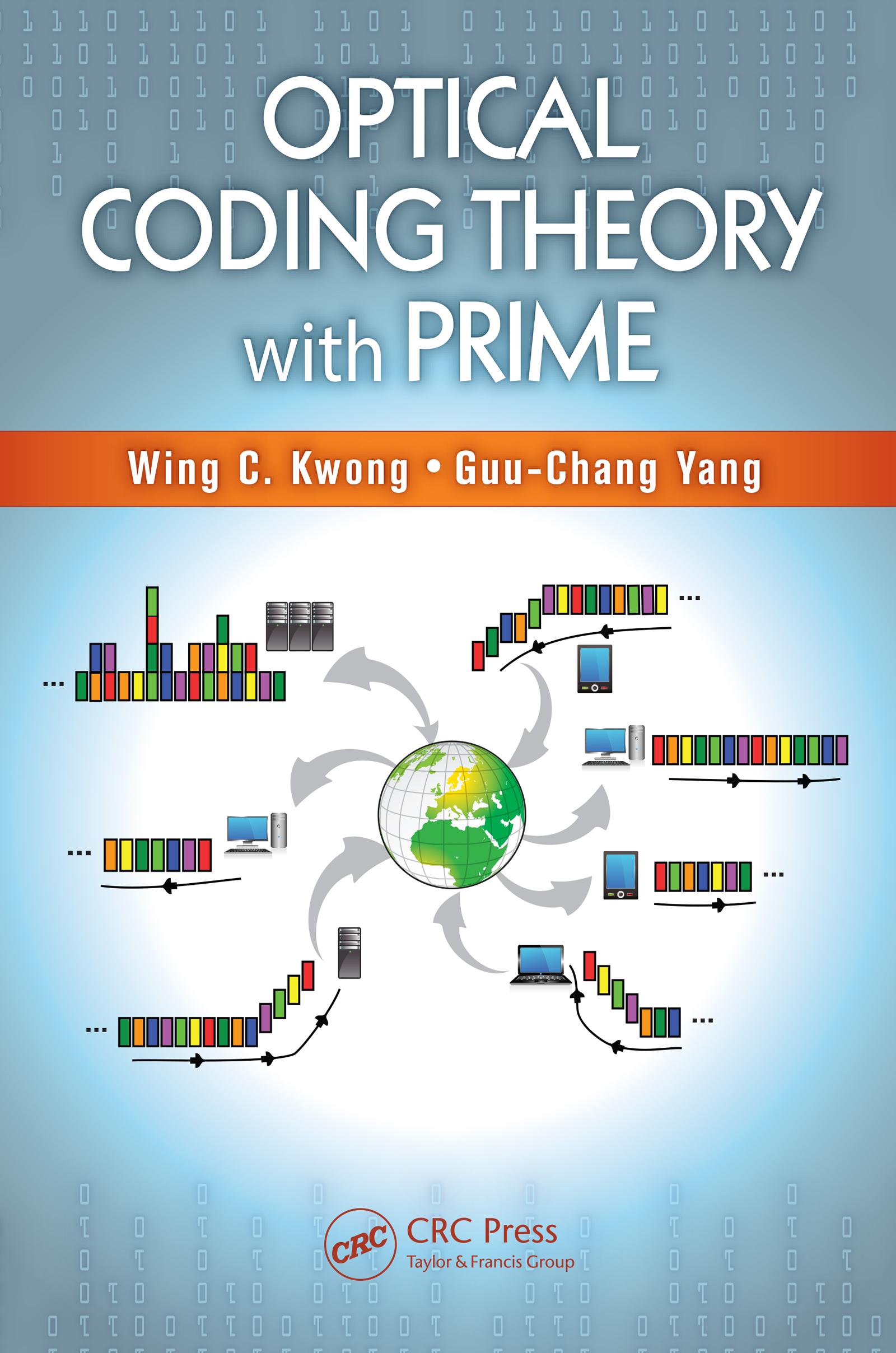
Although several books cover the coding theory of wireless communications and the hardware technologies and coding techniques of optical CDMA, no book has been specifically dedicated to optical coding theory—until now. Written by renowned authorities in the field, Optical Coding Theory with Prime gathers together in one volume the fundamentals and developments of optical coding theory, with a focus on families of prime codes, supplemented with several families of non-prime codes. The book also explores potential applications to coding-based optical systems and networks.
Learn How to Construct and Analyze Optical Codes
The authors use a theorem-proof approach, breaking down theories into digestible form so that readers can understand the main message without searching through tedious proofs. The book begins with the mathematical tools needed to understand and apply optical coding theory, from Galois fields and matrices to Gaussian and combinatorial analytical tools. Using a wealth of examples, the authors show how optical codes are constructed and analyzed, and detail their performance in a variety of applications. The book examines families of 1-D and 2-D asynchronous and synchronous, multilength, and 3-D prime codes, and some non-prime codes.
Get a Working Knowledge of Optical Coding Theory to Help You Design Optical Systems and Networks
Prerequisites include a basic knowledge of linear algebra and coding theory, as well as a foundation in probability and communications theory. This book draws on the authors’ extensive research to offer an authoritative reference on the emerging field of optical coding theory. In addition, it supplies a working knowledge of the theory and optical codes to help readers in the design of coding-based optical systems and networks.
For more on the technological aspects of optical CDMA, see Optical Code Division Multiple Access: Fundamentals and Applications (CRC Press 2005).
Zahle einfach mit Karte, Klarna, Apple Pay oder Google Pay. Nicht zufrieden? Du hast immer ein 14-tägiges Widerrufsrecht. Lies mehr in unseren AGB. Hast du Fragen, schreib uns eine E-Mail an hello@memmo.org.
Memmo macht das Lernen einfacher – wo auch immer du bist. Bei uns findest du deine Kursbücher und smarte Lerntools an einem Ort: Zusammenfassungen, Quizzes, Podcasts und Lernkarten. Und Ted, dein Lernbuddy, beantwortet alles, was du wissen möchtest. Über 50.000 Studierende lernen bereits hier – gemacht, damit du schneller lernst und weniger Stress hast.