
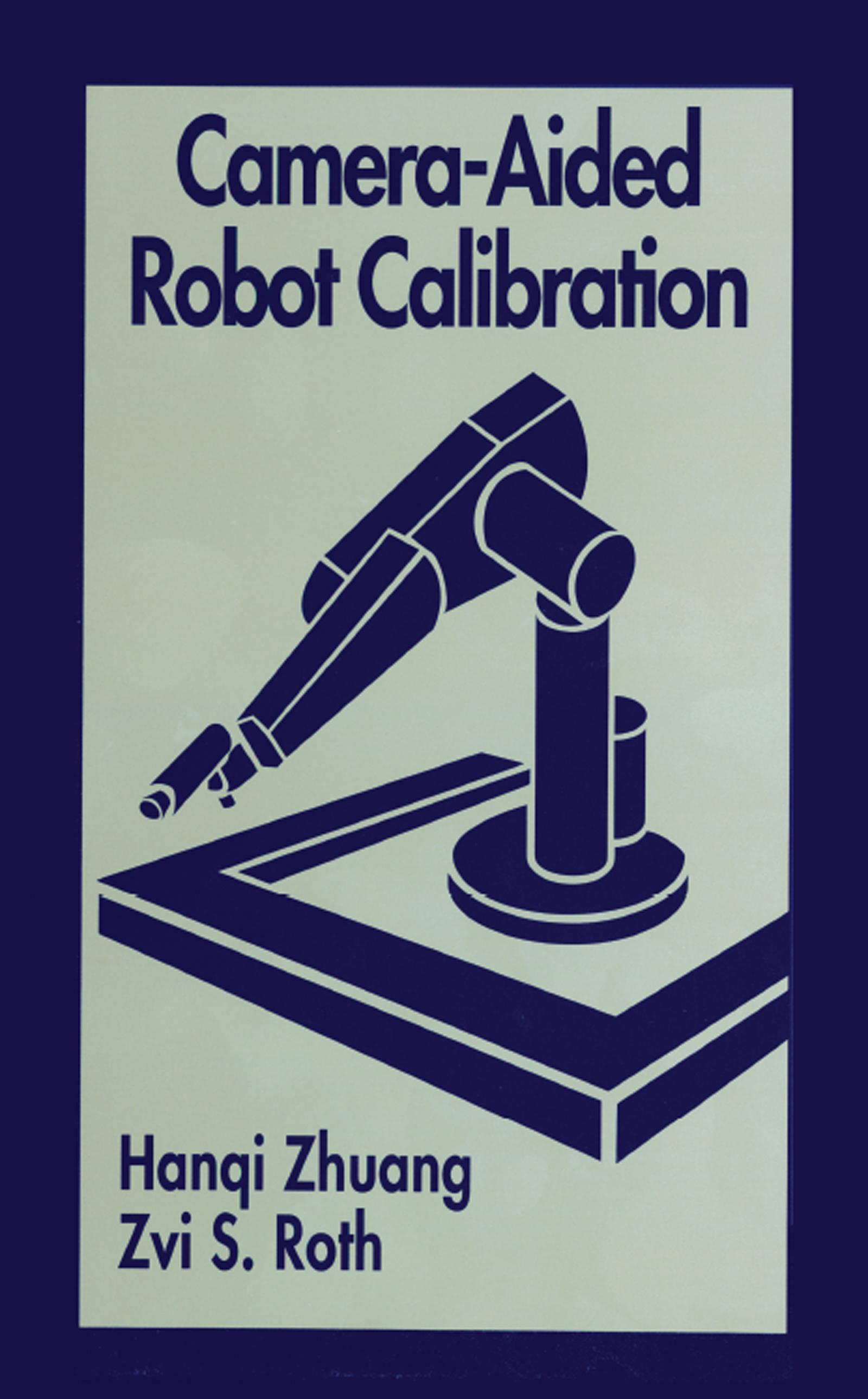
Robot calibration is the process of enhancing the accuracy of a robot by modifying its control software. This book provides a comprehensive treatment of the theory and implementation of robot calibration using computer vision technology. It is the only book to cover the entire process of vision-based robot calibration, including kinematic modeling, camera calibration, pose measurement, error parameter identification, and compensation.
The book starts with an overview of available techniques for robot calibration, with an emphasis on vision-based techniques. It then describes various robot-camera systems. Since cameras are used as major measuring devices, camera calibration techniques are reviewed.
Camera-Aided Robot Calibration studies the properties of kinematic modeling techniques that are suitable for robot calibration. It summarizes the well-known Denavit-Hartenberg (D-H) modeling convention and indicates the drawbacks of the D-H model for robot calibration. The book develops the Complete and Parametrically Continuous (CPC) model and the modified CPC model, that overcome the D-H model singularities. The error models based on these robot kinematic modeling conventions are presented.
No other book available addresses the important, practical issue of hand/eye calibration. This book summarizes current research developments and demonstrates the pros and cons of various approaches in this area. The book discusses in detail the final stage of robot calibration - accuracy compensation - using the identified kinematic error parameters. It offers accuracy compensation algorithms, including the intuitive task-point redefinition and inverse-Jacobian algorithms and more advanced algorithms based on optimal control theory, which are particularly attractive for highly redundant manipulators.
Camera-Aided Robot Calibration defines performance indices that are designed for off-line, optimal selection of measurement configurations. It then describes three approaches: closed-form, gradient-based, and statistical optimization. The included case study presents experimental results that were obtained by calibrating common industrial robots. Different stages of operation are detailed, illustrating the applicability of the suggested techniques for robot calibration. Appendices provide readers with preliminary materials for easier comprehension of the subject matter. Camera-Aided Robot Calibration is a must-have reference for researchers and practicing engineers-the only one with all the information!
Zahle einfach mit Karte, Klarna, Apple Pay oder Google Pay. Nicht zufrieden? Du hast immer ein 14-tägiges Widerrufsrecht. Lies mehr in unseren AGB. Hast du Fragen, schreib uns eine E-Mail an hello@memmo.org.
Memmo macht das Lernen einfacher – wo auch immer du bist. Bei uns findest du deine Kursbücher und smarte Lerntools an einem Ort: Zusammenfassungen, Quizzes, Podcasts und Lernkarten. Und Ted, dein Lernbuddy, beantwortet alles, was du wissen möchtest. Über 50.000 Studierende lernen bereits hier – gemacht, damit du schneller lernst und weniger Stress hast.
Das könnte dir auch gefallen
Buch kaufen0