
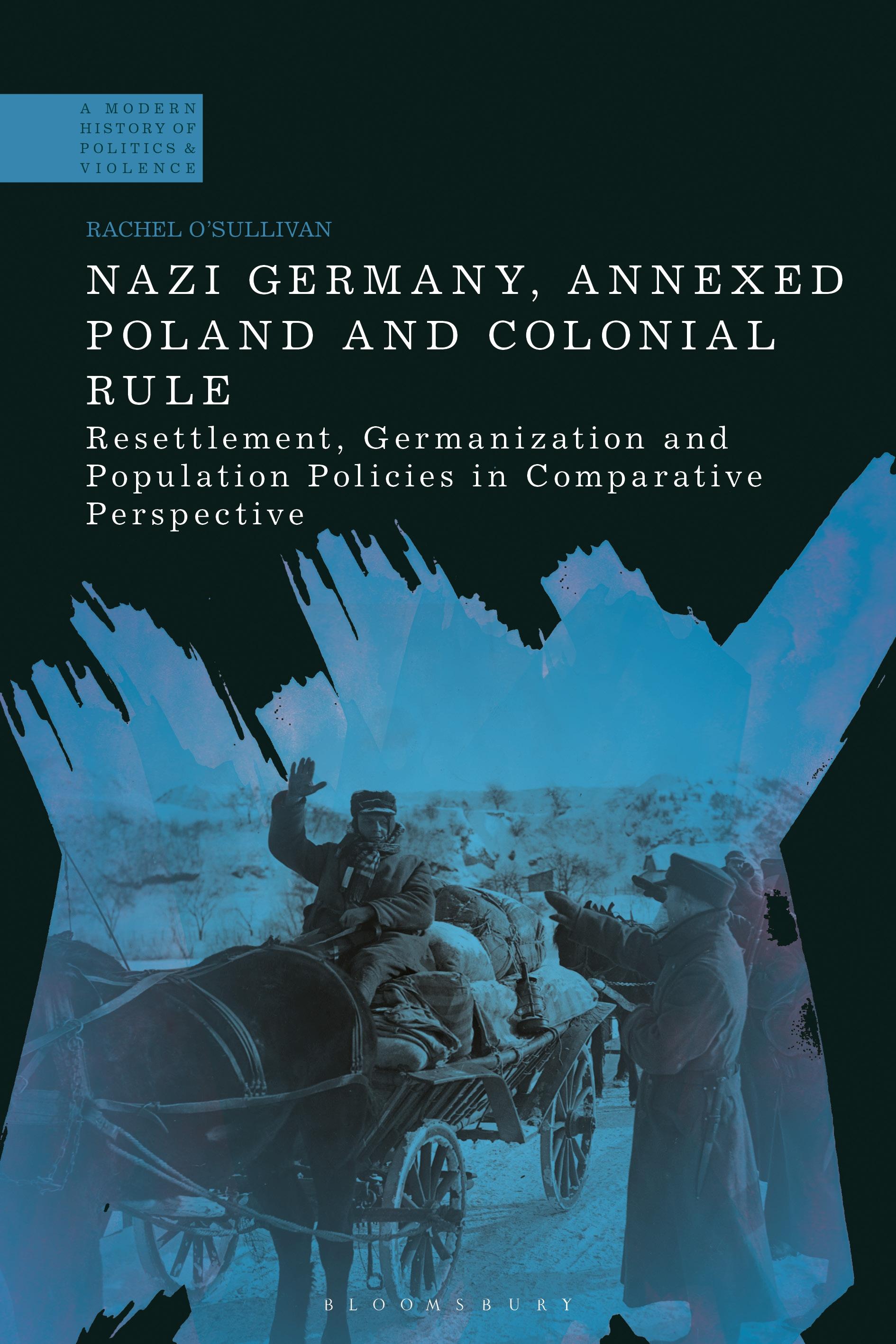
This book examines Nazi Germany's expansion, population management and establishment of a racially stratified society within the Reichsgaue (Reich Districts) of Wartheland and Danzig-West Prussia in annexed Poland (1939-1945) through a colonial lens. The topic of the Holocaust has thus far dominated the scholarly debate on the relevance of colonialism for our understanding of the Nazi regime. However, as opposed to solely concentrating on violence to investigate whether the Holocaust can be located within wider colonial frameworks, Rachel O'Sullivan utilizes a broader approach by investigating other aspects, such as discourses and fantasies related to expansion, settlement, 'civilising missions' and Germanisation, which were also intrinsic to Nazi Germany's rule in Poland.
The resettlement of the ethnic Germans-individuals of German descent who lived in Eastern Europe until the outbreak of the Second World War-forms a main focal point for this study's analysis and investigation of colonial comparisons. The ethnic German resettlement in the Reichsgaue laid the foundations for the establishment and enforcement of German society and culture, while simultaneously intensifying the efforts to control Poles and remove Jews. Through this case study, O'Sullivan explores Nazi Germany's dual usage of inclusionary policies, which attempted to culturally and linguistically integrate ethnic Germans and certain Poles into German society, and the contrasting exclusionary policies, which sought to rid annexed Poland of 'undesirable' population groups through segregation, deportation and murder. The book compares these policies - and the tactics used to implement them - to colonial and settler colonial methods of assimilation, subjugation and violence.
The resettlement of the ethnic Germans-individuals of German descent who lived in Eastern Europe until the outbreak of the Second World War-forms a main focal point for this study's analysis and investigation of colonial comparisons. The ethnic German resettlement in the Reichsgaue laid the foundations for the establishment and enforcement of German society and culture, while simultaneously intensifying the efforts to control Poles and remove Jews. Through this case study, O'Sullivan explores Nazi Germany's dual usage of inclusionary policies, which attempted to culturally and linguistically integrate ethnic Germans and certain Poles into German society, and the contrasting exclusionary policies, which sought to rid annexed Poland of 'undesirable' population groups through segregation, deportation and murder. The book compares these policies - and the tactics used to implement them - to colonial and settler colonial methods of assimilation, subjugation and violence.
Zahle einfach mit Karte, Klarna, Apple Pay oder Google Pay. Nicht zufrieden? Du hast immer ein 14-tägiges Widerrufsrecht. Lies mehr in unseren AGB. Hast du Fragen, schreib uns eine E-Mail an hello@memmo.org.
Memmo macht das Lernen einfacher – wo auch immer du bist. Bei uns findest du deine Kursbücher und smarte Lerntools an einem Ort: Zusammenfassungen, Quizzes, Podcasts und Lernkarten. Und Ted, dein Lernbuddy, beantwortet alles, was du wissen möchtest. Über 50.000 Studierende lernen bereits hier – gemacht, damit du schneller lernst und weniger Stress hast.