
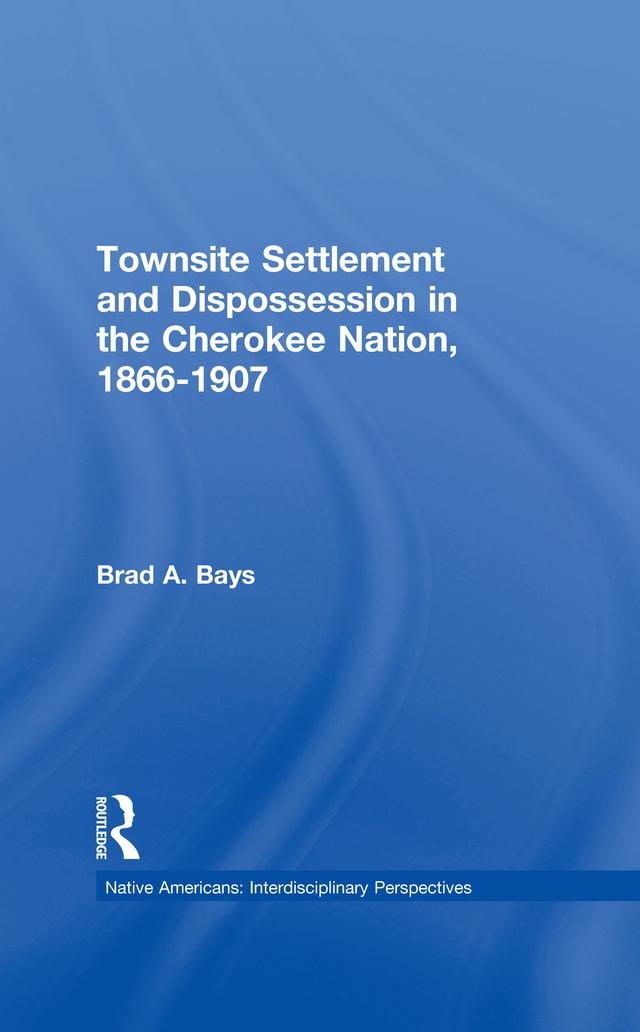
In response to the influx of white settlement after the Civil War, the Cherokee nation devised a regional development plan which allowed whites to establish farms and build towns while reinforcing Cherokee tribal sovereignty over the territory. The presence of sizeable towns and numerous villages presented a legal conundrum for Congress when it legislated away Cherokee sovereignty at the turn of the century. By 1898, tens of thousands of whites owned residential and commercial properties worth millions of dollars in Cherokee Nation towns, but every lot was owned by the Cherokee people. The federal government created a program to transfer legal ownership of town lots to white occupants, but poor implementation of the program allowed individuals to subvert the law for their own gain. The author explores the subject using primary documentation of such diverse sources as traveler's reports, land records, tribal and federal correspondence, and accounts of Cherokee and white settlers. Descriptive statistics and analytical mapping of historical data provide additional facets to the analysis. Also inlcludes 50 maps.
(Ph.D. dissertation, University of Nebraska-Lincoln, 1996; revised with new preface, introduction, afterword) Index. Bibliography.
Zahle einfach mit Karte, Klarna, Apple Pay oder Google Pay. Nicht zufrieden? Du hast immer ein 14-tägiges Widerrufsrecht. Lies mehr in unseren AGB. Hast du Fragen, schreib uns eine E-Mail an hello@memmo.org.
Memmo macht das Lernen einfacher – wo auch immer du bist. Bei uns findest du deine Kursbücher und smarte Lerntools an einem Ort: Zusammenfassungen, Quizzes, Podcasts und Lernkarten. Und Ted, dein Lernbuddy, beantwortet alles, was du wissen möchtest. Über 50.000 Studierende lernen bereits hier – gemacht, damit du schneller lernst und weniger Stress hast.
Das könnte dir auch gefallen
Buch kaufen0