
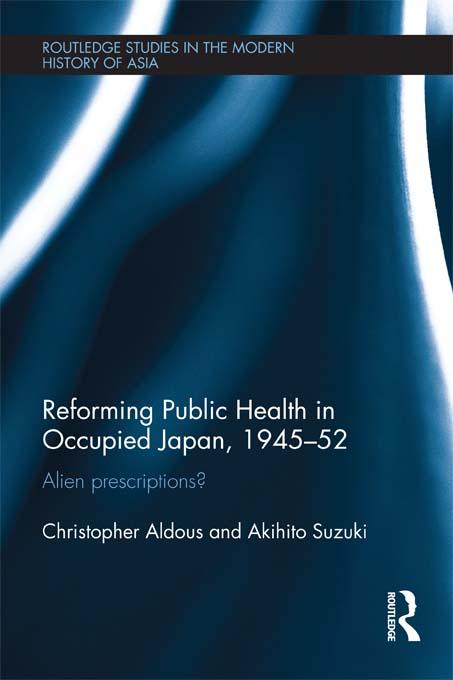
Whilst most facets of the Occupation of Japan have attracted much scholarly debate in recent decades, this is not the case with reforms relating to public health. The few studies of this subject largely follow the celebratory account of US-inspired advances, strongly associated with Crawford Sams, the key figure in the Occupation charged with carrying them out. This book tests the validity of this dominant narrative, interrogating its chief claims, exploring the influences acting on it, and critically examining the reform’s broader significance for the Occupation and its legacies for both Japan and the US. The book argues that rather than presiding over a revolution in public health, the Public Health and Welfare Section, headed by Sams, recommended methods of epidemic disease control and prevention that were already established in Japan and were not the innovations that they were often claimed to be. Where high incidence of such endemic diseases as dysentery and tuberculosis reflected serious socio-economic problems or deficiencies in sanitary infrastructure, little was done in practice to tackle the fundamental problems of poor water quality, the continued use of night soil as fertilizer and pervasive malnutrition. Improvements in these areas followed the trajectory of recovery, growth and rising prosperity in the 1950s and 1960s.
This book will be important reading for anyone studying Japanese History, the History of Medicine, Public Health in Asia and Asian Social Policy.
Zahle einfach mit Karte, Klarna, Apple Pay oder Google Pay. Nicht zufrieden? Du hast immer ein 14-tägiges Widerrufsrecht. Lies mehr in unseren AGB. Hast du Fragen, schreib uns eine E-Mail an hello@memmo.org.
Memmo macht das Lernen einfacher – wo auch immer du bist. Bei uns findest du deine Kursbücher und smarte Lerntools an einem Ort: Zusammenfassungen, Quizzes, Podcasts und Lernkarten. Und Ted, dein Lernbuddy, beantwortet alles, was du wissen möchtest. Über 50.000 Studierende lernen bereits hier – gemacht, damit du schneller lernst und weniger Stress hast.