
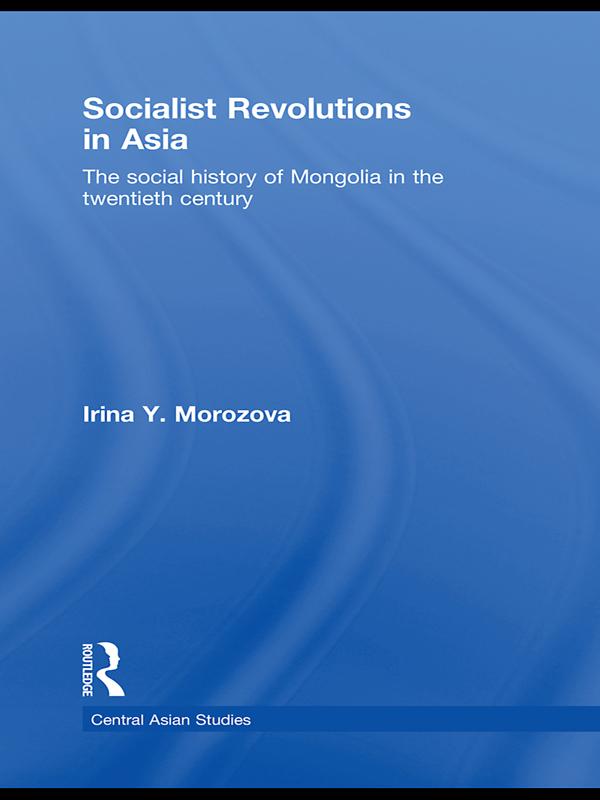
Contemporary Mongolia is often seen as one of the most open and democratic societies in Asia, undergoing remarkable post-socialist transformation. Although the former ruling party, the Mongolian People’s Revolutionary Party (the MPRP), has fundamentally changed its platform, it holds leadership and frames nation-building policy. This book re-conceptualises the socialist legacy of Mongolia and explains why in the 1920s a shift to socialism became possible. Furthermore, the role of Mongolian nationalism in the country's decision to ally with the USSR in the 1920-1930s and to choose a democratic path of development at the end of the 1980s is explored.
Focusing on social systems in crisis periods when the most radical differentiation in social relationships and loyalties occur, the book describes the transformation of the elite and social structures through the prism of the MPRP cadres’ policy and the party’s collaborations with the Third Communist International and other Soviet departments that operated in Mongolia. Based on original sources from former Soviet and Mongolian archives the author offers a critique of the post-modernist approaches to the study of identity and its impact on political change. This book will be of interest to academics working on the modern history of Central and Inner Asia, socialist societies and communist parties in Asia, as well as the USSR’s foreign policy.
Zahle einfach mit Karte, Klarna, Apple Pay oder Google Pay. Nicht zufrieden? Du hast immer ein 14-tägiges Widerrufsrecht. Lies mehr in unseren AGB. Hast du Fragen, schreib uns eine E-Mail an hello@memmo.org.
Memmo macht das Lernen einfacher – wo auch immer du bist. Bei uns findest du deine Kursbücher und smarte Lerntools an einem Ort: Zusammenfassungen, Quizzes, Podcasts und Lernkarten. Und Ted, dein Lernbuddy, beantwortet alles, was du wissen möchtest. Über 50.000 Studierende lernen bereits hier – gemacht, damit du schneller lernst und weniger Stress hast.
Das könnte dir auch gefallen
Buch kaufen0